
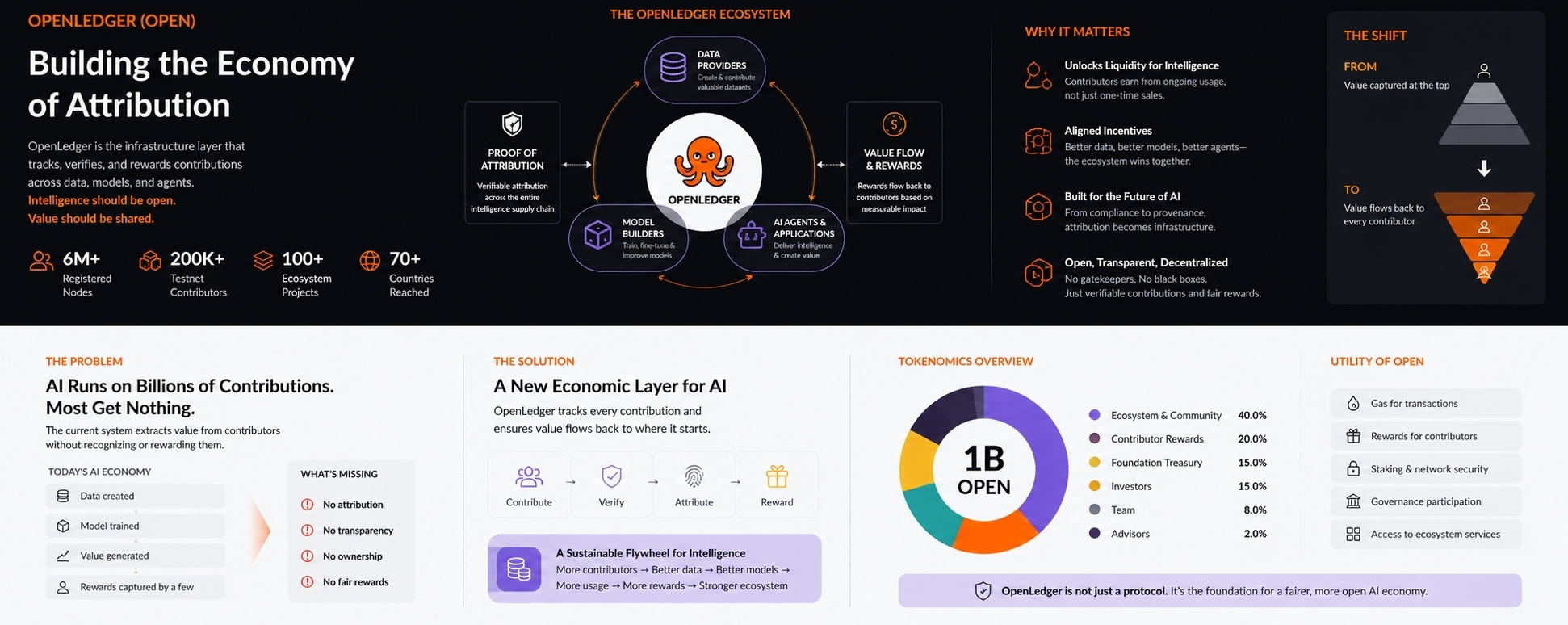
The more time I spend watching the AI industry evolve, the more I feel like everyone is staring at the same thing while missing the question sitting quietly underneath it.
We obsess over intelligence.
Who has the smartest model. Who can train faster. Who can build something more powerful than what came before.
But intelligence was never the entire story.
The real story is where that intelligence comes from.
Every AI model is built on millions of invisible contributions. Data created by strangers. Knowledge gathered over years. Insights produced by experts who may never receive recognition. Entire communities unknowingly shaping systems they will never own.
Yet when value is finally created, most of those contributors disappear from the picture.
The model gets the credit. The company gets the revenue. The people who helped make it possible fade into the background.
That imbalance has become so normal that many people no longer question it.
OpenLedger does.
What makes the project interesting is not that it combines AI and blockchain. That narrative exists everywhere now. What caught my attention is that it is trying to solve a problem most people treat as unavoidable.
It asks a simple question.
If intelligence is built from countless contributions, why does the economic value usually stop at the final layer?
That question sounds straightforward until you sit with it.
Because once you do, you start realizing how much of the current AI economy depends on people creating value without ever participating in the value they create.
OpenLedger is built around the idea that this does not have to be the default outcome.
At its heart, the project is attempting to create a system where contributions remain connected to the future value they help generate. Data, models, and eventually agents are not treated as isolated pieces. They become part of a larger chain where influence can be tracked and rewards can flow back toward the source.
Whether the system achieves that perfectly is almost beside the point.
What matters is the direction of the idea.
Most platforms are designed around ownership.
OpenLedger is trying to design around contribution.
That shift changes everything.
A researcher with highly specialized knowledge suddenly matters.
A small community maintaining valuable information suddenly matters.
A niche dataset that solves a problem no one else can solve suddenly matters.
In the traditional model, these contributions often become raw material. They are absorbed into larger systems and eventually forgotten.
OpenLedger is betting that they should remain visible.
And honestly, that feels less like a technology argument and more like an economic one.
The deeper I looked, the more it felt as though the project is challenging one of the biggest assumptions in AI.
The industry treats data like fuel.
Use it. Consume it. Move on.
OpenLedger treats data more like capital.
Something that continues generating value over time.
That distinction might sound small, but entire industries have been built on shifts in perspective that looked insignificant at first.
Because if data becomes an asset instead of a disposable input, the incentives surrounding AI begin to change.
Participation changes.
Ownership changes.
The flow of value changes.
At the same time, this is where reality becomes complicated.
It is easy to agree with attribution in theory.
Almost everyone believes contributors deserve recognition.
The challenge begins when you try to measure contribution inside systems that are becoming impossibly complex.
Modern AI is not a straight line.
Models learn from overlapping sources. Outputs emerge from countless interactions. Knowledge blends together until clear boundaries disappear.
At some point difficult questions emerge.
How much value came from the data?
How much came from the model?
How much came from fine tuning?
How much came from the people who built the surrounding infrastructure?
There are no perfect answers.
Every attribution system eventually has to make judgments.
And those judgments only matter if people trust them.
That may end up being one of the hardest challenges OpenLedger faces.
Not the technology.
Trust.
Because trust is what transforms an idea into an economy.
There is another challenge that deserves just as much attention.
Human behavior.
Every reward system attracts optimization.
People naturally move toward incentives. That is how markets work.
The problem is that incentives do not always produce the behavior you want.
Sometimes they encourage genuine contribution.
Sometimes they encourage activity that only looks like contribution.
The difference is enormous.
A network can become very busy without becoming very valuable.
Crypto has taught that lesson repeatedly.
This is why the OPEN token is so important to the project's future.
It is not simply a utility token. It is the mechanism coordinating behavior across the network.
In the early stages, incentives can help solve a difficult problem. Every intelligence network starts empty. No contributors. No data. No models. No users.
Something has to spark the flywheel.
Tokens can do that.
But eventually every network faces the same moment of truth.
People stop asking what they can earn.
They start asking whether they actually need the system.
That is where real adoption begins.
And that is where OpenLedger's future will ultimately be decided.
One of the most overlooked aspects of the project has very little to do with crypto at all.
It has to do with accountability.
While most of the market remains focused on model performance, governments, enterprises, and regulators are becoming increasingly interested in a different question.
Where did the data come from?
That question is not going away.
If anything, it is becoming more important with every new wave of AI development.
The more powerful these systems become, the harder it becomes to ignore issues surrounding ownership, provenance, transparency, and economic rights.
This creates an interesting possibility.
What if attribution is not just a feature?
What if attribution eventually becomes infrastructure?
That possibility feels far more significant than most people realize.
Because if the future AI economy requires systems that can trace contributions, verify origins, and distribute value with transparency, then OpenLedger is operating in a category that could become increasingly important over time.
Not because it builds the smartest AI.
But because it helps answer who deserves credit when AI creates value.
And that brings me back to the thought that stayed with me throughout the entire project.
Most people assume the future of AI will be defined by intelligence itself.
I am not sure that is true.
Intelligence is becoming abundant.
The ability to track where that intelligence came from may become far more scarce.
OpenLedger is making a bet on that future.
A future where memory matters.
Where contributions are not forgotten the moment value is created.
Where the people helping build intelligence are not permanently separated from the rewards that follow.
That future is not guaranteed.
There are real risks. Real assumptions. Real execution challenges.
But if the world moves toward greater accountability, greater transparency, and greater recognition of contribution, OpenLedger may be building something far more important than another AI platform.
It may be building the economic memory layer that AI never had.
And if that happens, the biggest question in AI will no longer be who built the smartest machine.
It will be who made that intelligence possible in the first place.
