
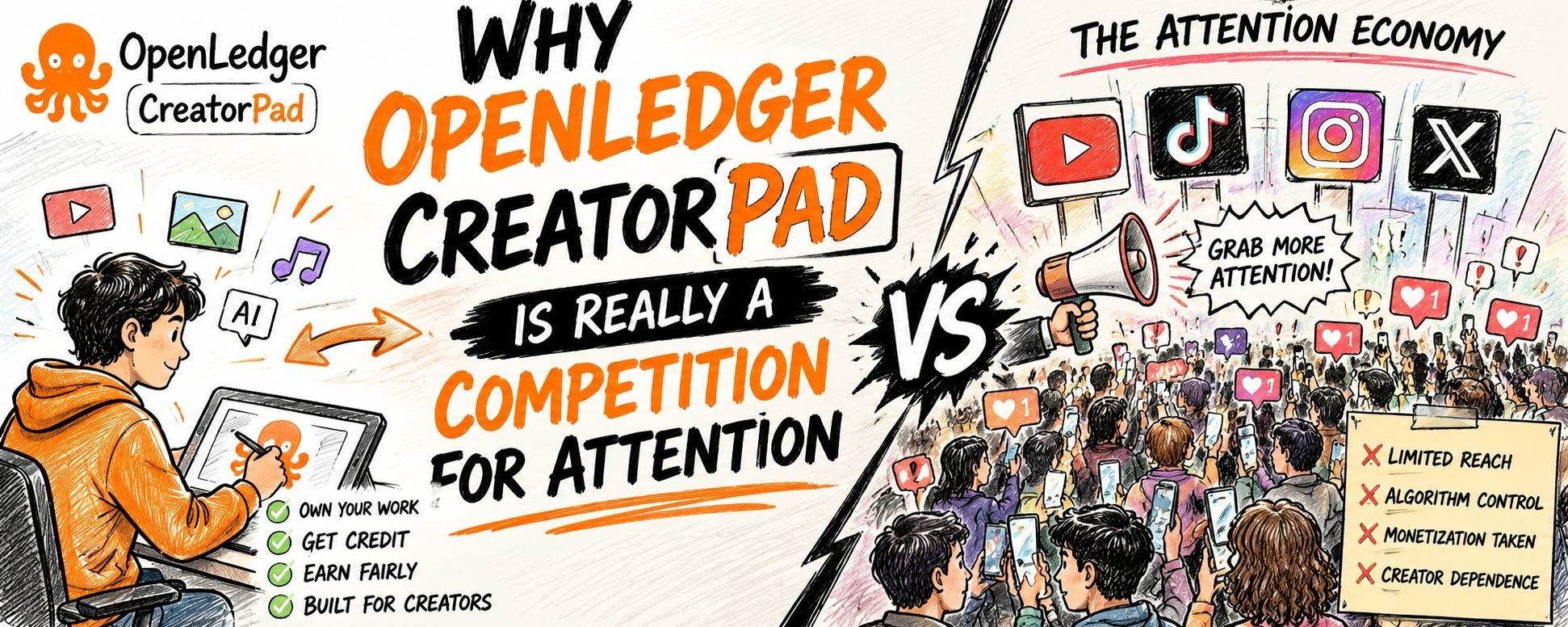
The first time I saw the OpenLedger CreatorPad campaign on Binance Square, I assumed it was just another content competition.
Post a few articles, collect some engagement, maybe earn a reward if things go well. Pretty standard.
But after spending some time reading through the mechanics, I realized the interesting part isn't really the prize pool itself. It's the system sitting underneath it.
A lot of crypto campaigns reward activity. Some reward capital. Some reward referrals. CreatorPad feels like it's trying to reward something harder to measure: attention that actually sustains itself.
That distinction kept pulling me back.
The headline number is obviously what catches people first. A $250,000 reward pool distributed in $OPEN tokens is hard to ignore. But the more relevant question is how participants actually qualify and move up the leaderboard.
From what I can tell, the campaign revolves around publishing content on Binance Square during the event window. Not just random posts, though. The ranking system appears designed to evaluate how content performs across multiple signals rather than rewarding pure volume alone.
Which makes sense.
Anyone can generate ten mediocre posts a day.
Generating something that people choose to read, share, discuss, or revisit is a different challenge entirely.
And that's where things get slightly more interesting.
It reads like an observation about how crypto ecosystems increasingly treat creators as part of their infrastructure stack.
I keep noticing a broader shift across crypto ecosystems. Projects increasingly need creators to function as infrastructure. Not infrastructure in the technical sense, but attention infrastructure.
Liquidity attracts traders.
Developers attract builders.
Content attracts understanding.
Without that last piece, most projects struggle to maintain momentum outside their existing communities.
OpenLedger seems to be leaning into that reality rather than pretending technology alone is enough.
The practical side of participating is fairly straightforward. Join the Binance Square CreatorPad event, publish eligible content related to OpenLedger, follow campaign guidelines, and track your ranking position throughout the event period.
Simple on paper.
Not necessarily simple in practice.
The leaderboard dynamic creates an entirely different layer. Once rankings become visible, creators stop competing against an abstract standard and start competing against each other.
That changes behavior.
People experiment with formats.
They test posting times.
They refine titles.
Sometimes they even discover entirely different narratives that resonate better than the original content idea.
I remember seeing similar patterns in earlier creator campaigns. What looked like a writing contest eventually became a distribution contest. Then a timing contest. Then somehow an experimentation contest.
The content itself was only part of the equation.
Maybe that's what participants should pay attention to here as well.
What makes this tricky is that every attention economy eventually runs into the same constraint. Rewards attract creators, creators generate content, content attracts attention—but if the growth of content outpaces the growth of genuine reader interest, the signal-to-noise ratio starts deteriorating. The leaderboard only works if meaningful engagement scales faster than optimization behavior. I'm not sure anyone has fully solved that problem yet.
Because if the algorithm rewards meaningful engagement signals, then maximizing reach isn't necessarily about posting more. It may be about understanding what information readers actually find useful.
That's the uncomfortable part about attention systems.
Everyone wants visibility, but visibility can't be manufactured forever. At some point the audience decides what deserves to spread.
Of course, there are still uncertainties.
No ranking system is perfect.
Algorithms can produce unexpected outcomes. Strong content sometimes gets overlooked. Average content occasionally catches momentum for reasons nobody fully understands.
Crypto platforms aren't immune to that reality.
Still, I think the OpenLedger CreatorPad campaign reflects something larger happening across the industry. The competition isn't just for users anymore. It's increasingly for interpretation, explanation, and narrative.
Projects are competing to be understood.
Creators are competing to become trusted translators.
And somewhere in the middle sits a leaderboard assigning scores to that process.
Maybe I'm overthinking it, but after sitting with it for a while, the whole thing started feeling less like a content campaign and more like an example of how crypto ecosystems increasingly treat creators as part of their infrastructure stack.
Whether that's an effective way to discover quality creators—or simply a better-packaged attention market—is the part I'm still trying to figure out.