I sat at my desk after midnight, with a cold cup of tea beside my keyboard, rereading OpenLedger’s whitepaper because I kept circling one question in my notes: is this just another AI-chain idea, or is something more practical being assembled here?
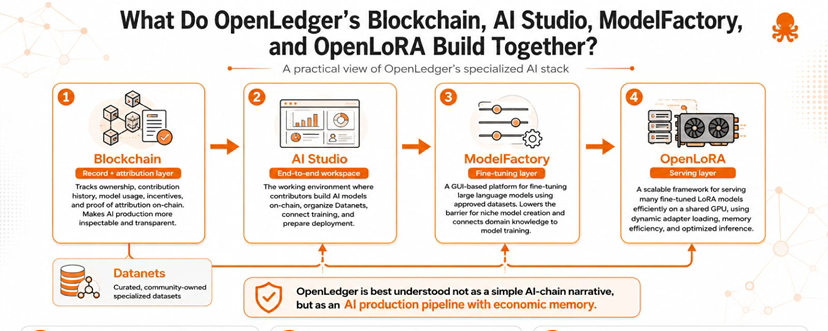
My answer is that OpenLedger’s blockchain, AI Studio, ModelFactory, and OpenLoRA are trying to build a working path for specialized AI, not a loose bundle of features. I see the blockchain as the record layer, AI Studio as the workspace, ModelFactory as the training path, and OpenLoRA as the serving layer. Together, the stack tries to move a model from data contribution to usable inference while keeping ownership, attribution, and rewards visible. That matters because the whitepaper starts from a real problem: specialized AI needs high-quality domain data, but contributors are hard to trace and value can disappear into an opaque system.
The blockchain part matters most when I stop treating it like a token wrapper and read it as an accounting surface for AI work. OpenLedger describes itself as built for attribution, model tracking, contribution history, and collaborative ownership, with an EVM-compatible blockchain maintaining records for specialized models, ownership, incentives, data points, and proof of attribution. In plain terms, I see an attempt to make AI production inspectable. If a model improves because of legal data, finance data, or validator feedback, the system is designed to preserve a trail instead of turning that work into invisible fuel.
AI Studio is where the idea becomes less abstract for me. The project presents it as an end-to-end model development framework where a person can contribute or build AI models on-chain, with Datanets for collecting and curating specialized datasets, ModelFactory for fine-tuning, and OpenLoRA for deployment. I like that framing because it gives the blockchain a job beyond settlement. A chain for AI is only useful if it connects to data collection, training, testing, deployment, and usage. Without that workflow, I would see narrative. With it, I see a product thesis: specialized intelligence should be easier to build, prove, and monetize.
ModelFactory is the strongest practical bridge in that thesis. The docs describe it as a GUI-based fine-tuning platform for large language models, removing the need for command-line tools or API integrations, while still letting a builder choose a base model, select Datanets, adjust training settings, and create a model. That does not make model quality automatic. It does, however, lower the operating barrier. My practical view is simple: if OpenLedger wants many useful niche models, it cannot rely only on expert ML teams. It needs a workflow where domain knowledge can meet structured training.
OpenLoRA answers a different problem: serving cost. A marketplace of specialized models sounds elegant until every small model needs expensive infrastructure. OpenLoRA is described as a framework for serving thousands of fine-tuned LoRA models on a single GPU, using dynamic adapter loading, memory efficiency, optimized inference, streaming, quantization, and fast model switching. I see that as the cost-control layer of the system. It does not prove demand, but it reduces one excuse. If specialized models can be deployed more cheaply, the real test becomes usage: which models get called repeatedly, which data earns attribution, and which communities create durable value?
This is where my caution starts. OpenLedger’s architecture is coherent, but coherent architecture is not adoption. In the short term, I would watch real model creation, Datanet quality, inference activity, and whether deployed models solve narrow problems better than generic alternatives. In the long term, I would watch whether attribution rewards create better data or merely attract low-effort submissions. Governance can help filter quality, and validators can support alignment, but any incentive system has to resist spam, gaming, and shallow participation.
My market perspective is that OpenLedger is easiest to misunderstand as an AI narrative around a chain. I think the better lens is an AI production pipeline with economic memory. The blockchain remembers contribution and usage. AI Studio gives the builder a place to work. ModelFactory turns curated data into specialized models. OpenLoRA tries to make those models affordable to serve. If those parts keep feeding each other, OpenLedger builds more than infrastructure; it builds a test of whether specialized AI can become transparent, attributable, and economically sustainable. I am interested, but I would measure it by usage, not by the story around it.