
The first time I came across OpenLedger it wasn't during one of those moments when the market was exploding and every new project seemed destined to trend for a week. It was actually during a fairly ordinary evening of scrolling through crypto updates trying to make sense of where attention was quietly drifting.
Lately I've found myself spending less time looking at price charts and more time watching behavior. The charts tell you what happened. The behavior often tells you what might happen next.
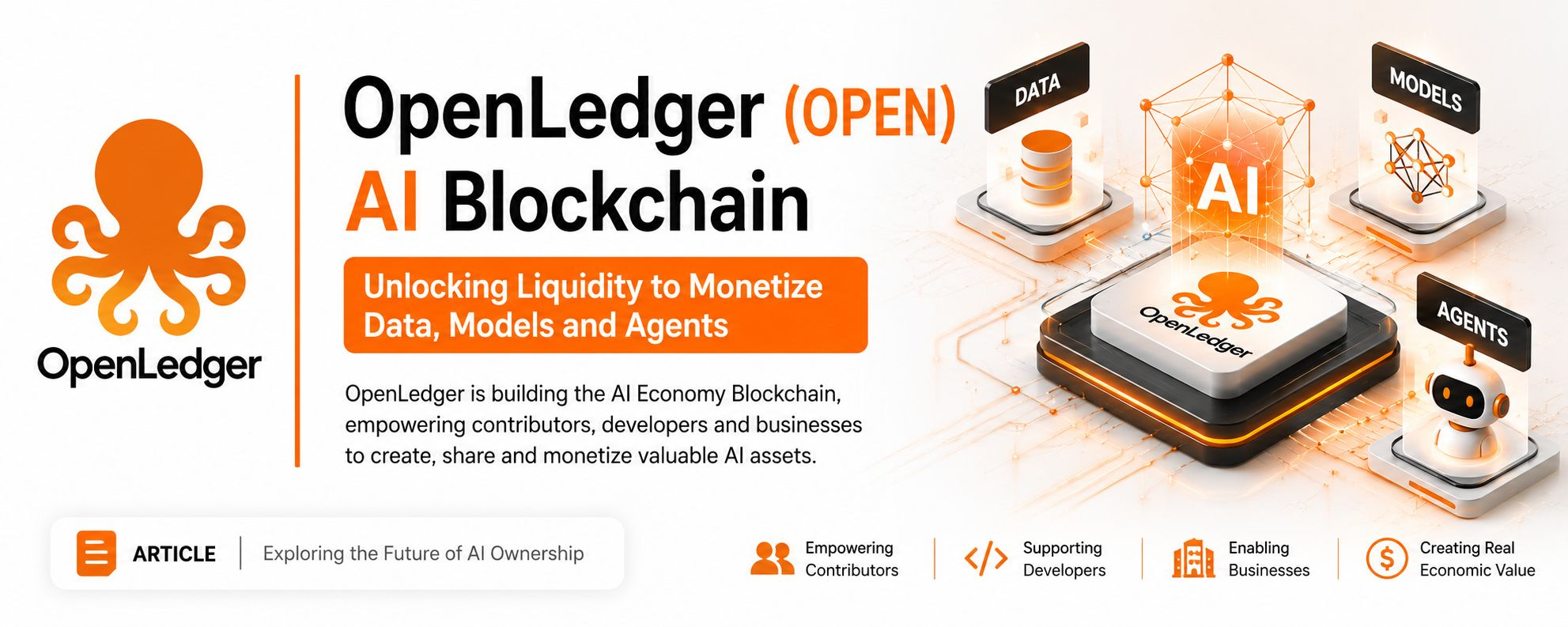
OpenLedger caught my attention because it was positioned as an AI blockchain focused on monetizing data, models, and agents. At first I honestly didn't think much of it. The AI narrative has become crowded enough that it's easy to dismiss new projects after reading a single sentence.
But something about it stayed in my mind.
Maybe it's because the market itself feels like it's entering a strange transition period. We're no longer in the phase where simply attaching AI to a project is enough to attract endless liquidity. Investors seem more selective now. Narratives still matter, but people are asking tougher questions.
What actually creates value?
Who captures that value?
And perhaps most importantly who deserves to?
The more I thought about OpenLedger the more I realized those questions are becoming central to how the market evaluates AI-related opportunities.
For years, data has quietly been one of the most valuable assets in the world. Entire technology giants were built on collecting it, organizing it and extracting insights from it. Most users contributed value without ever directly participating in the economic upside.
That model worked because there wasn't really an alternative.
Now AI is changing the equation.
Every model needs data. Every intelligent agent depends on information. Every prediction, recommendation, or generated response originates from some combination of human-created knowledge and machine processing.
Yet when I look at the broader AI landscape, I keep wondering whether the economic incentives are keeping pace with the technological progress.
That's where OpenLedger started becoming more interesting to me.
Not because I immediately viewed it as an investment opportunity. That's not how I evaluate projects anymore.
After enough market cycles, I've become more interested in understanding why certain ideas emerge at specific moments. Projects often reflect the deeper concerns and desires of the market that creates them.
And right now, the market seems increasingly focused on ownership.
Not ownership in the traditional crypto sense of holding tokens.
Ownership of contribution.
Ownership of intelligence.
Ownership of the resources that power AI itself.
When I think back to previous cycles, every major narrative was ultimately connected to some form of economic redistribution.
DeFi challenged traditional financial intermediaries.
NFTs challenged assumptions about digital ownership.
Layer 1 ecosystems competed over who would host the next generation of applications.
Now AI infrastructure appears to be asking a different question: if intelligence becomes a productive asset, how should its value be distributed?
I don't think there's a clear answer yet.
Honestly, I think that's exactly why investors are paying attention.
Markets are attracted to unresolved questions.
The biggest opportunities often emerge before a consensus forms.
What's fascinating is that we're seeing liquidity gradually rotate toward infrastructure again. During highly speculative periods, capital tends to chase visible products and consumer-facing applications. Those stories are easier to understand and easier to market.
Infrastructure is different.
Infrastructure requires conviction before excitement.
It asks investors to care about systems before outcomes.
That's not always an easy sell, especially in crypto.
Yet I keep noticing that some of the most thoughtful conversations recently have been happening around the foundations being built underneath the AI economy rather than the flashy applications sitting on top.
OpenLedger seems to exist within that shift.
The concept of unlocking liquidity around data, models, and agents feels less like a short-term narrative and more like an attempt to address a structural question.
If AI becomes a major economic force over the next decade, how will ownership function inside that economy?
Who gets rewarded when an AI model creates value?
Who benefits when data improves performance?
What happens when autonomous agents begin generating economic activity on behalf of users or organizations?
These questions sound abstract today, but so did many crypto concepts before they became mainstream discussions.
At the same time, I've learned to be cautious whenever a narrative feels compelling.
One lesson the market has taught me repeatedly is that a good story and a successful execution are not the same thing.
Sometimes an idea is correct but arrives too early.
Sometimes the timing is perfect but the implementation falls short.
And sometimes the market spends years ignoring a concept before suddenly deciding it's important.
That's why I try not to approach projects with certainty.
I approach them with curiosity.
OpenLedger sparked that curiosity because it seems connected to a broader evolution in how people think about value creation.
The crypto market has always been obsessed with liquidity. We measure it, chase it, analyze it, and complain about its absence. But perhaps the next stage isn't just about where liquidity flows.
Perhaps it's about what liquidity is flowing toward.
For most of crypto's history, capital itself was the primary asset.
Now we're entering a world where data, intelligence, and autonomous systems may become assets in their own right.
That possibility feels bigger than any single token or project.
And maybe that's why OpenLedger stayed on my radar after I first discovered it.
Not because it provided answers, but because it highlighted a question I can't stop thinking about.
As artificial intelligence becomes more embedded in the economy, will the value it creates remain concentrated in a handful of platforms, or will entirely new ownership models emerge?
The market doesn't seem to know yet.
But judging by where attention is slowly gathering, it feels like more people are starting to ask the same question.
