
OpenLedger and the Fight to Turn AI Into an Economy
For years, the artificial intelligence industry has operated on a strange bargain.
Millions of people create the raw material. A handful of companies collect the rewards.
Think about it. Every photo uploaded, every review posted, every forum discussion, every research paper, every customer support ticket—these tiny pieces of information have become the fuel powering modern AI. Yet the people who generate that fuel rarely see a cent when billion-dollar models are built on top of it.
That's not a technical problem.
It's an economic one.
And that's exactly the gap OpenLedger is trying to attack.
I've spent enough time around both crypto and AI to know that grand promises are cheap. Every few months, another project appears claiming it will "revolutionize" everything. Most disappear. Some never ship. Others get buried under bugs, regulatory headaches, or plain old corporate ego.
OpenLedger is making a different bet.
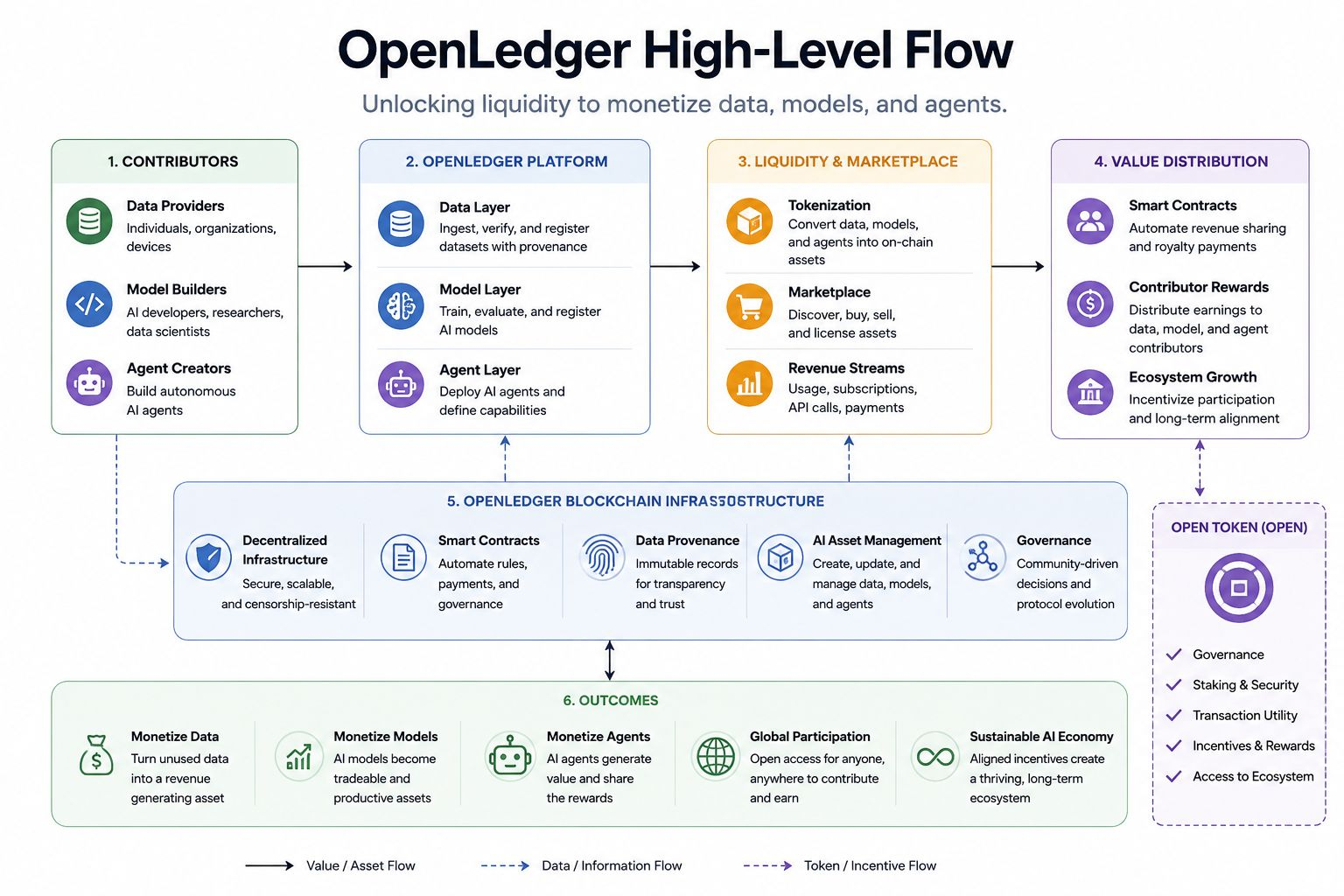
Instead of focusing solely on building smarter AI, it wants to build the economic rails underneath AI itself. Data. Models. Agents. The project treats all three as assets that should be owned, traded, rewarded, and monetized.
Simple idea.
Complicated execution.
But potentially a very big deal.
The first thing to understand is that OpenLedger isn't trying to compete with AI models like ChatGPT or Claude. That's not the game here. The project is focused on something deeper—the infrastructure layer that determines who gets paid when AI creates value.
Right now, the economics of AI are lopsided.
A researcher might spend years collecting valuable data.
A developer might build a specialized model.
A business might provide real-world usage and feedback.
An AI agent might automate thousands of hours of work.
Yet the financial upside often ends up concentrated in one place.
The real kicker is that AI itself has become incredibly valuable while the assets that make AI possible remain surprisingly illiquid.
Data is valuable but difficult to monetize.
Models are valuable but difficult to price.
Agents are valuable but difficult to own collectively.
OpenLedger's answer is liquidity.
That word gets thrown around constantly in crypto circles, usually to the point where it loses meaning. Here, however, it matters.
Liquidity simply means turning something valuable into something usable.
A house has value, but selling it takes time. A stock can be sold instantly. Stocks are more liquid.
OpenLedger wants to bring that same flexibility to AI assets.
Imagine a medical researcher sitting on a rare healthcare dataset. Under traditional systems, monetization options are limited. Sell the data once. License it. Maybe partner with a corporation.
OpenLedger imagines a different model.
The dataset becomes a living asset inside an economic network. If future AI systems generate value from that data, contributors can continue participating in the upside rather than collecting a single payment and walking away.
That changes incentives dramatically.
People take data quality more seriously when they have skin in the game.
Developers benefit too.
Anyone who has built machine learning systems knows the ugly reality. Building a model is only half the battle. Distribution, monetization, infrastructure, customer acquisition—those challenges can crush even technically brilliant projects.
OpenLedger attempts to reduce that friction by creating a marketplace where models become discoverable economic assets rather than isolated software projects hidden in a GitHub repository.
Then there are AI agents.
This is where things start getting interesting.
And weird.
An AI agent isn't just a chatbot answering questions. It's software capable of performing tasks autonomously. Scheduling meetings. Conducting research. Executing workflows. Managing operations.
We're entering an era where digital workers can generate measurable economic value.
The question nobody has fully answered yet is simple:
Who owns those workers?
Who gets paid?
Who receives the revenue generated by their activity?
OpenLedger's architecture suggests that agents themselves can become participants in a larger economic system, with transparent ownership structures and programmable reward mechanisms.
It's a fascinating idea because it pushes AI beyond software and closer to infrastructure.
Of course, none of this works without trust.
That's where blockchain enters the picture.
Crypto critics often roll their eyes whenever blockchain gets attached to a new industry. Sometimes that's justified. Plenty of projects slap a token onto a product and call it innovation.
But AI has a genuine transparency problem.
Training data is often opaque.
Ownership is often unclear.
Attribution is frequently impossible.
Blockchain doesn't magically solve every issue, but it does create an immutable record of contributions, transactions, and ownership relationships.
That matters.
Especially when real money enters the equation.
The OPEN token serves as the economic glue holding the entire machine together.
Rewards flow through it.
Governance flows through it.
Participation flows through it.
The success of the token ultimately depends on whether the ecosystem generates genuine demand rather than speculative excitement. That's an important distinction. Crypto history is littered with projects that built token economies before building actual economies.
OpenLedger will need to avoid that trap.
And there are plenty of traps.
Let's be honest about that.
Data verification remains messy.
AI quality control remains messy.
Regulators haven't decided how they want to treat many AI-generated assets.
Cross-border compliance is a nightmare.
Scalability challenges don't disappear because a whitepaper says they will.
Then there's competition.
Lots of it.
The race to build decentralized AI infrastructure has become crowded. New protocols appear constantly. Some focus on compute. Others focus on data. Others focus on model marketplaces.
OpenLedger must convince developers, businesses, and users that its approach deserves attention.
That's easier said than done.
Still, the broader trend is difficult to ignore.
We're witnessing the birth of entirely new digital economies.
A decade ago, people argued about ownership of websites.
Then ownership of social networks.
Then ownership of digital assets.
Now we're moving toward ownership of intelligence itself.
That shift sounds dramatic, but look around.
AI systems already influence decisions worth billions of dollars. They create content. Generate software. Analyze markets. Automate customer support. Assist researchers.
As these systems become more capable, questions of ownership and compensation become impossible to avoid.
Who gets rewarded when intelligence creates value?
That's the question sitting underneath all of this.
And that's the reason OpenLedger deserves attention.
Not because it's another blockchain.
Not because it has a token.
Not because AI happens to be the hottest narrative in technology.
It matters because it is trying to solve a real economic problem that sits at the center of the AI industry.
Will it succeed?
Nobody knows.
The history of technology is full of elegant ideas that collided with reality. Markets are stubborn. Users are unpredictable. Regulations change. Competitors emerge from nowhere.
But if OpenLedger can create a system where data contributors, model builders, and AI agent operators share in the value they create, it may help define an entirely new layer of the digital economy.
And that's a much bigger ambition than launching another crypto project.
It's an attempt to redesign how intelligence itself gets monetized.
That's the bet.
Now we wait to see if the market agrees.
