
Lately it feels like every project wants to connect AI and blockchain somehow.
Maybe that's unfair. Maybe some of them genuinely have a reason for doing it. But after hearing the same promises over and over, I think I've become a little skeptical whenever I see those two words in the same sentence.
That's probably why OpenLedger caught my attention.
Not because it sounded revolutionary or anything. Honestly, it was more because the idea seemed to revolve around a question that keeps coming up whenever people talk about AI: who actually benefits from all the data being used?
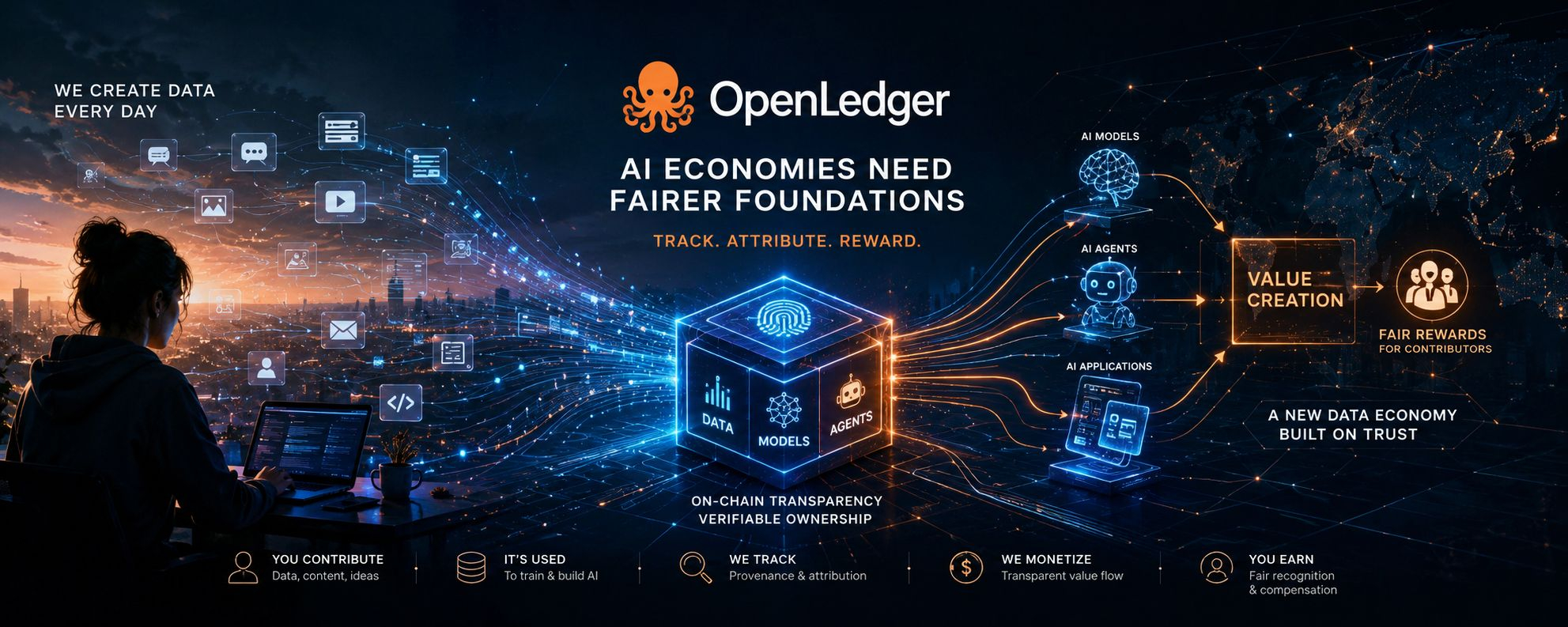
Most of us create data constantly without really thinking about it. We write things, upload things, interact with apps, leave trails everywhere online. Then AI systems learn from huge collections of information, companies build products around them, and somehow the connection between the people providing the raw material and the value being created feels a bit blurry.
OpenLedger seems to be looking at that gap.
From what I understand, the project is trying to create a way for data, AI models, and agents to become assets that can be tracked and monetized more openly. At least that's the general idea. The technical explanations get complicated pretty quickly, and I'll admit I had to read some parts twice.
Still, the basic concept makes sense to me.
If data has value, shouldn't there be a clearer way to measure where that value comes from?
The thing I'm not sure about is whether people actually want that system badly enough to use it.
That's not meant as criticism. It's just something I wonder whenever I see ambitious infrastructure projects. The technology can be impressive, but getting real people to change habits is usually the harder part.
For years we've been hearing that data is valuable. Maybe even more valuable than some traditional assets. Yet most people don't think about their data in economic terms. They use services because they're convenient. They click "accept" without reading. They move on with their day.
OpenLedger seems to be betting that this relationship might eventually change.
Maybe it will.
AI is becoming a bigger part of everyday life, and the conversations around ownership are getting harder to ignore. If an AI model learns from millions of contributions, who deserves recognition? Who deserves compensation? Is that even possible to calculate fairly?
I don't have answers to any of that.
Sometimes I think the internet became so large that tracing value back to individual contributions is nearly impossible. Other times it feels strange that we don't even try.
That's where projects like OpenLedger become interesting to watch.
Not because they're guaranteed to succeed. If anything, I'd be cautious about making that assumption. The history of both crypto and emerging technology is filled with ideas that sounded convincing but never found a practical audience.
But occasionally a project appears that asks a worthwhile question, even if the final solution isn't perfect.
I think OpenLedger falls into that category.
The part that interests me isn't really the token or the blockchain itself. It's the underlying argument that AI economies might eventually need better ways to identify and reward the things that make them possible.
Whether that happens through OpenLedger or through something completely different, I honestly don't know.
What I do know is that AI keeps growing, data keeps becoming more important, and the conversation around who benefits from all of it feels like it's only getting started.