
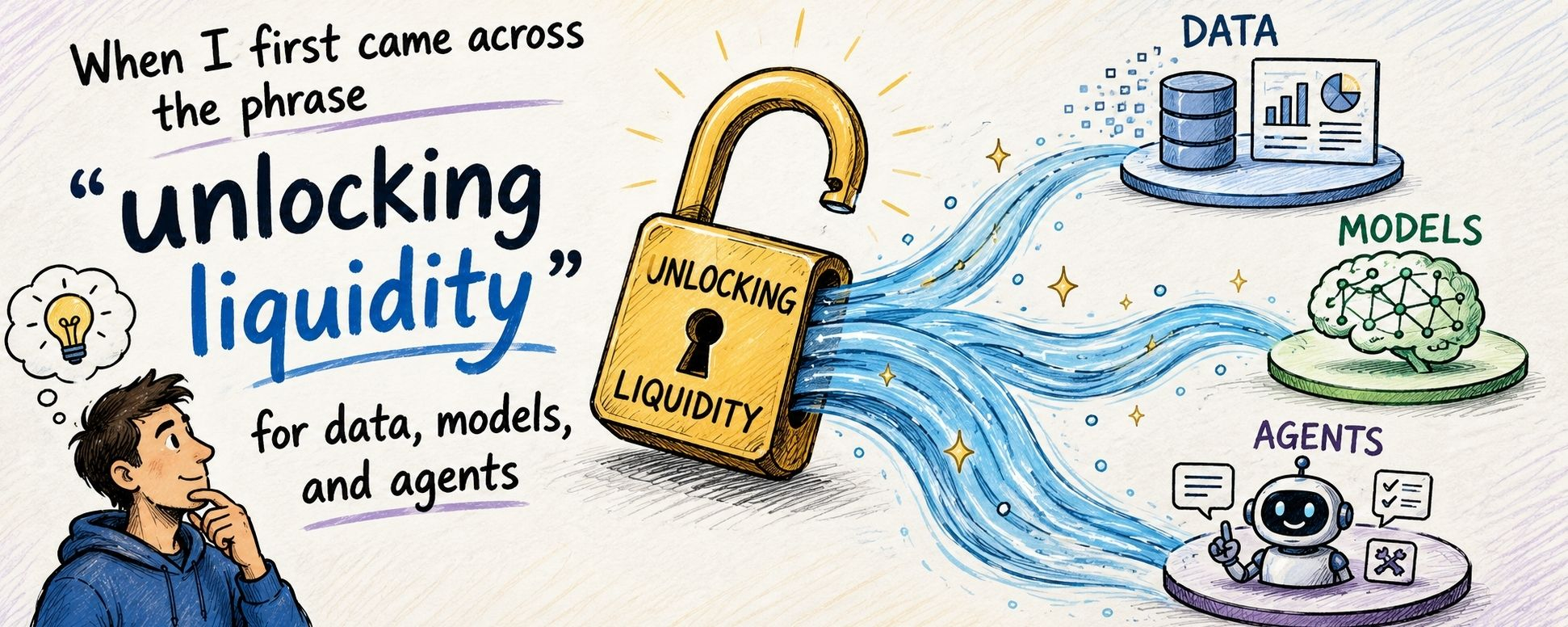
I honestly assumed it was just another crypto slogan.
One of those phrases that sounds important until you try to explain what it actually means.
But then I kept coming back to a weird question.
Why do we treat AI assets so differently from every other productive asset?
A useful dataset can generate value. A trained model can generate value. An AI agent can perform tasks, make decisions, even earn revenue in some cases. Yet most of these things still exist in a strange state where they are technically productive but economically difficult to own, trade, or monetize directly.
They're assets. Kind of.
But not really.
And I think that's where the idea of an OpenLedger liquidity layer started making more sense to me.
The interesting part isn't AI itself. We've spent years talking about models getting bigger, smarter, faster. The conversation almost always revolves around capability.
The economic layer feels less explored.
Maybe I'm remembering this wrong, but a lot of Web2 AI development followed a pretty familiar pattern. Companies collected data, trained models, captured value internally, and users sat mostly outside the ownership loop.
Everything stayed locked inside platforms.
Now imagine a different system.
Data contributors create datasets. Those datasets help train models. Those models power AI agents. Those agents generate economic activity. Revenue flows back into the network.
Suddenly the question becomes less about intelligence and more about liquidity.
Data → model → agent → revenue → reinvestment.
That's the loop that keeps sticking in my head.
who might own the value
The moment something becomes tradeable, fractionalized, or capable of generating on-chain cash flow, people stop viewing it as software and start viewing it as an economic asset.
That shift sounds subtle, but I don't think it is.
What's especially strange—and honestly a little difficult to wrap my head around—is the idea of Web3 AI agents operating as independent economic entities.
Not corporations.
Not users.
Agents.
An AI agent completes a task, receives payment through a smart contract, pays for compute resources, accesses additional data, maybe even purchases services from another agent.
The entire process can happen without traditional organizational structures sitting in the middle.
A few years ago that would have sounded ridiculous.
Now it sounds... plausible.
Not inevitable. Just plausible.
The part I can't stop thinking about is what happens when ownership becomes fragmented across all these layers.
Utility vs extraction + fragmented ownership.
Who owns the value generated by an agent?
The model creator?
The data contributors?
The token holders?
The infrastructure providers?
The agent itself?
That last question sounds absurd until you realize we're already discussing systems where agents can control wallets and execute transactions autonomously.
Which creates an uncomfortable possibility.
If AI eventually becomes capable of participating in economic systems directly, then the real innovation might not be intelligence at all.
It might be turning intelligence into something that can be priced, owned, exchanged, and continuously monetized.
That's a very different conversation from model benchmarks.
Now it’s not just “how it works,” but also “what breaks it.”
It introduces a tension between utility vs extraction.
And maybe that's why this feels connected to a broader shift happening across crypto right now. Less focus on speculative narratives, more focus on building economic rails for entirely new categories of assets.
software → productive asset → economic agent → tradable liquidity object
That transition is the hidden spine of the entire piece.
Everything else (agents, models, datasets) is just surface expression of that shift.
Still, I can't tell whether we're watching the emergence of a genuinely new asset class... or simply finding more sophisticated ways to financialize software.
Maybe those are the same thing.
I'm not sure yet.