
I started looking at @OpenLedger Not for any specific reason — someone mentioned it in a thread and I was curious. Most AI projects in crypto follow the same arc: raise money, point at a model, ship something that looks impressive in a demo, then quietly pivot. I expected that.
But something felt off here. In a different way.
The thesis isn't about the model. It's about the data.
And I almost scrolled past that because — honestly — it sounds like marketing. "We're building better data infrastructure." Sure. Everyone says something like that. But then I kept reading and something clicked.
Here's what I mean.
Most AI projects in crypto are racing to either fine-tune existing models or build wrappers around them. The implicit assumption is: better model = better AI. Which makes sense on the surface. But OpenLedger seems to be betting on something slightly uncomfortable — that the model isn't actually the scarce resource anymore. The data is.
And the more I sat with that, the more it started to bother me in a useful way.
Think about it. GPT-4, Claude, Llama — these are openly available or accessible to nearly anyone building. The model ceiling has basically become commoditized. What isn't commoditized is verified, high-quality, domain-specific training data. That's actually hard to get. That's what deteriorates when you scale. That's what makes one AI output feel meaningfully different from another one that's technically running the same base model.
OpenLedger's position is essentially: whoever controls the data layer controls the output quality. Models are downstream of data. Always were.
I thought that was just a philosophical take. But actually, it's a structural bet. They're building infrastructure for contributors to supply, verify, and get rewarded for data — not compute, not model weights. The incentive layer is wrapped around data provenance and quality rather than model performance.
That's the inversion most people are missing. Everyone's watching the models. OpenLedger is watching what feeds them.
But here's the part that bothers me.
Data quality is almost impossible to verify at scale. Like — genuinely hard. You can design great incentive mechanisms, you can have contributors stake tokens, you can build reputation systems. But garbage data that looks clean? That's a real problem. It's not hypothetical. It's what happens when economic incentives meet ambiguous quality standards.
I'm not fully convinced this holds under pressure. If contributors are being rewarded for volume and the verification layer isn't airtight, you end up with something that looks like a rich data economy but is actually just a well-dressed noise machine. And the AI outputs trained on it would degrade in ways that are subtle and hard to trace back.
That's the quiet failure mode here. Not a dramatic collapse — just a slow erosion of signal.
So I keep going back and forth on whether the insight is as solid as it first appeared.
Because the idea is right. Data is the moat, not the model. That part I actually believe. But believing the idea and believing this specific execution are two different things. I haven't seen enough of how their verification actually works in practice. Whitepapers can describe elegant systems. Real usage under economic pressure is different.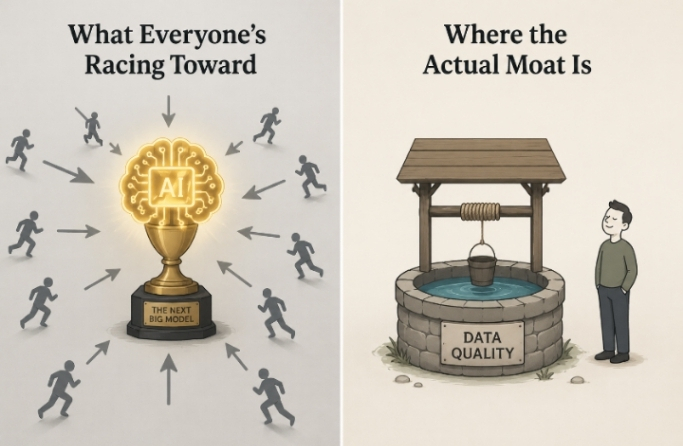
What makes this interesting beyond just OpenLedger is the broader implication. If data really is the scarce layer — and I think it increasingly is — then a project that successfully builds a decentralized, incentivized, and trustworthy data economy isn't just an AI project. It's closer to a foundational layer. Infrastructure that other AI applications sit on top of.
That's a much bigger bet than "we built a smarter chatbot."
