
OPENLEDGER AND THE RACE TO BUILD AN AI ECONOMY
Artificial intelligence has a strange dirty secret.
Everyone talks about the models. Almost nobody talks about the people feeding them.
Think about it for a second.
Every breakthrough chatbot, image generator, research assistant, and autonomous agent is built on mountains of human-created information. Photos. Articles. Reviews. Research papers. Forum discussions. Customer support transcripts. Endless streams of digital breadcrumbs left behind by millions of people.
Yet when the money starts flowing, most of it ends up in the same place: the companies controlling the infrastructure.
That's the imbalance OpenLedger is trying to attack.
And it's not a small ambition.
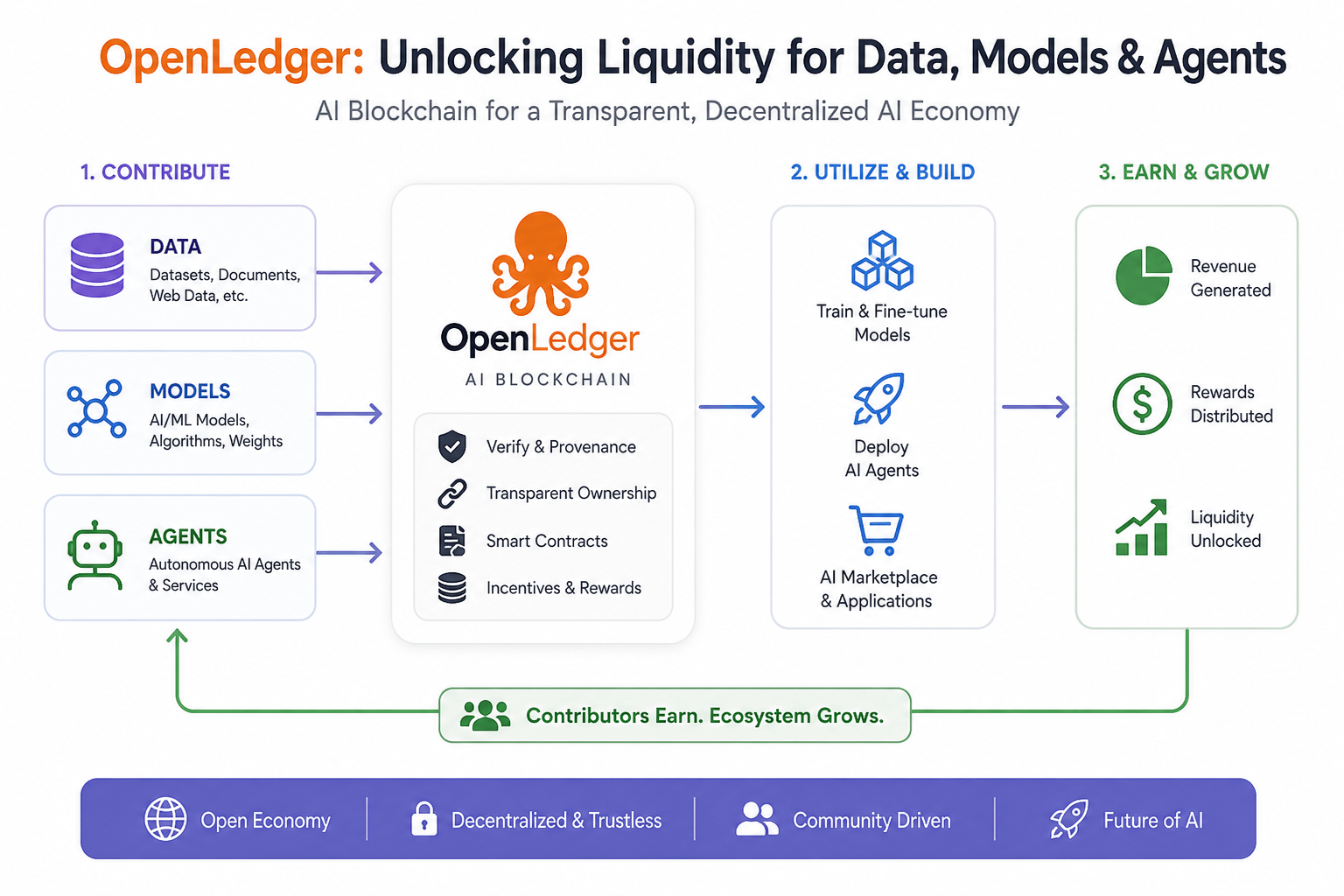
The project isn't pitching itself as just another blockchain looking for an AI narrative. We've seen plenty of those already. Most disappear into the noise after a few marketing cycles. OpenLedger is making a much bigger claim. It wants to build the economic rails for artificial intelligence itself, creating a marketplace where data, AI models, and autonomous agents can be treated as productive assets instead of disposable resources.
If that sounds complicated, that's because it is.
But the underlying idea is surprisingly simple.
The current AI industry resembles a giant factory where millions of people unknowingly supply raw materials while a handful of companies own the finished products. Data goes in. AI comes out. Value accumulates at the top.
OpenLedger wants to change that equation.
The project is built around a straightforward belief: if your data helps create value, you should have a way to participate in the upside. If you build a model that people use, ownership should be transparent. If an AI agent generates revenue, there should be a native system that allows it to operate economically without relying on a centralized gatekeeper.
Easy to say.
Much harder to build.
That's where blockchain enters the story.
For years, blockchain advocates have argued that decentralized networks can solve ownership problems that traditional platforms struggle with. In theory, blockchains are very good at recording contributions, tracking transactions, distributing rewards, and creating transparent systems of accountability.
AI, meanwhile, has the opposite problem.
The technology is becoming more powerful every year, but the economics surrounding it remain remarkably opaque. Ask most users where a model's training data came from, who contributed it, and who got paid for it. The answer is usually a shrug.
OpenLedger is attempting to create a ledger for intelligence itself.
Data becomes an asset.
Models become monetizable products.
Agents become economic participants.
The vision is ambitious enough to attract attention and controversial enough to invite skepticism.
Both reactions are justified.
Because creating an open AI economy sounds elegant on paper. Reality is usually messier.
Data quality is a perfect example.
Anyone who has spent time around machine learning knows that bad data can poison a system faster than almost anything else. Open contribution sounds great until spam, manipulation, duplication, and low-quality submissions start flooding the network. Suddenly you're not building intelligence. You're building a garbage disposal unit.
OpenLedger's long-term success will depend heavily on solving this problem.
The same goes for attribution.
Let's say a model generates millions in value. How do you accurately determine which dataset contributed what percentage of that success? How do you reward thousands—or potentially millions—of contributors fairly?
There isn't a magical answer.
There are only increasingly sophisticated attempts to solve a very difficult accounting problem.
Here's where things get interesting.
The rise of AI agents may actually create a stronger case for networks like OpenLedger than traditional chatbots ever did.
We're moving toward a world where software doesn't just answer questions. It performs tasks. Books travel. Executes trades. Negotiates contracts. Conducts research. Manages workflows.
These systems don't simply consume information. They generate economic activity.
That changes everything.
Imagine an AI agent running a customer support operation twenty-four hours a day. It serves clients, collects fees, purchases computational resources, and improves its performance over time. Suddenly you're no longer talking about software as a tool.
You're talking about software as a participant.
Traditional infrastructure wasn't designed for that future.
OpenLedger is betting that blockchain-based coordination becomes increasingly valuable once millions of autonomous agents begin interacting with each other.
Maybe they're right.
Maybe they're early.
History has a habit of making those two things look identical for a while.
I've watched enough technology cycles to know that timing matters almost as much as execution. A brilliant idea launched five years too soon often looks indistinguishable from a bad idea.
The AI sector is currently drowning in hype. Every week brings another protocol promising decentralized intelligence, autonomous economies, or revolutionary infrastructure. Most won't survive. Some are solving problems nobody actually has.
The real question is whether OpenLedger is tackling a problem that becomes impossible to ignore.
There are reasons to think it might be.
The AI industry is facing growing pressure from creators, regulators, researchers, and governments demanding more transparency around training data and ownership rights. Legal battles are already emerging. Regulatory headaches are multiplying. Corporate ego continues to complicate collaboration between organizations that would rather control ecosystems than share them.
Those pressures aren't going away.
If anything, they're intensifying.
An infrastructure layer capable of tracking contributions and distributing value could become increasingly useful as the industry matures.
Could OpenLedger become that layer?
Nobody knows.
And anyone claiming certainty is probably selling something.
What we can say is this: the project sits at the intersection of two massive technological shifts. One is artificial intelligence. The other is programmable digital ownership.
That's a fascinating place to be.
It's also a dangerous one.
Because building successful infrastructure rarely comes down to vision alone. It comes down to execution. Bugs matter. Incentives matter. Governance matters. User experience matters. Communities matter.
Most importantly, trust matters.
The internet is littered with technically impressive projects that failed because nobody showed up.
OpenLedger's challenge isn't simply building technology.
It's convincing developers, researchers, businesses, and data contributors that a different economic model for AI is worth participating in.
That's a much harder task.
But it's also the opportunity.
The bottom line?
OpenLedger isn't really trying to build another blockchain.
It's trying to answer one of the biggest unanswered questions in artificial intelligence: who should own the value created by machine intelligence?
The answer could shape the next decade of technology.
And that's a story worth paying attention to.
