
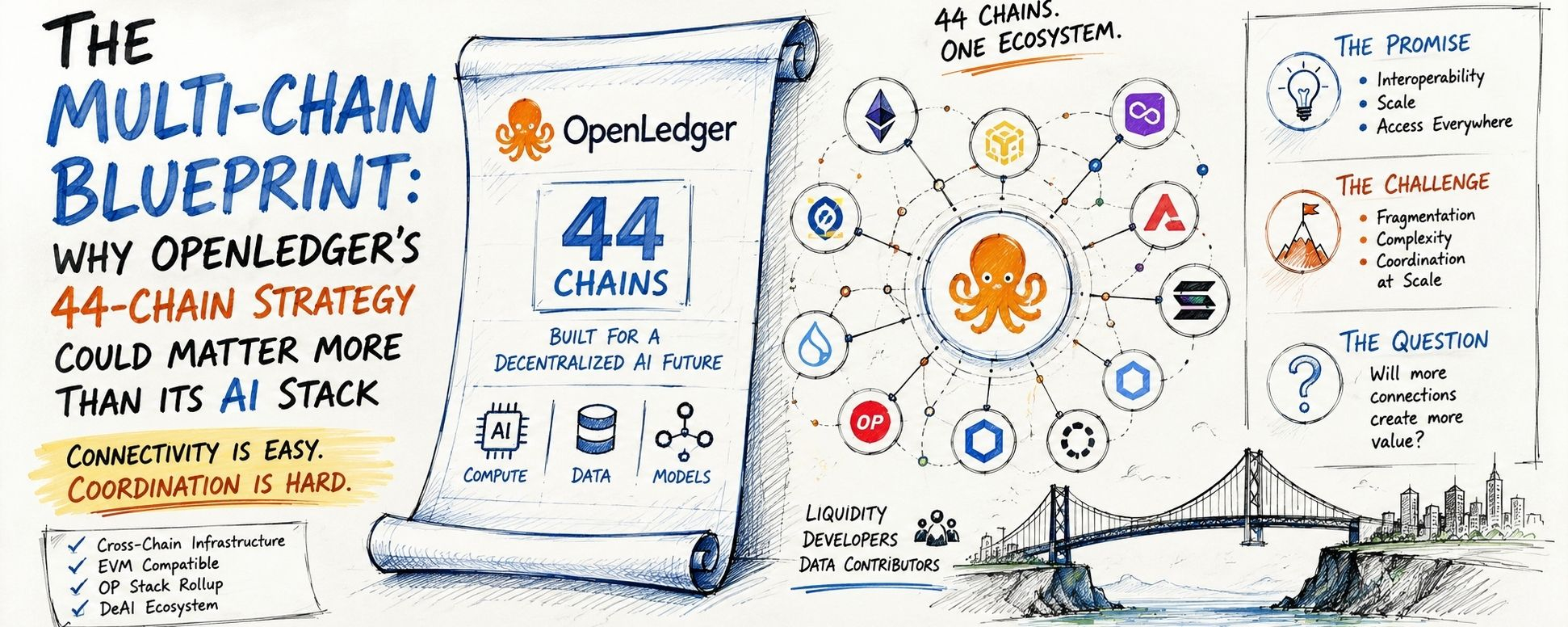
I've been noticing something lately when people talk about AI infrastructure in crypto.
A lot of the conversation still revolves around models, datasets, agents, inference layers... all the things happening on top. But weirdly, the thing that keeps pulling my attention back is infrastructure. The boring part. Or at least the part that's supposed to be boring.
Maybe that's because every time a new ecosystem launches as its own isolated chain, the same problem shows up sooner or later. Users end up in one place, liquidity ends up somewhere else, developers build in another corner entirely, and suddenly everyone is spending more energy connecting systems than actually using them.
That's partly why OpenLedger's approach caught my eye.
At first glance, "44-chain infrastructure" sounds like one of those big numbers projects throw around because it looks impressive in a tweet. I kind of dismissed it initially. Then I started thinking about what happens if the goal isn't simply to launch another blockchain, but to build an AI-focused ecosystem that actually needs participants from multiple environments to interact.
The more I thought about it, the less a single-chain strategy made sense.
AI systems don't naturally stay inside one network. Data comes from different places. Developers use different tools. Communities form on different chains. Even incentives move around constantly. Trying to force all of that into one isolated environment feels a little like building a modern internet application and insisting it only works on a single server.
Maybe that's an exaggeration. But not by much.
What's interesting is that this isn't just an OpenLedger question. Crypto as a whole seems to be moving away from the idea that one chain can do everything. Over the last few years, the industry has gradually shifted toward modular architectures, shared liquidity layers, and specialized execution environments. In that context, a cross-chain DeAI ecosystem feels less like an exception and more like a logical extension of where infrastructure design is already heading.
What makes OpenLedger interesting is that it seems to start from the assumption that fragmentation already exists and isn't going away. Instead of treating cross-chain connectivity as an upgrade to be added later, the architecture appears built around it from the beginning.
The Ethereum compatibility piece feels important here too.
I remember how difficult blockchain onboarding felt a few years ago whenever developers had to learn entirely new execution environments just to experiment with a project. Most people simply didn't bother. EVM compatibility changed that equation because developers could bring existing tools, workflows, and habits with them.
It's not the most exciting feature to talk about. Nobody gets hyped about compatibility layers.
Yet those are often the things that determine whether an ecosystem grows or stays niche.
The OP Stack roll-up design adds another layer to that conversation. Not because roll-ups are new anymore—they're everywhere now—but because scaling AI-related activity may require a different mindset than scaling traditional DeFi transactions. Data movement, verification, model interactions, incentives... the workload starts looking different.
And that's where the DeAI cross-chain narrative becomes more interesting to me.
The challenge isn't simply creating decentralized AI. It's creating decentralized AI that doesn't become trapped inside its own liquidity silo or user silo the moment it gains traction.
That's easier said than done, obviously.
Cross-chain systems introduce complexity. More connections mean more things that can break. Coordination becomes harder. Security assumptions multiply. Sometimes simplicity has value precisely because it limits what can go wrong.
Still, I keep coming back to the same thought.
If AI is genuinely becoming a networked layer that spans multiple ecosystems, then maybe the winning infrastructure won't be the chain with the strongest walls. Maybe it'll be the one with the most useful bridges.
What I keep wondering, though, is whether cross-chain expansion actually solves fragmentation or just redistributes it. A network can connect to 44 chains, but if liquidity, developers, and data contributors don't continue converging toward the same economic center, the system risks becoming a collection of bridges without a destination. Connectivity scales easily. Coordination doesn't. And that distinction might end up being more important than the chain count itself.
I can't tell yet whether that's where the industry is heading or if we're just entering another cycle of interoperability promises. But the idea of building DeAI across 44 chains feels less like expansion for its own sake and more like an acknowledgment of how fragmented crypto already is.
Maybe that's the real insight here... or maybe we're only seeing the first version of what a cross-chain AI ecosystem eventually becomes.