
Market's been sideways for a few days now. Not crashing, not running — just that weird in-between where nothing feels urgent enough to trade but you can't really walk away either. I ended up spending most of this session just reading docs instead of watching charts.
Somehow I ended up deep in the OpenLedger stack. Not even sure how it started — probably a tweet about OctoClaw that I half-noticed and then went back to. Started reading about $OPEN , and somewhere around the third tab I had open, something shifted in how I was thinking about the whole thing.
So here's what I thought I was looking at: an AI agent play. OpenLedger builds a smart agent — OctoClaw — that executes on-chain workflows, automates DeFi tasks, handles the stuff that used to require either a quant team or a lot of painful manual position management. Classic AI-in-crypto narrative. I'd seen a dozen versions of this pitch before.
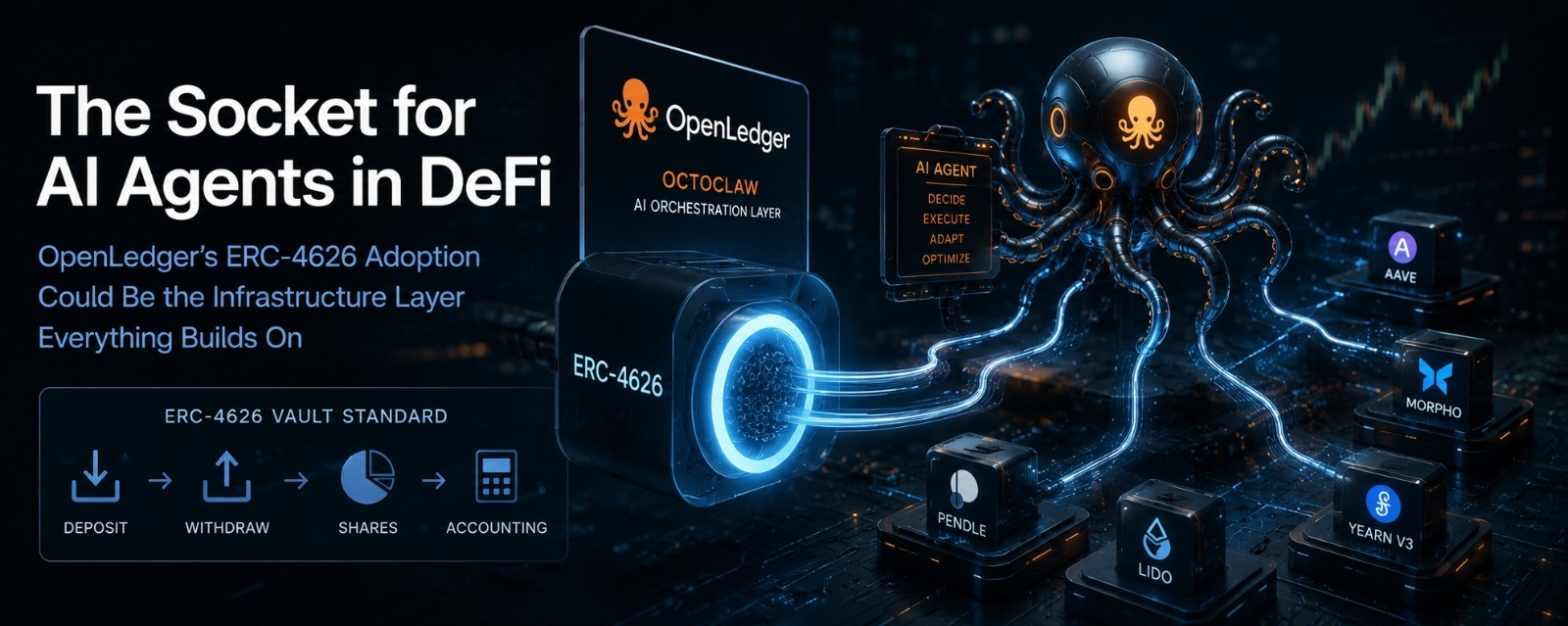
But then I looked at the ERC-4626 announcement from March 20th. OpenLedger officially adopted the vault standard. And that's when the framing shifted for me.
Because ERC-4626 isn't an AI thing. It's a vault interface standard — the thing Morpho, Yearn V3, and Aave all converged on because it lets protocols talk to each other through a single consistent socket: deposit, withdraw, shares math, done. Before it existed, every yield protocol had its own interface and every integration was custom work. After it, you write once and plug in anywhere.
The realization: OpenLedger's automation story isn't really about whether the agents are smart. It's about whether they have a standardized place to plug in.
This is the part people are looking at backwards. The discussion around AI agents in DeFi keeps centering on agent intelligence — can it make better yield decisions, can it out-trade manual strategies, can it respond to on-chain conditions fast enough. But none of that matters if the agent can't physically insert itself into live DeFi infrastructure cleanly. ERC-4626 is that insertion point. OctoClaw is the orchestration layer sitting above it. The agents just need a socket. OpenLedger just put a socket in.
I thought the interesting question was "how smart is the agent." It's actually "does the agent have a standardized interface." Those are very different problems.
Here's the part that still bothers me though.
ERC-4626 was designed for passive vault accounting. It's elegant for products that deposit capital, accrue yield, and let users redeem shares. Static-ish. Predictable. The math holds because the underlying behavior is constrained.
Plugging an active, decision-making AI agent into a passive accounting standard is a different beast. The vault interface doesn't know the agent is making autonomous choices inside it. It just sees deposits and withdrawals. That gap between what ERC-4626 was designed to express and what an AI agent actually does inside those positions — I'm not sure anyone has fully worked out what breaks there. If the agent makes a sequence of rapid internal moves that the vault interface can't represent cleanly, what happens to the share price accounting? Does the standard hold?
Maybe it does. OpenLedger's team clearly knows this better than I do. And honestly, the fact that they chose ERC-4626 at all rather than building proprietary vault logic suggests they thought about composability first, which is the right call for long-term DeFi integration.
But I keep coming back to it. The history of DeFi is full of things that were composable in theory and fragile in practice — not because the individual pieces were bad, but because the assumptions baked into each standard were slightly incompatible at the edges.
What matters for all of this isn't whether OpenLedger's agents are technically impressive. It's whether the automation infrastructure holds under real market stress — fast-moving prices, liquidity crunches, oracle lag. The socket only matters if the current actually flows through it reliably.
The agent economy in DeFi either finds its infrastructure layer sometime in the next year or it stays a research project indefinitely. If OpenLedger's ERC-4626 move is the actual insertion point everyone else ends up building around — not just a product announcement — then the "cloud-based agent architecture" framing undersells what's actually happening here.
Though it's also possible I've been staring at docs for too long and read too much into a vault standard adoption.
Market still quiet. I'll probably revisit this in a few weeks when there's more execution data on the vault side.