
After spending years watching the crypto industry evolve, I have developed a habit that feels almost unavoidable. Whenever a new project begins attracting attention, my first instinct is no longer curiosity. It is caution.
That reaction is not rooted in cynicism as much as experience. The blockchain sector has produced an endless sequence of compelling stories. Every cycle introduces a fresh set of ideas that appear capable of solving major problems. Scalability was supposed to transform everything. Interoperability was supposed to connect fragmented ecosystems. Decentralized finance was supposed to reinvent financial infrastructure. Some innovations delivered meaningful progress, while many others gradually faded into the background after the initial excitement disappeared.
That history is one reason why I find Open Ledger interesting, but not necessarily for the reasons many people might assume.
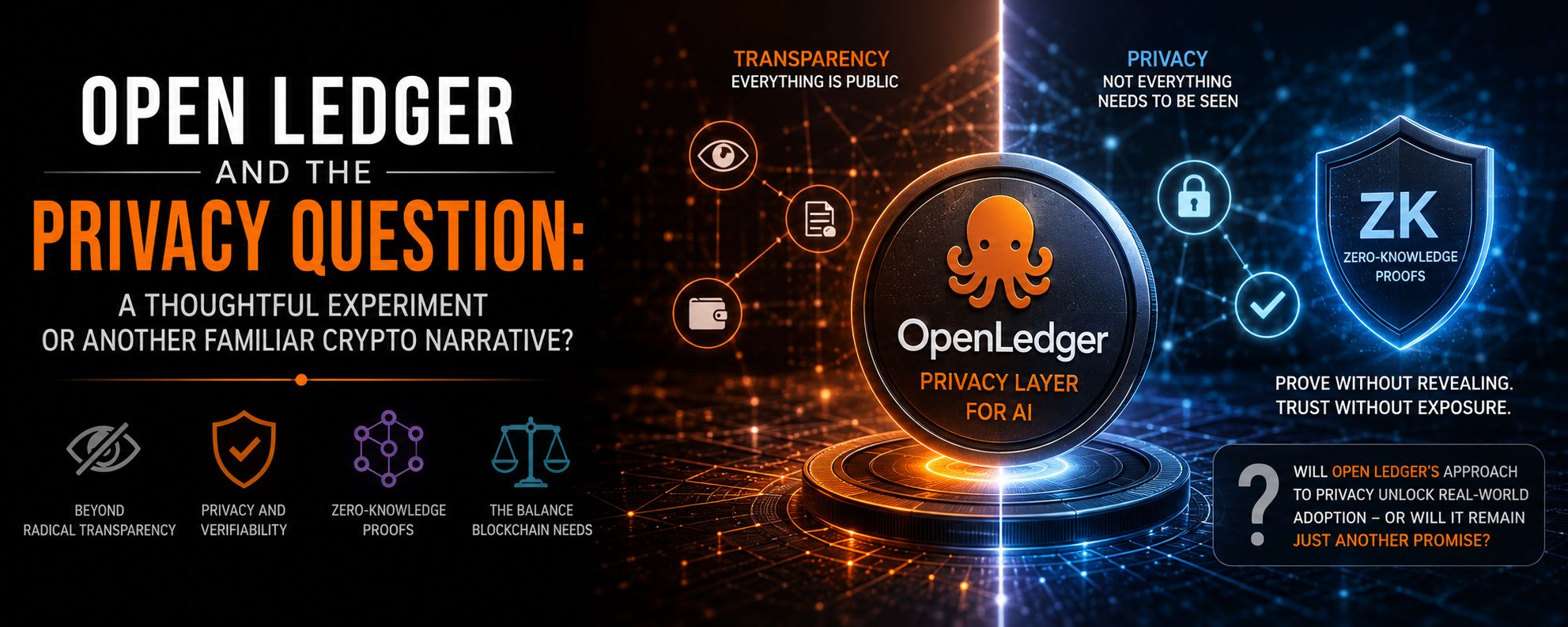
What draws my attention is not the token, the market speculation, or even the broader AI narrative often attached to the project. The more interesting question sits deeper within the architecture itself. Open Ledger appears to be asking whether blockchain systems can move beyond the industry's long-standing assumption that radical transparency is always desirable.
For most of blockchain's history, transparency has been treated almost as a sacred principle. Every transaction can be inspected. Every wallet can be tracked. Every interaction becomes part of a permanent public record. This level of visibility is often presented as one of blockchain's greatest strengths because it allows anyone to independently verify activity occurring on the network.
In theory, this sounds compelling.
In practice, the picture becomes more complicated.
The longer I observe how blockchain systems are used, the more I wonder whether complete transparency is actually suitable for mainstream adoption. Transparency works well when users are experimenting with technology, managing small amounts of capital, or participating in open communities where visibility is expected. It becomes less attractive when blockchain begins interacting with larger organizations, businesses, institutions, or ordinary individuals who may not want every financial action permanently exposed.
Imagine operating a business where competitors can observe supplier payments. Imagine negotiating large transactions while outside observers monitor every movement. Imagine personal financial activity becoming permanently visible to anyone willing to spend enough time analyzing blockchain data.
The industry often celebrates transparency without fully acknowledging the practical discomfort that comes with it.
This is where Open Ledger's upcoming Phase 1 becomes interesting from a structural perspective.
Rather than treating privacy and transparency as mutually exclusive concepts, the project appears to be exploring a middle ground through the use of zero-knowledge proofs. The underlying idea is straightforward, even if the technology itself is highly sophisticated. Information can be verified without necessarily revealing the information itself.
In other words, a system can prove that something is true without exposing every detail behind that truth.
Conceptually, this is one of the more elegant developments to emerge from blockchain research over the past several years. It addresses a tension that has existed since the industry's earliest days. Users want trustless verification, but they also want a degree of privacy. Businesses want accountability, but they do not necessarily want complete exposure. Developers want transparent systems, but they also recognize that transparency can create practical limitations.
Open Ledger seems to be positioning itself around this balance.
The ambition is understandable. If blockchain technology is ever going to support broader real-world activity, some form of privacy infrastructure will likely be necessary. Complete visibility may satisfy ideological preferences within crypto communities, but it does not automatically satisfy the requirements of everyday users.
Yet this is where experience encourages caution.
One lesson repeated throughout blockchain history is that elegant architecture does not guarantee successful adoption.
The industry is filled with projects that solved theoretical problems beautifully while struggling to solve practical ones. Whitepapers often describe systems that appear logically sound. Technical diagrams look impressive. Design choices make sense when discussed among developers and researchers.
Then real users arrive.
That is usually where the true test begins.
Privacy systems introduce complexity. Zero-knowledge technologies can reduce information exposure, but they also introduce additional layers of abstraction. Developers must learn new tools. Applications must integrate unfamiliar frameworks. Users must understand new concepts, even if only indirectly.
Every additional layer creates friction.
Sometimes that friction remains manageable. Sometimes it becomes the reason adoption never reaches meaningful scale.
This is one of the questions I find myself asking when looking at Open Ledger's upcoming Phase 1. The technology may be capable of balancing privacy and verifiability. The architecture may successfully address legitimate weaknesses in traditional blockchain transparency. The engineering may even function exactly as intended.
But will people actually use it?
That question sounds simple, yet it has quietly defeated many projects over the years.
Demand for privacy is often discussed as if it is universal. I am not entirely convinced. Some users care deeply about privacy. Others care primarily about convenience. Many simply follow whichever applications offer the smoothest experience. Technical superiority alone rarely determines winners.
There is also the possibility that blockchain's transparency problem is less urgent than privacy-focused builders assume. Developers may prioritize speed over privacy. Businesses may continue relying on traditional systems. Users may decide that public visibility is an acceptable tradeoff for simplicity.
These possibilities do not invalidate Open Ledger's approach. They simply remind us that solving a problem and creating demand for the solution are not necessarily the same thing.
What I find most compelling about Open Ledger is not that it claims to have all the answers. It is that the project appears focused on a question the industry will eventually need to confront. If blockchain technology continues evolving beyond speculation and enters more practical forms of usage, privacy will likely become increasingly important. The challenge is determining how much privacy users actually need and how much complexity they are willing to tolerate in exchange.
That balance has proven difficult for nearly every technological system that has attempted to achieve it.
As Phase 1 approaches, I find myself less interested in announcements and more interested in behavior. I want to see how developers interact with the tools. I want to see whether applications emerge that genuinely benefit from this architecture. I want to see whether privacy becomes a feature people actively seek out or merely a concept that sounds appealing during discussions about the future.
The crypto industry has never lacked ambitious ideas. What it has often lacked is the ability to translate those ideas into habits that ordinary users adopt naturally.
Open Ledger may ultimately demonstrate that privacy and verifiability can coexist in a practical and sustainable way. It may also discover that the gap between theoretical elegance and real-world adoption is wider than expected.
For now, that uncertainty is precisely what makes the project worth watching. Not because success is guaranteed, but because the outcome may reveal something important about blockchain itself. After years of promises, experiments, and abandoned narratives, the question is no longer whether privacy can be built into blockchain systems. The more interesting question is whether enough people will care once it arrives, and whether Open Ledger can withstand the long-term pressure of real-world adoption after the initial curiosity fades away.
