
I started poking around @OpenLedger . Not for any real reason. Someone mentioned it in passing and I half-dismissed it, assuming it was another "decentralized AI" project with a whitepaper full of promises and not much else.
But then something stopped me.
Most of the conversation around AI and blockchain goes like this: let's put AI outputs on-chain, make them verifiable, blah blah blah. It's a familiar loop. I've read it a hundred times.
OpenLedger is doing something different — and it took me a while to actually see it.
The thing they're focused on isn't the AI output. It's the data that trained the AI in the first place.
And here's where it clicked for me:
Every AI model running right now was trained on data that came from somewhere. Articles, books, conversations, research, images — all of it created by people. And almost none of those people got anything for it. The data just got scraped, processed, absorbed, and the value got concentrated somewhere else entirely.
OpenLedger is essentially asking: what if you could trace that?
Not in some theoretical future — but as an actual on-chain attribution layer. Every dataset, every contribution, tracked and tied to something real. If a model's output can be traced back to specific data inputs, those data contributors could — in theory — be compensated.
I thought I understood this when I first read it. But actually, I didn't.
I was thinking about it like a royalty system. Like Spotify for data. But that's not quite it.
It's more like… proof of origin for intelligence. The model doesn't just exist as a black box. There's a ledger underneath it — a record of what went in, who contributed it, what weight it carried.
That's genuinely weird to think about. Because it implies that AI models aren't just tools. They're accumulated value — and right now, there's no mechanism to acknowledge where that value came from.
But here's the part that bothers me.
Attribution sounds clean in theory. In practice, how do you actually measure the contribution of one dataset against millions of others? If someone's writing was in a training corpus of 10 billion tokens, what's their share worth? Who decides the weighting? Who audits it?
I'm not fully convinced this holds under pressure. The moment you introduce any kind of reward mechanism tied to data quality, you get people gaming it. Low-quality data floods in, dressed up to look useful. We've seen this pattern everywhere — play-to-earn, liquidity mining, yield farming. Every time a reward system launches without airtight quality controls, the incentive structure gets exploited almost immediately.
And there's another thing I keep coming back to: the AI labs that actually need this data aren't exactly lining up to participate in attribution systems. They've operated without it for years. Why change now unless something forces them to?
Maybe regulation forces it. Maybe a competitor who does use attribution builds better models because contributors are more engaged. Maybe it just takes time.
Or maybe it stays a beautiful idea that never fully scales.
What I do think is real: the framing shift matters, even if the execution takes a decade.
Right now, data is treated like a raw material — free to extract, no credit owed. If OpenLedger (or anything like it) normalizes the idea that data has traceable, compensable value, that changes the negotiation. For developers, for contributors, for the AI companies themselves eventually.
It probably matters most in specialized domains first. Medical data. Scientific research. Legal documents. Places where data provenance already matters for other reasons — and where the contributors are identifiable and motivated to participate.
That's probably where you'd see proof-of-concept before it touches anything broader.
Anyway. Charts still look shaky. I'll probably just keep watching this one from the side for now — curious whether the attribution mechanism actually gets stress-tested at any real scale, or whether it stays elegant on paper.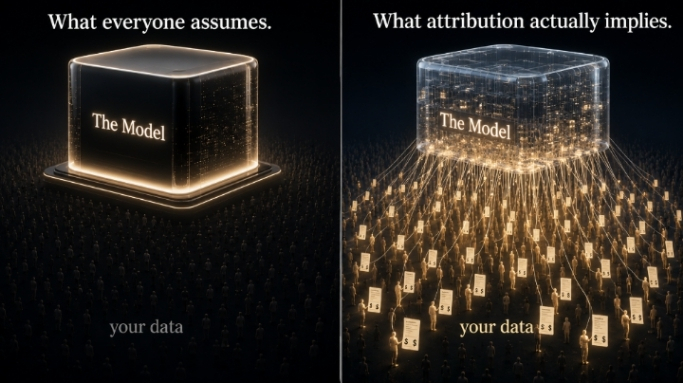
Still thinking about it though. That's usually a sign something's there.
