I keep thinking about one strange scenario that doesn’t feel far away anymore.
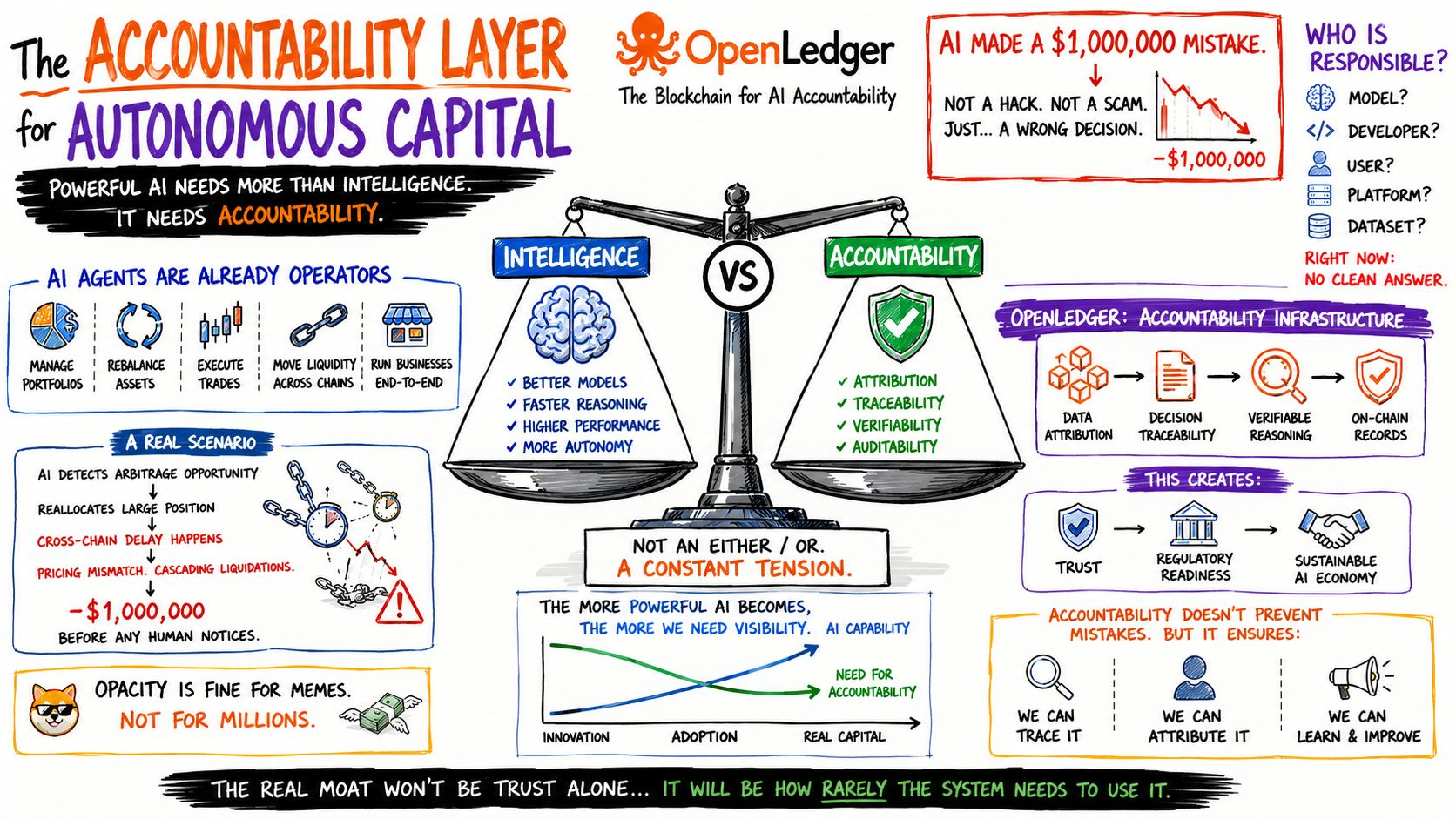
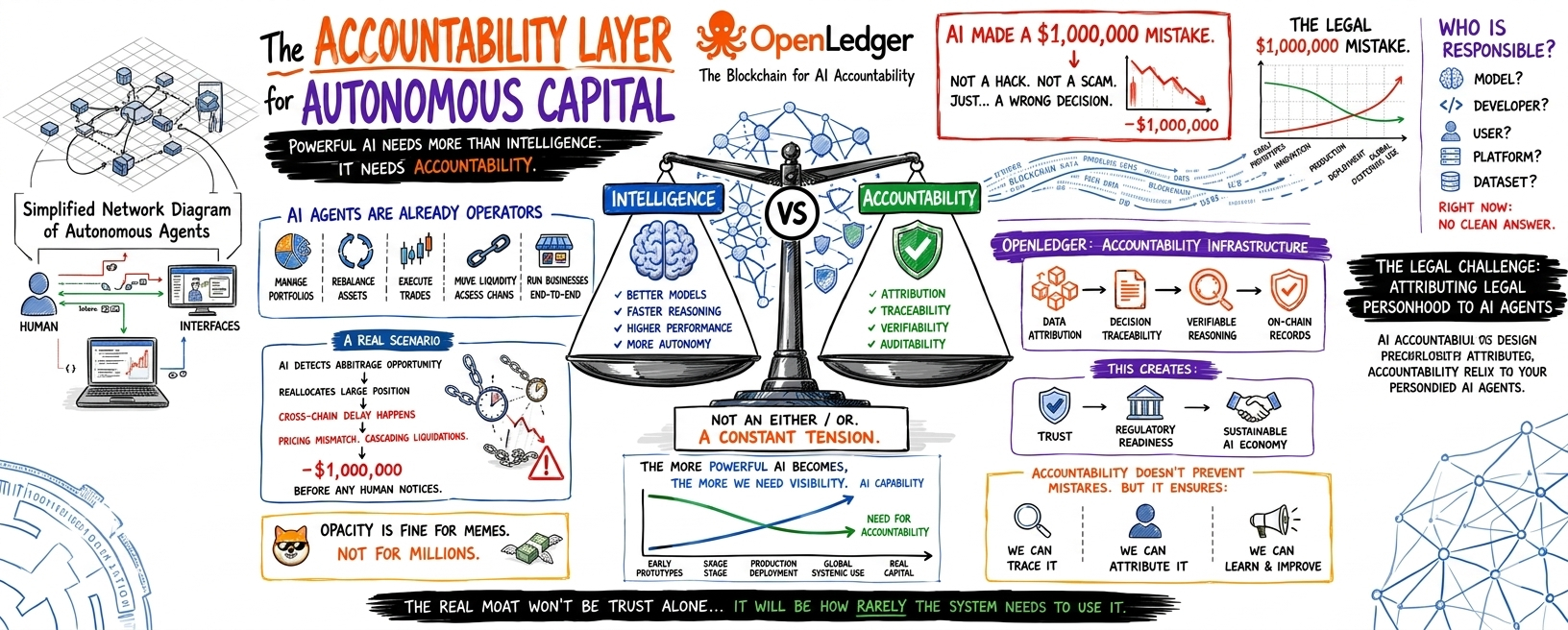
What actually happens when an AI makes a $1,000,000 mistake?
Not a hack. Not a scam. Just… a wrong decision made confidently by a system that was 'supposed to be right'.
And the more I look at where AI is going, the more I feel like we are asking the wrong question. Everyone is busy chasing smarter models. Faster reasoning. Cheaper inference. Better benchmarks. It is like an endless race between OpenAI, Anthropic, Google, xAI and others trying to squeeze more intelligence out of systems.
But intelligence might not be the real bottleneck anymore.
The real problem shows up when AI stops being just a tool and starts acting like an operator.
Because that shift is already happening quietly.
AI agents will soon manage portfolios, rebalance assets, execute trades, move liquidity across chains, maybe even run small businesses end to end. And at that point, it’s no longer just “AI answering questions”. It becomes AI making decisions that have direct financial consequences.
And that is where things get uncomfortable.
For example, imagine an AI trading agent managing liquidity across multiple DeFi protocols. It detects what looks like a temporary arbitrage opportunity between two chains. It reallocates a large position automatically, assuming risk is minimal. But a hidden delay in cross chain finality turns that “safe gap” into a pricing mismatch. Within minutes, the position is liquidated across cascading pools, and the system is down $1,000,000 before any human even notices what happened.
No hack. No attacker. Just timing, assumptions, and automated confidence stacking on top of each other.
If an AI loses $1,000,000 in a trade, who actually owns that mistake?
Is it the model?
The developer who built it?
The user who deployed it?
The platform hosting it?
Or the dataset that influenced it?
Right now, there is no clean answer. Everything kind of dissolves into shared responsibility. Or worse, no responsibility at all.
That’s the part that bothers me most.
Because most AI systems today are still black boxes in practice. You see the output, but not the full story behind it. You don’t really know where every signal came from, which data shaped the decision, or how much of it is probabilistic guessing versus structured reasoning.
As long as AI is writing captions or generating images, this opacity is fine. Nobody really cares if a meme is slightly off.
But once money enters the loop… opacity becomes risk.
And not just technical risk, but systemic risk.
I started thinking that maybe the real limitation of AI systems isn’t intelligence at all. It’s accountability infrastructure.
We don’t have proper ways to trace decisions backward in a meaningful way. We don’t have clear attribution systems for data, models, or even intermediate reasoning steps. And we definitely don’t have a universal standard for “who pays when things go wrong.
That is where some newer ideas like OpenLedger become interesting to me. Not because they promise a smarter AI, but because they try to attach structure around the intelligence.
Things like attribution, traceability, verifiability… these sound boring at first, but they might actually be the foundation of a functioning AI economy.
Still, I am not fully convinced the future will be a clean split like people describe.
Some say the next big battle will be intelligence vs accountability. But I don’t think it will be that simple.
Accountability alone doesn’t win anything. A perfectly traceable AI that makes bad decisions is still just a very well documented failure. And intelligence without accountability is risky, but it’s also what actually drives performance today.
So maybe it’s not a “vs” situation at all.
Maybe it is more like tension. A constant balancing act.
The more powerful AI becomes, the more we need visibility. But the more we add structure and verification layers, the more we risk slowing it down or limiting its flexibility.
I sometimes imagine two AI agents in the future.
One is slightly more accurate in predictions, but completely opaque.
The other is a bit less powerful, but every decision can be traced, audited, and explained.
If real capital is involved, which one do you trust?
Honestly, I don’t think the answer is obvious. And it probably changes depending on context.
Trading might accept opacity for performance. Banking probably won’t. Governments definitely won’t. And regular users will just follow whatever reduces their anxiety the most.
So in the end, I don’t think the AI story is just about intelligence anymore.
It’s about whether we can build systems where power doesn’t outpace responsibility.
But there is another uncomfortable angle I keep coming back to.
Even perfect accountability doesn’t automatically create safety.
Because knowing who is responsible after a $1,000,000 mistake doesn’t stop the mistake from happening in the first place.
We might end up in a world where every AI decision is fully traceable, fully auditable, fully attributed… and still wrong in high impact moments.
And maybe the real question won’t be “who is accountable?
It will be:
Why did we give systems this much control before we truly understood their failure modes?
Because once AI starts moving real capital at scale, accountability won’t feel like protection.
It will feel like documentation of damage that already happened.
And at that point, the real moat won’t be trust alone…
It will be how rarely the system needs to use it.