Iran on Monday announced it was cutting off all message exchanges with Washington and threatening to completely close the Strait of Hormuz in retaliation for ceasefire violations.
This was after the U.S. and Iran exchanged strikes over the weekend, with U.S. Central Command confirming Monday that American forces intercepted two Iranian ballistic missiles overnight that were targeting U.S. troops in Kuwait.
Adding to this backdrop, the Israeli Prime Minister intensified his invasion and bombing of Lebanon — seizing more territory and ordering strikes on Beirut's suburbs.
Iran's negotiating team made its position explicit. In light of the continuation of Israeli military operations in Lebanon — which Tehran had set as a precondition for any ceasefire — and with the ceasefire now violated across all fronts, including Lebanon, Iran formally suspended talks.
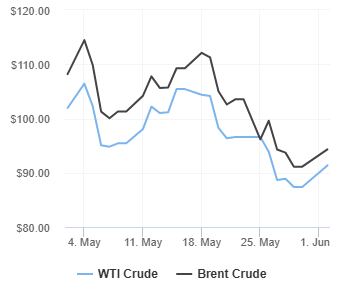
Trump told CNBC he simply "doesn't care" if the talks collapse entirely. His exact words about the negotiations: "the talks were starting to get very boring." Oil didn't share that sentiment. WTI surged more than 5% to close at $92.16 per barrel. Brent advanced more than 4% to settle at $94.98.
Markets that would ordinarily buckle under that kind of geopolitical pressure did something different on Monday. The AI trade completely overpowered the oil spike.
The reason was Taiwan. At the Computex conference, Nvidia CEO Jensen Huang unveiled the RTX Spark superchip, developed alongside Microsoft, describing it as a full "reinvention" of the PC.
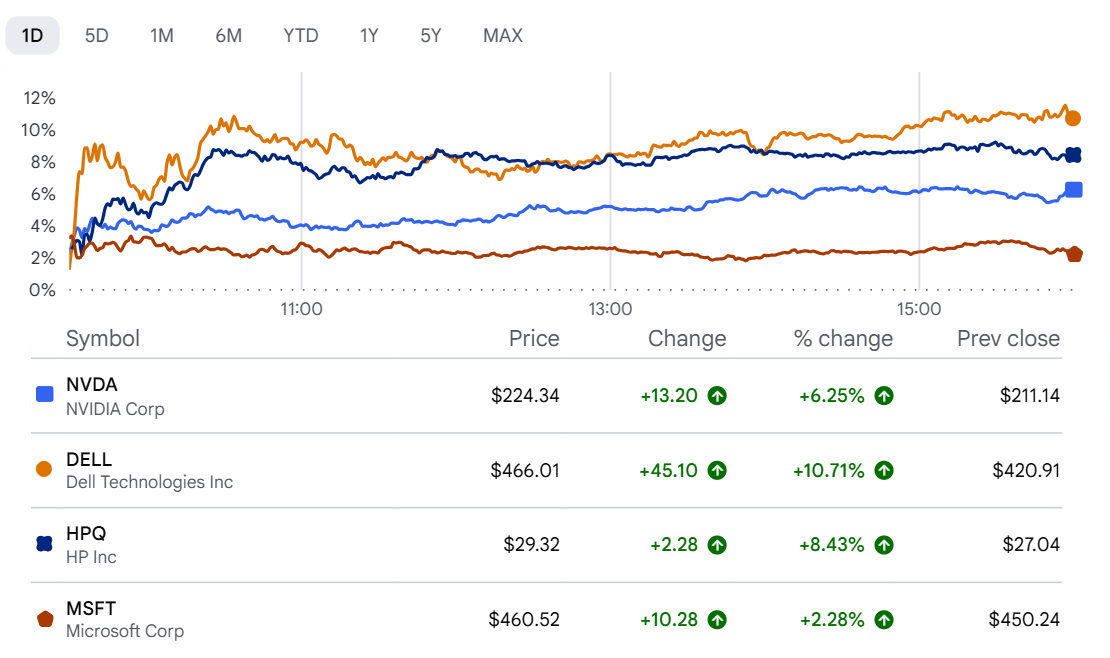
Agentic AI will run natively across every computer powered by the new chip when it hits the market this fall. The market's reaction was immediate. Nvidia surged more than 6%. Dell jumped more than 10%. HP climbed more than 8%, while Microsoft rose by 2.28%.
Anthropic then added another wave of excitement. The company confidentially filed its IPO prospectus, setting up what could be a landmark share sale. The numbers behind it are striking — revenue run rate has reached $47 billion this year, up from $10 billion in 2025. Last week, Anthropic closed a funding round at a $965 billion valuation.
SoftBank CEO Masayoshi Son told CNBC's Arjun Kharpal that the AI revolution is 50 times bigger than the dot-com era. Those weren't just words. SoftBank announced an investment of 45 billion euros, approximately $53 billion, to build AI infrastructure in France — part of a broader 75-billion-euro program targeting 5 gigawatts of AI data center capacity across the country.
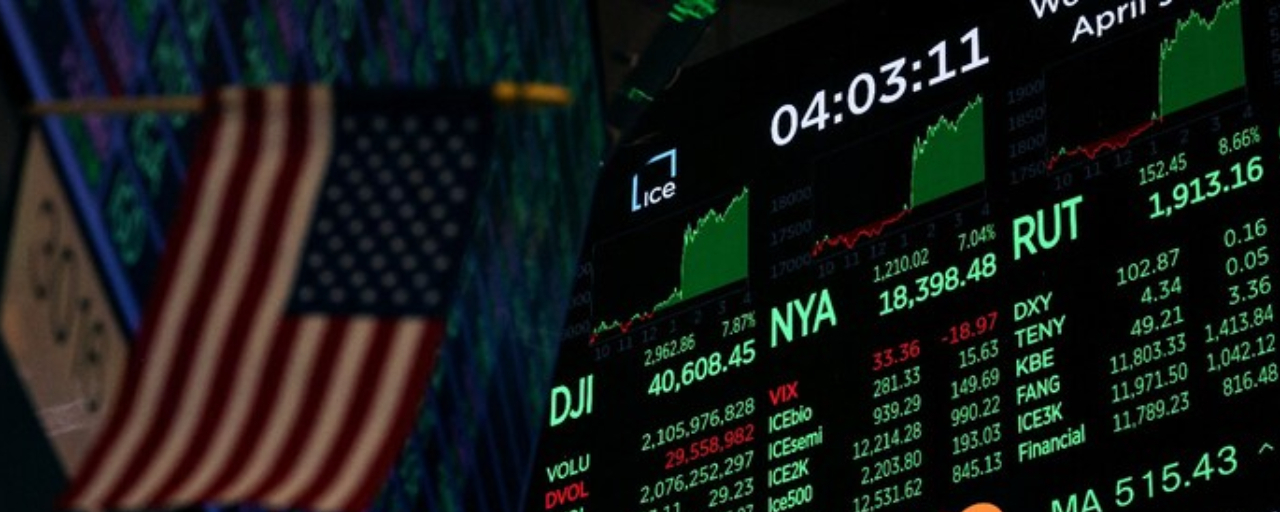
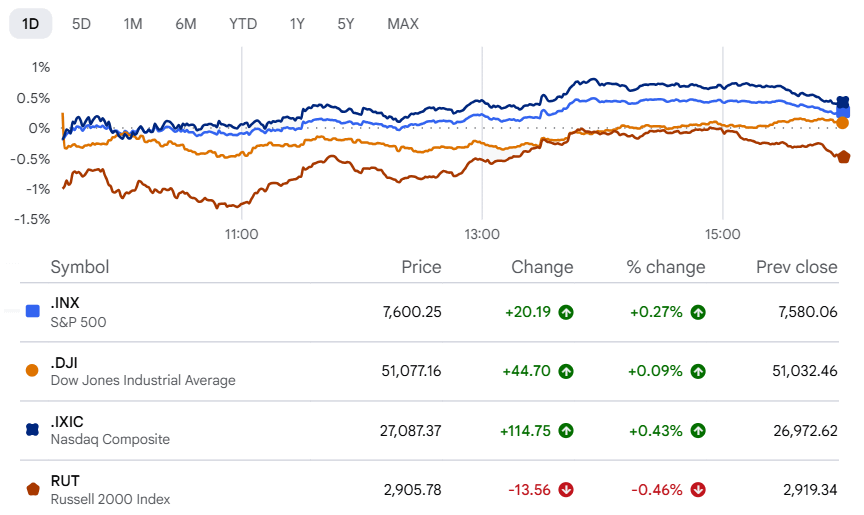
The indexes reflected the mood. The broad S&P 500 advanced 0.26% to close at a record 7,599.96, opening June on a strong note. The tech-heavy Nasdaq gained 0.42% to finish at 27,086.81. The 30-stock Dow Jones Industrial Average added 46.42 points or 0.09% to close at 51,078.88. All three hit fresh intraday all-time highs and closed at records.
The Russell 2000 was the lone decliner, closing at 2,905.78, down 0.46%. The oil spike reignited sticky inflation concerns immediately, pushing bond yields higher as traders priced in the Fed staying elevated for longer. Small-cap companies rely heavily on borrowing to fund operations, with a significant portion of that debt tied to floating rates. When yields jump, their debt-servicing costs rise instantly — compressing already-thin profit margins in a way that tech giants simply don't face.
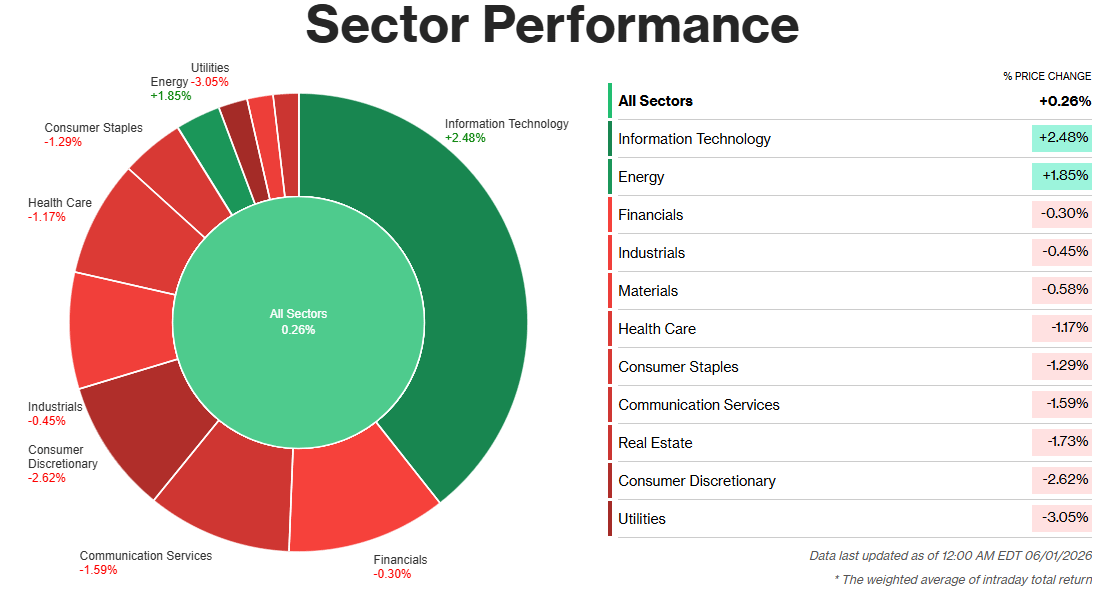
Sector Analysis:
Information Technology +2.48%: Nvidia's new AI superchip launch at Computex lifted the entire semiconductor space. The bigger story was software — ServiceNow jumped 9% after analysts argued AI would accelerate its business rather than displace it, triggering sympathy rallies across Oracle, Adobe, and CrowdStrike. The SaaS disruption narrative just got a serious rebuttal.
Energy +1.85%: WTI spiked 5% to $92 a barrel as U.S.-Iran peace talks stalled and supply uncertainty returned. Capital rotated back into energy names quickly — that's what a 5% crude move does.
Consumer Discretionary -2.62%: Oil at $92 directly threatens consumer wallets. Combined with slowing real income growth and depleted household savings, investors sold consumer cyclicals aggressively on fears that demand was about to weaken meaningfully.
Utilities -3.05%: Worst performer of the day. Oil spiked, inflation fears returned, bond yields moved higher — and utilities, a rate-sensitive, dividend-heavy sector, immediately lost its appeal. Investors rotated out quickly toward faster-growing parts of the market.