
A few nights ago I found myself jumping between AI infrastructure discussions and on-chain dashboards. Not because I was looking for anything specific,
but because sometimes patterns become visible when you stop chasing headlines and start watching how systems actually behave.
At first, everything looked familiar.
New AI protocols. New agent frameworks. New claims about autonomous economies and decentralized intelligence.
The language changes every few months, but the underlying promise often stays the same: smarter models will create more value.
The more I thought about it, the less convinced I became that intelligence is the real bottleneck.
What if the harder problem is economic coordination?
AI today is built by an enormous network of contributors who rarely share the same incentives.
Data contributors, model developers, compute providers, application builders, researchers, and users all participate in value creation. Yet most of them operate in separate environments with separate reward systems.
The final product gets attention.
The process that created it often disappears.
That feels increasingly important because intelligence itself is becoming more accessible. Models are improving faster, costs are falling, and open-source alternatives continue to close gaps that once looked impossible to bridge.
When intelligence becomes abundant, scarcity moves elsewhere.
It moves toward ownership.
It moves toward attribution.
It moves toward understanding who contributed value and how that value should be rewarded.
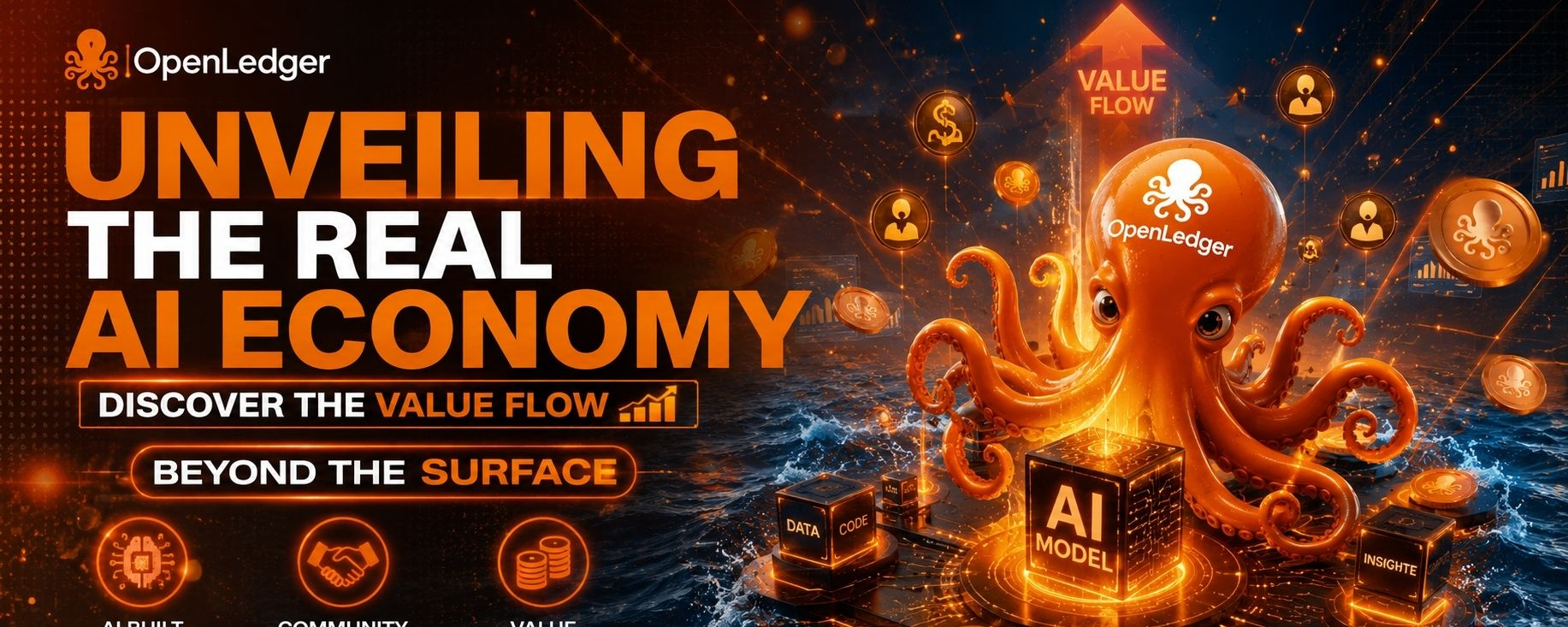
This is one reason OpenLedger caught my attention.
Not because it claims to build better intelligence than everyone else, but because it appears focused on the economic structure around intelligence production.
That distinction matters.

Most discussions around AI infrastructure focus on model capability. OpenLedger seems more interested in making contributions measurable and economically visible.
The challenge is not simply creating intelligence. The challenge is creating systems where contributors can participate in the value generated by that intelligence.
That sounds simple until you examine how difficult attribution becomes in practice.
Useful data rarely arrives in a neat package.
Model improvements often come from thousands of small inputs.
Some contributions become valuable immediately. Others only reveal their importance months later.
Trying to track all of this introduces complexity, and complexity creates opportunities for manipulation.
Every incentive system eventually attracts behavior designed to maximize rewards rather than maximize usefulness.
Crypto has shown this repeatedly.
People optimize for the metric.
Then the metric starts drifting away from the original goal.
The question is never whether this happens.
The question is whether a system can continue functioning when it does.
That may be the real test for AI infrastructure moving forward.
Not whether it can operate under perfect conditions, but whether it remains useful when participants aggressively search for edge cases, loopholes, and economic advantages.
Because that pressure is unavoidable.
What makes the conversation interesting is that AI assets do not behave like traditional assets. Data, models, and agents all have different lifecycles. Some become obsolete quickly. Others remain valuable for years in specialized environments.
Yet markets often attempt to treat them as if they belong inside the same liquidity framework.
That mismatch creates friction.
And friction usually points toward unsolved problems.
Maybe the next phase of AI is less about building smarter systems and more about building better economic rails around the people who contribute to those systems.
Rights.
Provenance.
Attribution.
Reward distribution.
Ownership.
These topics sound less exciting than model benchmarks, but they may end up defining how value actually moves across the AI economy.
I'm not certain any single project has solved this yet.
But I increasingly suspect that the future of AI infrastructure will be determined not only by who creates intelligence, but by who creates the fairest and most durable system for distributing the value that intelligence generates.
That is the idea I keep returning to.
And for now, I'm still watching.