
I’ve been thinking about something that most people in AI and crypto rarely stop to question.
We keep hearing the same story every day AI is getting bigger, smarter, faster. New models, better reasoning, higher benchmarks, improved performance. It feels like an endless race where progress is measured only in technical upgrades.
But somewhere in all of this noise, a deeper question quietly gets ignored.
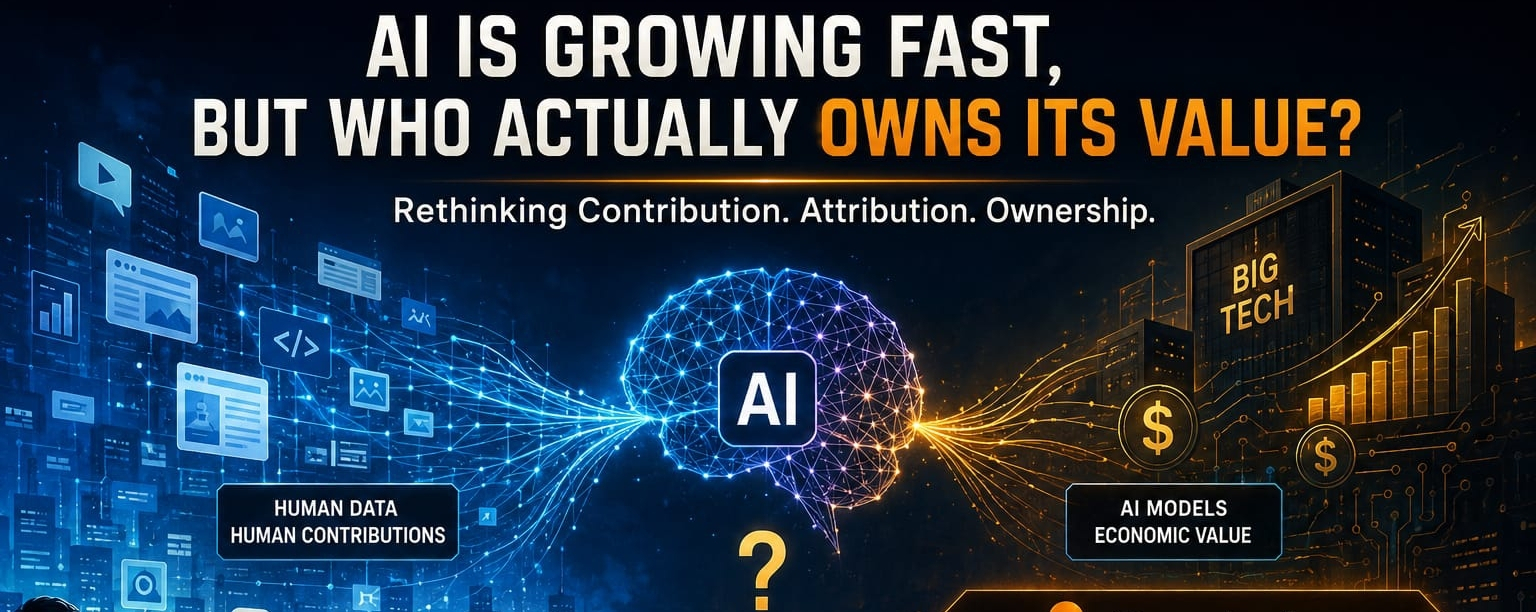
Who is actually creating the value behind AI?
Because if you strip everything down, AI doesn’t exist in isolation. It doesn’t magically produce intelligence out of nowhere. It learns from something far more fundamental data.
And that data is human at its core.
It comes from the internet we all interact with daily. Conversations people have, articles written, code shared, research published, mistakes made, corrections added, opinions expressed, creativity explored. A massive, continuous stream of human activity.
All of that becomes the foundation of modern AI systems.
But here’s where things start to feel a bit unfair.
When AI systems turn that data into massive economic value, most of that value flows toward a small group of model owners and large companies. The people whose data actually made it possible? They usually remain invisible in the final outcome.
That imbalance is what pushed me to look deeper into how this system could evolve.
One project I came across was OpenLedger.
At first, it felt like just another name in the growing list of AI + blockchain projects. And honestly, many of those projects don’t go beyond buzzwords.
So my expectations were low.
But the interesting part is not what it claims it’s the direction it tries to explore.
Instead of asking, “How do we build better AI models?” the focus shifts to something more fundamental:
How do we build an AI economy where contribution itself can be measured, tracked, and rewarded?
That one shift changes the entire conversation.
Because now AI is not just a technology problem anymore. It becomes an economic and ownership problem.
One of the core ideas here is something called “datanets.”
Instead of treating data as something silently collected and consumed by models, it becomes something actively contributed. People can create, verify, and refine data specifically for AI systems.
That sounds simple, but the implication is powerful.
Data stops being invisible fuel and starts becoming recognized contribution.
Then comes another layer the “Model Factory.”
Right now, building AI models is still locked behind technical complexity. Even with tools available, the barrier is high for most people. You need skills, infrastructure, and resources.
The Model Factory idea tries to lower that barrier so more builders can experiment, create, and contribute without needing massive setups.
If that works even partially, innovation stops being limited to big labs and starts spreading to independent builders.
But the most interesting and the hardest part is “Proof of Attribution.”
Today, AI models work like black boxes. We see the output, but we don’t really know how different pieces of data influenced that output.
Everything gets compressed, blended, and hidden inside model weights.
Proof of Attribution tries to change that by estimating how much specific data sources contributed to a given AI output.
And if you can measure contribution even approximately it opens a completely new economic model.
A system where contributors can be rewarded based on their actual impact on AI outputs.
That’s a massive shift in thinking.
Because it means AI value is no longer captured only at the top. It can be distributed across the entire contribution chain.
There’s also a practical advantage that makes this idea easier to adopt.
With EVM compatibility, developers don’t need to learn a completely new ecosystem. They can build using familiar Ethereum tools, wallets, and smart contracts Ethereum.
That reduces friction, and in real-world adoption, friction is often the biggest barrier not innovation.
The $OPEN token then ties everything together used for fees, rewards, inference, and governance. Instead of being just a trading asset, it becomes part of the system’s internal flow.
So in theory, everything forms a loop: contribution, usage, reward, and reinvestment.
But it’s also important to stay grounded here.
Because systems like this are extremely hard to execute in reality.
The first challenge is attribution accuracy. If you cannot reliably measure contribution, then fairness becomes questionable.
The second challenge is adoption. Even strong ideas fail if developers and users don’t actively participate.
The third challenge is output quality. At the end of the day, users don’t care about economic design they care about whether the AI actually performs well.
So what we’re really looking at is not a finished solution, but an evolving experiment.
Still, the direction itself is interesting.
A loop where better data improves models, better models attract usage, and usage brings more contributors back into the system.
A self-reinforcing cycle.
And that’s why this feels bigger than just another AI or blockchain narrative.
It feels like an attempt to rethink how intelligence itself should be owned and shared.
Whether OpenLedger fully succeeds or not is still uncertain.
But one thing is becoming clearer as AI evolves:
The real conversation is shifting.
Away from just “how powerful AI becomes”
Toward something deeper:
Who built it. Who feeds it. And who actually benefits from it.
And maybe, in the long run, that will matter more than any benchmark or model score we celebrate today.