
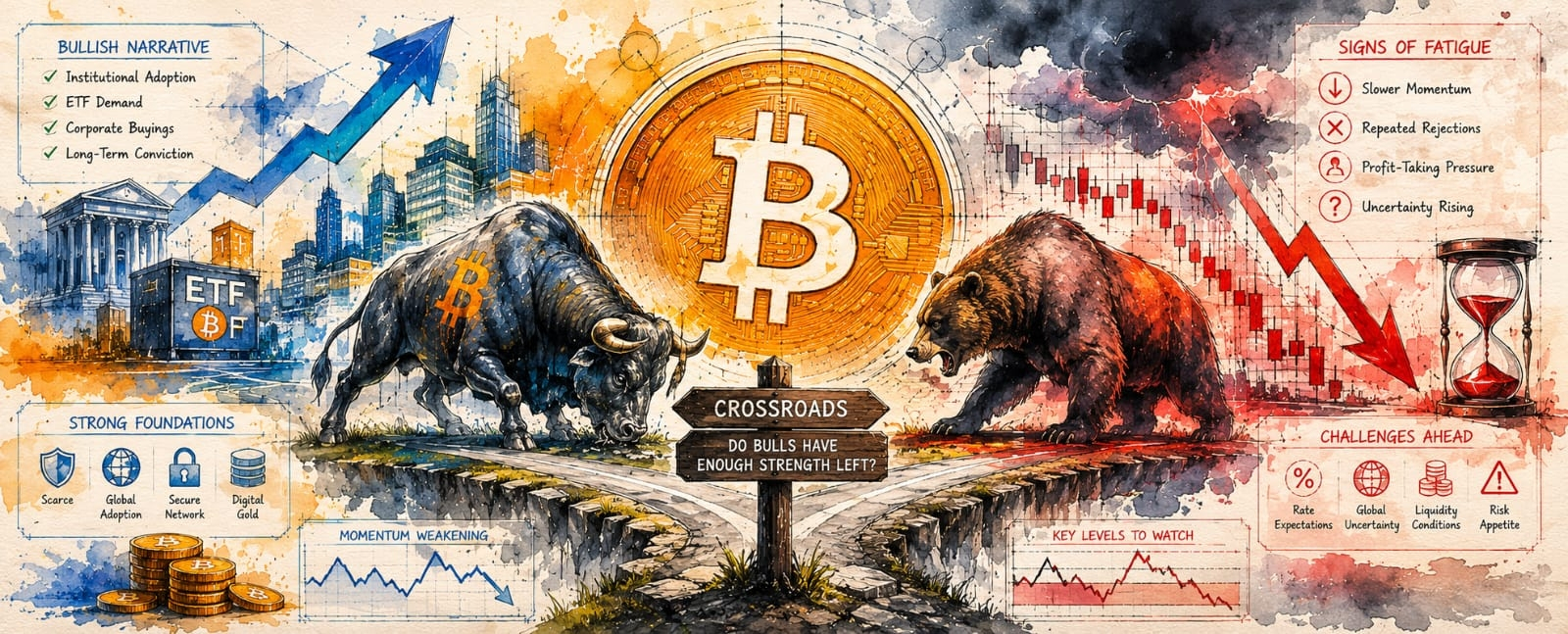
@Bitcoin For much of this cycle, Bitcoin has enjoyed a powerful narrative. Institutional adoption has accelerated, spot #etf demand has brought fresh capital into the market, and corporate buyers continue adding $BTC to their balance sheets. On the surface, the long-term story remains intact.
Yet markets don't move on long-term narratives alone.

Recently, #bitcoin has begun showing signs of fatigue that traders cannot ignore. Price continues hovering near important levels, but momentum appears noticeably weaker than it was during earlier stages of the rally. Instead of aggressive breakouts, the market is seeing slower advances, repeated rejections, and growing uncertainty around the next major move.
What makes this situation challenging for bulls is that expectations remain extremely high. After months of strong performance, many investors have become accustomed to viewing every dip as a buying opportunity. That strategy works well during powerful uptrends, but markets eventually reach a point where buyers need fresh reasons to stay aggressive.
At the moment, those reasons are becoming harder to find.
Institutional demand remains strong, but it is no longer a surprise. ETF inflows continue attracting attention, yet they are increasingly viewed as part of the normal market structure rather than a new catalyst. Corporate accumulation stories generate headlines, but their ability to drive sustained upside appears smaller than it was earlier in the cycle.
Meanwhile, profit-taking pressure is beginning to emerge. Long-term holders sitting on substantial gains have little incentive to chase prices higher, while short-term traders are becoming more sensitive to signs of weakness. This creates an environment where every failed breakout attracts additional caution.
There is also a broader macroeconomic backdrop influencing sentiment. Interest rate expectations, global liquidity conditions, and geopolitical uncertainty continue shaping investor behavior across multiple asset classes. Bitcoin may have matured significantly, but it remains connected to the wider financial system. When risk appetite weakens, crypto rarely remains completely unaffected.
The key issue isn't that Bitcoin has suddenly become bearish. The larger trend still favors long-term strength. The concern is that momentum and trend are not the same thing. Markets can remain bullish over long periods while experiencing painful corrections and extended consolidation phases along the way.
That distinction matters because many traders entered the market expecting a straight path higher. Historically, Bitcoin has rarely rewarded that assumption. Some of its strongest bull markets included sharp pullbacks that temporarily convinced participants the rally was over.
The current environment feels increasingly similar. Bulls are not necessarily losing control, but they are being forced to work harder to maintain it. Every attempt to push higher requires more buying pressure than before, while sellers appear increasingly willing to challenge advances.
For now, Bitcoin remains at a crossroads. A renewed wave of demand could quickly restore confidence and send prices toward new highs. But if momentum continues fading, the market may need a deeper reset before the next major leg upward begins.
That is why the conversation is changing. The question is no longer whether Bitcoin has a strong long-term story.
The question is whether bulls have enough strength left to keep that story moving forward right now.
#BitcoinTwoMonthLowStocksHitATH
