
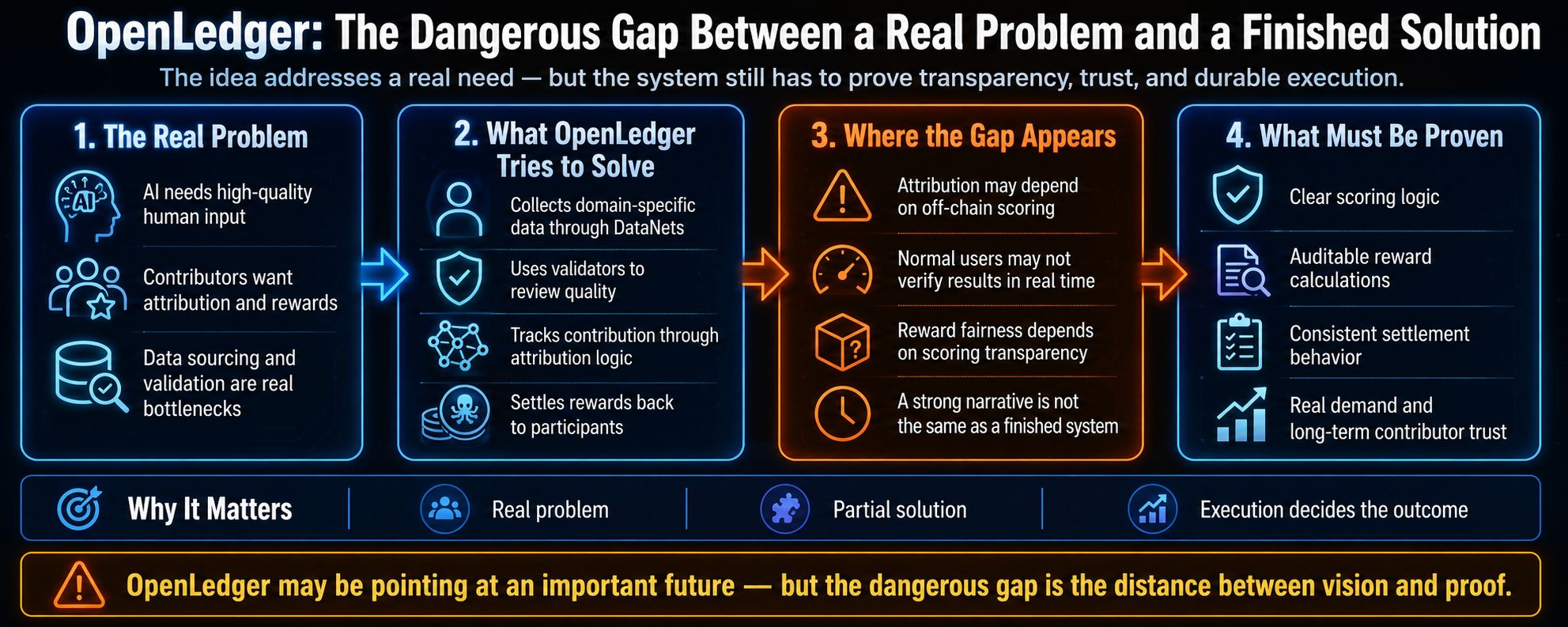
I’ve been watching OpenLedger for a while, and the more I study it, the more I feel the real question is not whether the idea is interesting.
The real question is much colder:
Can this system turn experiments into repeatable revenue?
That is where $OPEN starts to look complicated.
On the surface, OpenLedger has the kind of partnership list that usually makes retail traders pay attention. AI, DePIN, attribution, data ownership, gaming integrations, ecosystem collaborations — everything sounds aligned with the current market narrative. But after looking past the announcements, I’m not fully convinced that these partnerships have turned into a real commercial engine yet.
There is a huge difference between a pilot and a paying customer.
A pilot proves that a company is willing to test something.
A paying customer proves that the product is valuable enough to keep buying.
Right now, OpenLedger seems to have more evidence of the first than the second.
Take the gaming-related collaborations as an example. A project can test AI-based attribution or track digital activity through a proof mechanism, and that may be technically impressive. But if the result is a custom experiment rather than an ongoing paid service that continuously consumes the network, then the value for the token economy remains limited.
That is the part many people skip.
They see a known partner name and immediately treat it like revenue. But a collaboration headline is not the same as recurring demand. Integration is not the same as procurement. Ecosystem alignment is not the same as cash flow.
This is why I’m careful with the “Payable AI” narrative.
The concept sounds powerful. In theory, data contributors, model builders, agents, and users all interact inside a measurable economy where value can be tracked and paid for. On paper, that fixes one of the biggest problems in AI: attribution.
But markets do not reward theory forever.
At some point, the system has to show that real companies are willing to pay for this infrastructure at scale, not just explore it during early-stage pilots.
And that is where OpenLedger currently feels stuck.
The project is trying to build a full on-chain value layer for AI contribution. That is ambitious. It wants to verify who contributed what, measure impact, assign rewards, and make AI data monetization more transparent. I respect that direction because the AI industry clearly has a contribution problem. A lot of human work, user data, niche knowledge, and training material gets absorbed into models without clear compensation.
So the problem OpenLedger is pointing at is real.
But identifying a real problem does not automatically mean the project has found a finished business model.
That difference matters.
Traditional AI companies are very practical. They care about cost, speed, reliability, risk, and integration effort. If they can use a cheaper centralized API without dealing with token volatility, wallet infrastructure, on-chain settlement, or extra compliance complexity, they will usually choose the simpler path.
This is the uncomfortable part for Web3 AI projects.
Crypto users may care about ownership and attribution.
Enterprise buyers usually care about efficiency and reduced risk.
For OpenLedger to win commercially, it has to prove that its system is not only more transparent, but also necessary. Not just interesting. Not just innovative. Necessary.
Because without that necessity, the token economy becomes dependent on incentives rather than real demand.
And that is where the pressure starts building.
If contributors, validators, and node operators are mostly being rewarded through daily token emissions, then activity can look healthy even when business revenue is weak. People continue participating because they expect future upside. But that type of growth is fragile. It works while belief is strong and token prices are supportive. Once yields fall, costs rise, or the market stops rewarding the narrative, the same participants may begin calculating things more brutally.
Hardware cost.
Bandwidth cost.
Time cost.
Opportunity cost.
Token unlock pressure.
Actual revenue backing the system.
That is when a network learns whether it has true demand or just subsidized participation.
This is also why I don’t get overly excited by protocol announcements alone. A payment standard, ecosystem partnership, or technical framework can be useful, but it does not automatically mean customers are paying meaningful fees through the OpenLedger economy. Infrastructure only becomes valuable when someone repeatedly depends on it.
A protocol can be elegant and still under-monetized.
A dashboard can show activity and still lack durable value capture.
A token can have utility and still fail to receive meaningful demand from the actual business layer.
That is the contradiction I keep coming back to with $OPEN.
The project is technically trying to solve an important issue, but the market seems to be pricing in a level of commercialization that has not clearly appeared yet. The story feels bigger than the cash flow. The partnerships feel louder than the payment trail. The future value sounds promising, but the present revenue still needs to catch up.
And in crypto, that gap can become dangerous.
When a project depends on narrative, every announcement feels bullish.
When a project depends on revenue, every invoice matters more than every announcement.
That is the standard I think OpenLedger should be judged by now.
Not how many pilots it can announce.
Not how many ecosystem names it can attach to its roadmap.
Not how polished the “Payable AI” phrase sounds.
The real test is whether companies start paying for OpenLedger services consistently enough to create organic demand for the network.
Until then, retail participants are carrying most of the risk. They provide attention, liquidity, hardware, data, and belief while waiting for the business side to mature. Maybe that maturity comes. Maybe the pilots eventually turn into contracts. Maybe the attribution layer becomes valuable enough that AI companies cannot ignore it.
But I don’t think that should be assumed.
For now, I see OpenLedger as a project with a real thesis, real technical ambition, and a real commercialization problem.
That combination is not automatically bearish, but it does demand caution.
Because in the end, a Web3 AI project does not survive on vision alone. It survives when outside customers create enough demand that the token economy no longer has to depend mainly on emissions and speculation.
That is what I’ll be watching over the next few months.
Not the next partnership post.
Not the next big narrative push.
Not another polished ecosystem update.
I want to see real paid usage, visible revenue flow, and proof that OpenLedger can move from pilot excitement into repeatable business.
Until that happens, the biggest risk is simple:
OpenLedger may be solving a real AI problem, but still struggling to prove that the market is ready to pay for its solution.