A few days ago, I found myself thinking about something that sounded strange at first.
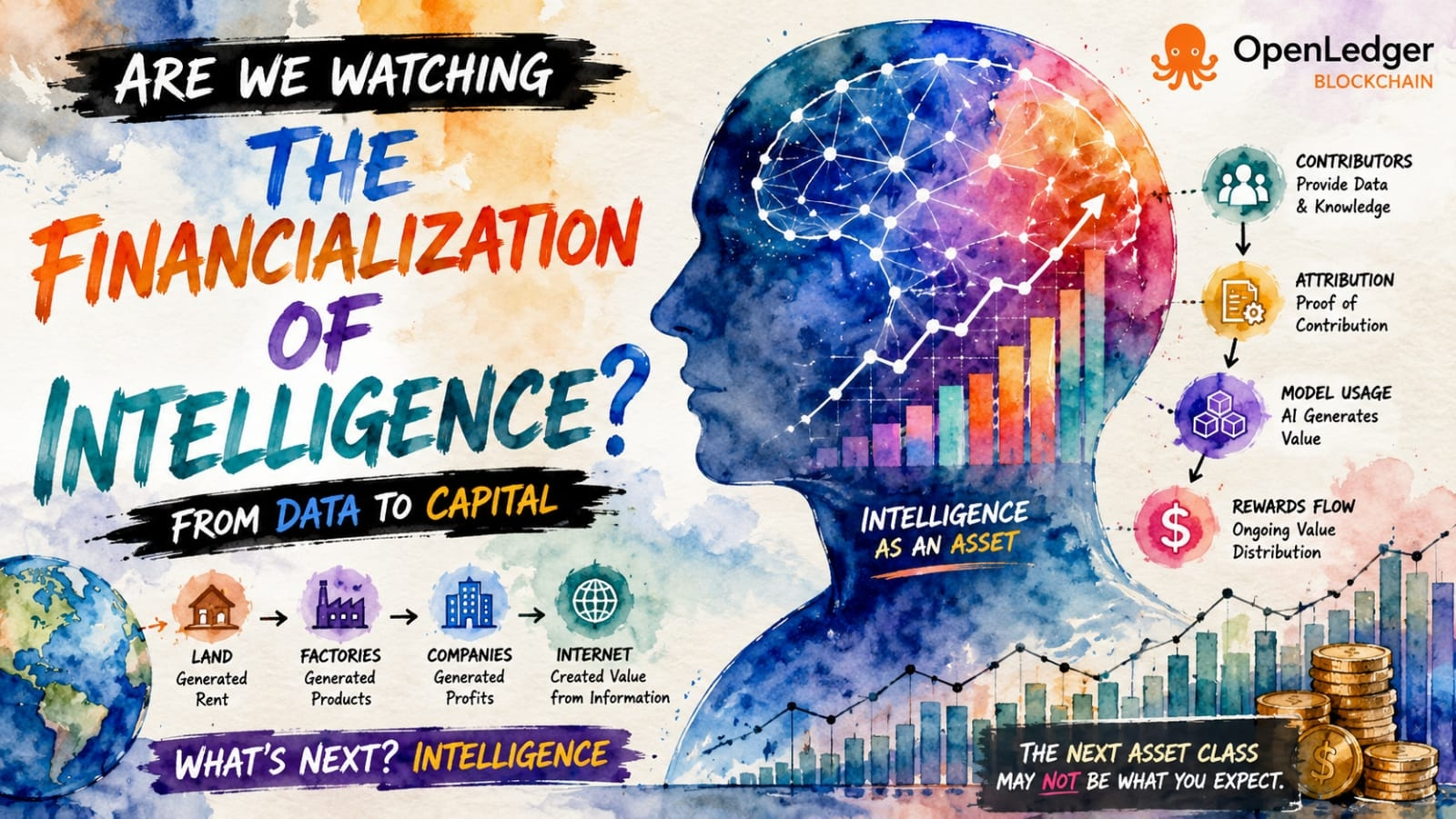
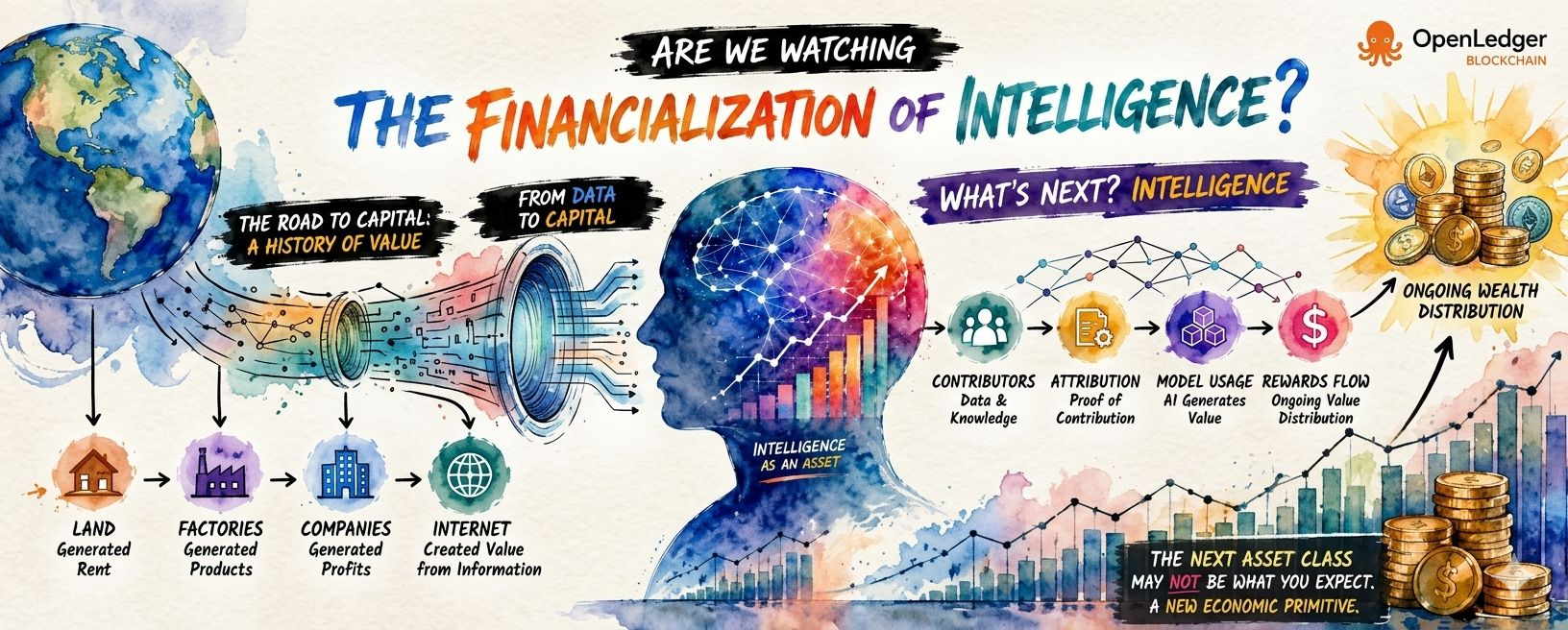
For most of history, wealth was tied to physical things. Land generated rent. Factories generated products. Companies generated profits. Then the internet arrived and created value from information itself.
Now I'm starting to wonder if we're entering another shift.
What if intelligence becomes the next asset class?
Not AI companies.
Not AI infrastructure.
Intelligence itself.
The thought came to me while exploring OpenLedger. Like many people, I initially viewed it as another AI and blockchain project focused on attribution and data ownership. That's the narrative most people see. Contributors provide data, models get trained, rewards get distributed, and blockchain ensures transparency.
Fair enough.
But the more I looked, the more I felt that something bigger was happening underneath.
Most discussions around AI focus on making models smarter. Larger context windows. Better reasoning. Faster inference. More parameters.
OpenLedger seems to be asking a completely different question.
Instead of asking how intelligence is created, it asks who should own the value that intelligence creates.
That distinction may sound small, but I think it changes everything.
The current AI economy operates a lot like an extraction economy. Data comes from millions of people. Models are trained on that data. Products are built on top. Revenue is generated.
Yet most of the economic value ends up concentrated around the companies that own and operate the models.
The contributors who helped create that intelligence rarely participate in the long-term upside.
OpenLedger's attribution model challenges that assumption.
What caught my attention wasn't simply the idea of rewarding contributors. Plenty of projects have attempted incentive systems before.
What interested me was the attempt to connect future model usage back to past contributions.
That is a very different mechanism.
When an AI system generates value, OpenLedger attempts to identify which contributions influenced that output and allocate rewards accordingly.
At first glance, this looks like a compensation system.
The more I thought about it, the less I saw compensation and the more I saw financialization.
Historically, financialization happens when something gains three characteristics.
It can be owned.
Its contribution can be measured.
And it can generate cash flow.
Land became financialized because ownership could be verified and rent could be collected.
Businesses became financialized because ownership could be represented through shares and profits.
Crypto networks became financialized through tokens and network participation.
OpenLedger appears to be experimenting with something similar for intelligence.
The idea is subtle.
Instead of treating intelligence as a product that gets sold once, the system treats intelligence as something capable of generating ongoing economic activity.
That changes how we think about data entirely.
Data stops looking like raw material.
It starts looking like productive capital.
The contribution is no longer valuable because it exists.
The contribution becomes valuable because it may continue generating future economic output.
That's a very different mental model.
I think many people are still viewing AI through the lens of software.
Software gets built and distributed.
OpenLedger's model suggests intelligence might eventually be viewed more like an asset that produces yield.
Whether that vision succeeds is another question entirely.
There are real challenges here.
The biggest is attribution itself.
Everything depends on accurately determining which contributions actually influenced a given output.
That sounds simple in theory.
In practice, AI systems are incredibly complex.
Influence is distributed across countless data points, training iterations, fine-tuning processes, and feedback loops.
Measuring contribution fairly may prove far more difficult than measuring ownership of traditional assets.
There's another risk that I don't think gets enough attention.
Whenever rewards become tied to measurable metrics, people eventually start optimizing for those metrics.
We've seen this happen with social media engagement.
We've seen it happen with SEO.
We've seen it happen with academic publishing.
The metric becomes the target.
If contributors begin optimizing for attribution scores rather than intelligence quality, the system could create incentives that look healthy on paper while producing lower-quality outcomes underneath.
That's a challenge every attribution-based economy will eventually face.
Still, I think the broader trend is worth paying attention to.
Across crypto, we've watched markets progressively transform non-financial assets into financial assets.
Tokens financialized communities.
DeFi financialized liquidity.
DePIN is attempting to financialize physical infrastructure.
AI may be pushing us toward financializing knowledge itself.
That's a much larger narrative than a single project.
What surprised me most wasn't OpenLedger's technology.
It was the possibility that projects like this are trying to create ownership structures around intelligence.
For decades, intelligence has been valuable but difficult to own directly.
You could own companies that employed intelligent people.
You could own software created by intelligent people.
You could own intellectual property generated by intelligent people.
But intelligence itself remained difficult to transform into a directly investable asset.
That may be starting to change.
Maybe the biggest story in AI isn't the race to build smarter models.
Maybe it's the race to determine who owns the economic value those models create.
And if that's true, then OpenLedger isn't simply building AI infrastructure.
It may be exploring what happens when intelligence itself becomes capital.
I'm not sure the market has fully appreciated that possibility yet.