
Everyone's been watching rate cut expectations get pushed back again. I ended up just... not looking at the macro today. Opened a few tabs, got distracted, ended up going down a rabbit hole on @OpenLedger instead.
I wasn't even planning to write about it. I was trying to figure out something unrelated — checking whether actual inference fees were showing up on-chain, like paid model runs, Datanet activity, the kind of transactions that would tell you a real AI economy was forming. The stuff OpenLedger gets cited for. Contributor-owned intelligence, Proof of Attribution, data that earns.
So I started looking at what was actually generating transaction volume. And here's the thing that stopped me.
The most legible on-chain activity around $OPEN right now isn't attribution payouts to data contributors. It's the OCTO NFT burn mechanic — the reward structure for the top 200 yappers from the Kaito Arena. These are the people who posted about OpenLedger consistently over six months, ranked on a social leaderboard, and got tokenbound NFTs as their payout vessel. To claim their $OPEN, they burn the NFT on-chain. Half unlocks immediately. The other half vests over ninety days — but only if you hold the NFT and stay in the ecosystem. There's even a gas fee just to mint the NFT in the first place. Meaning the act of accessing your reward costs $OPEN.
I sat with that for a minute.
The chain is moving — but it's moving because social contributors are navigating a claim decision, not because AI developers are paying inference fees or data providers are getting attribution payouts. The utility that's actually live and generating interactions is the one attached to content creation and community participation. Not the infrastructure pitch.
I thought the gap between those two things would bother me more than it does, honestly. But then I started thinking about sequencing. Every early-stage protocol has to bootstrap demand somehow. Liquidity mining, points programs, airdrop farming — it's all the same structure. You manufacture activity to simulate a functioning economy while the real product catches up. The Yapper Arena is just that, except the commodity being mined is attention and content reach instead of liquidity. And the OCTO NFT mechanic adds enough friction — burn early and lose fifty percent, or hold and stay engaged — that it keeps people in orbit longer than a straight token drop would.
That's actually clever design. I'll give it that.
But here's the part I keep coming back to. The whole thesis of OpenLedger is that data contributors and model builders eventually become the primary earners — that $OPEN flows toward the people feeding the AI stack, not the people posting threads about it. And right now, the Datanets are live on mainnet. Attribution Engine shipped in January. The infrastructure exists. But if you're looking at where the wallets are actually interacting with the protocol, it's still the social layer doing most of the work.
That's not necessarily fatal. But it does mean the token is currently valued — at least partially — on a narrative about who gets paid later, while the people getting paid now are the ones making noise about it. Those two groups have different incentive structures. The yapper who burned their NFT early for immediate liquidity is gone. The one holding for the ninety-day vest might sell the moment it unlocks. Neither of those is the data scientist running attribution-weighted contributions through a Datanet. That person hasn't arrived at scale yet.
Maybe they don't need to arrive for a while. Maybe the social economy is enough to sustain attention until the infrastructure layer actually thickens with real usage. I genuinely don't know. I've been wrong before about how long narrative can carry something before fundamentals need to show up.
The team keeps pointing toward enterprise pilots, AI Marketplace, cross-chain agent deployment. September brings the first cliff on team and investor unlocks too, which is a different kind of attention. A lot of variables moving at once.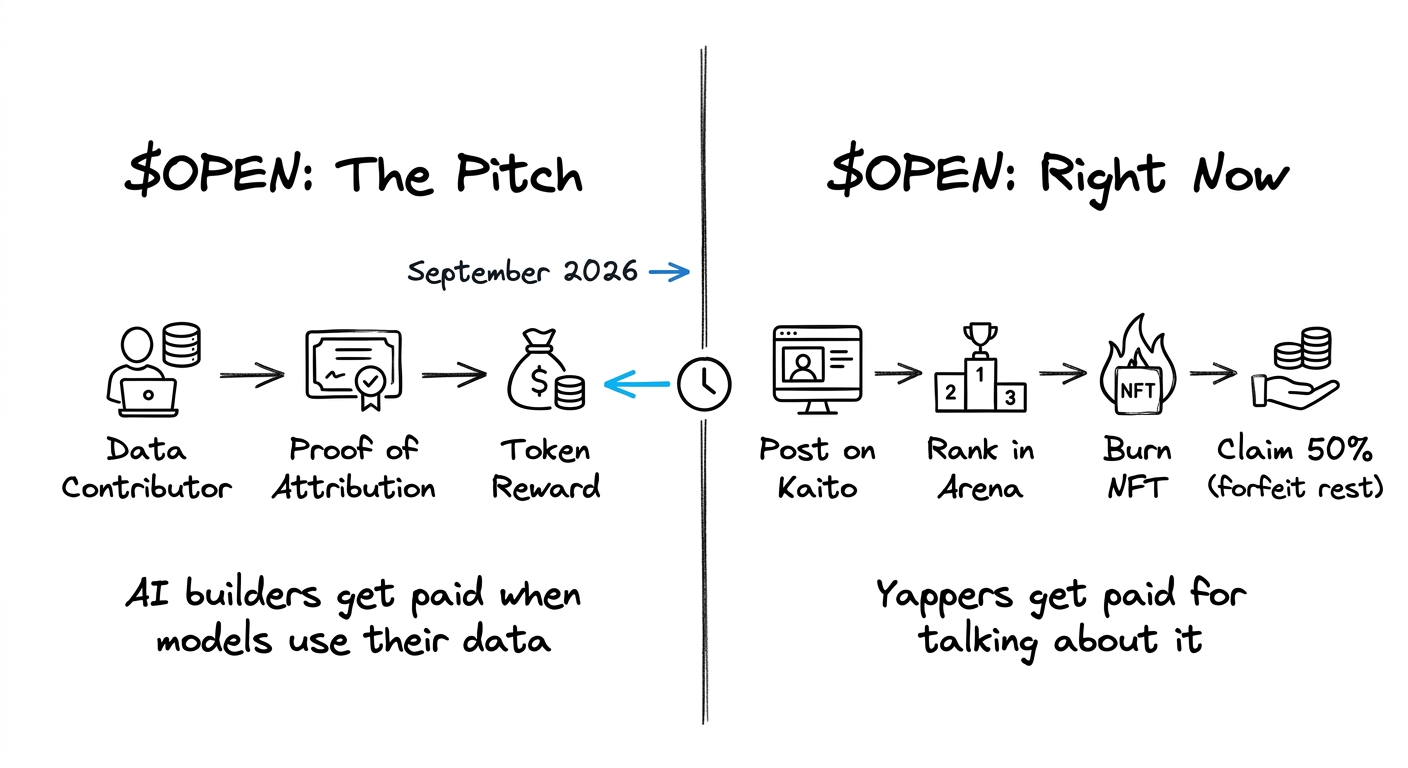
Anyway. I've still got those other tabs open. Charts still look shaky. I'll probably just watch how the Datanet activity numbers evolve over the next couple months and see if they start closing the gap with the social layer. Might mean nothing. Might mean everything.