
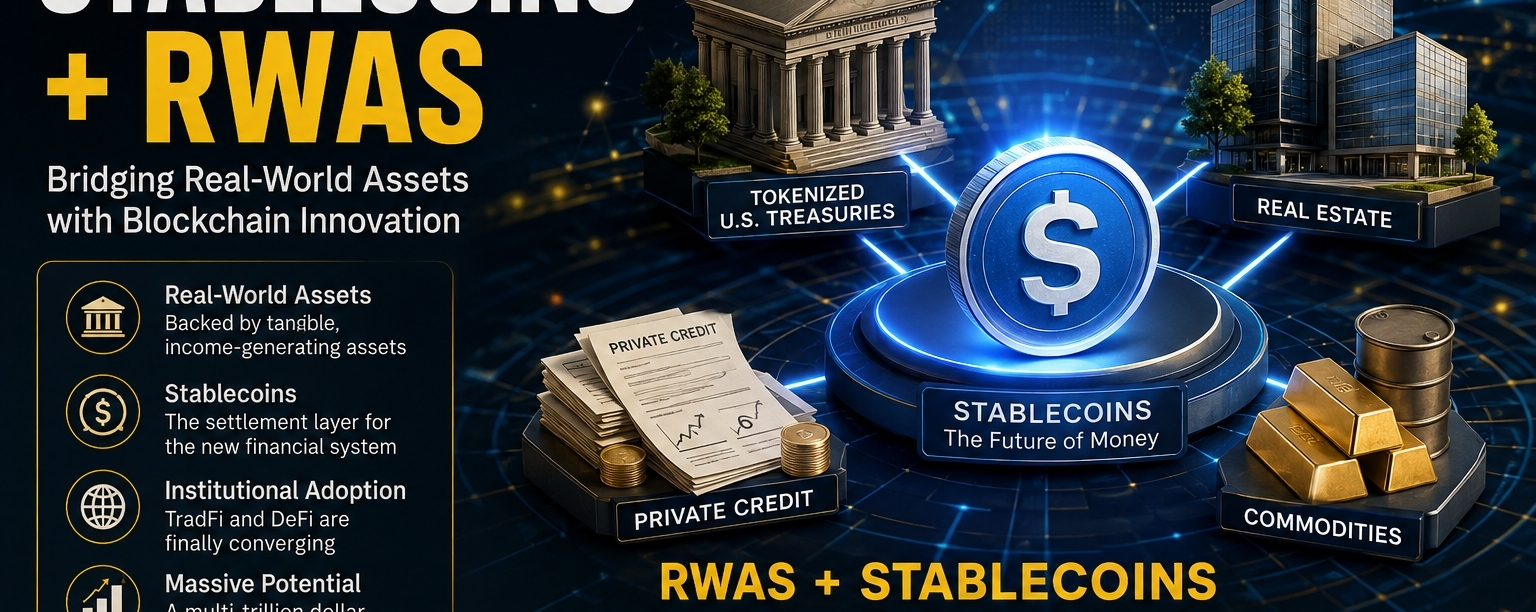
While meme coins and AI tokens continue to dominate social media, smart money is increasingly watching a different sector: the fusion of stablecoins and Real-World Assets (RWAs).
For years, crypto promised to bridge the gap between traditional finance and blockchain. In 2026, that vision is finally becoming reality. Tokenized U.S. Treasuries, private credit, commodities, and even real estate are rapidly moving on-chain, while stablecoins are evolving into the settlement layer that powers this new financial ecosystem.
Why Is This Narrative So Important?
RWAs solve one of crypto's biggest challenges: creating value backed by tangible, income-generating assets. Instead of relying solely on speculation, investors can gain exposure to tokenized bonds, money market funds, and other real-world instruments with blockchain efficiency. Recent industry reports show that the on-chain RWA market has grown dramatically, fueled by institutional adoption and increasing regulatory clarity.
At the same time, stablecoins are no longer just a tool for traders. They are becoming the preferred medium for cross-border payments, DeFi collateral, and on-chain settlements. Many analysts believe stablecoins could become core financial infrastructure over the coming years.
Institutions Are No Longer Sitting on the Sidelines
One of the clearest signals in this cycle is the growing involvement of traditional financial giants. Asset managers and fintech companies are increasingly exploring tokenized products and blockchain-based settlement systems, while major exchanges and DeFi protocols are building the infrastructure to support them.
This shift matters because institutional capital tends to favor projects with:
Real utility.
Sustainable revenue models.
Regulatory compatibility.
Long-term adoption potential.
That aligns perfectly with the RWA and stablecoin sectors.
What Should Crypto Investors Watch?
Rather than chasing every short-term trend, it may be worth keeping an eye on ecosystems building around:
Tokenized treasury and bond products.
Stablecoin payment networks.
RWA-focused Layer 1 and Layer 2 blockchains.
DeFi protocols integrating real-world collateral.
AI-powered financial infrastructure that uses stablecoins for autonomous transactions.
Final Thoughts
The next major crypto winners may not be the loudest meme coins, but the projects quietly connecting blockchain technology with the real economy. As stablecoins become the rails and RWAs become the payload, crypto is moving beyond speculation and toward genuine financial utility.
In this cycle, the biggest opportunity may not be choosing between TradFi and DeFi—but investing in the future where they merge.
What do you think: Will AI, RWAs, or stablecoins become the dominant crypto narrative of 2026? Share your thoughts