#MicronSharesRise10%AfterHours
Micron Technology just reminded Wall Street why memory chips are the quiet backbone of the AI boom.
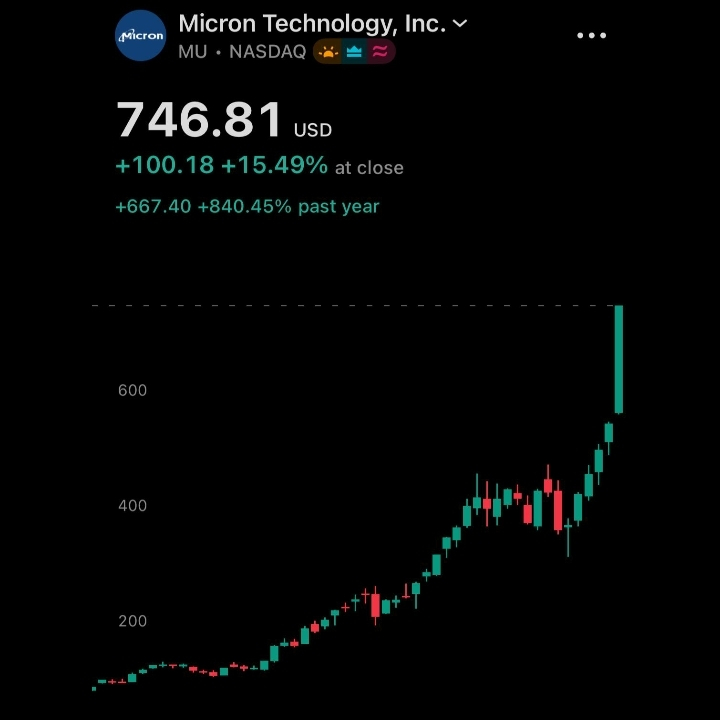
After the closing bell Wednesday, MU surged ∼11% in after-hours trading. Why? Q3 earnings crushed estimates, revenue went vertical, and guidance was even crazier. This wasn’t just a good quarter. It was a “memory shortage is real” quarter.
1. The Numbers That Moved MU 10% After-Hours
Micron reported fiscal Q3 results for quarter ending May 2026 after market close:
*The beat:*
1. *Revenue*: $41.5 billion, up 346% year-over-year. Analysts expected $35.3B. Beat by $6B+.
2. *EPS*: $25.11 per share vs $20.28 expected. Beat by almost $5.
3. *Guidance Q4*: Revenue ∼$50B vs $42.5B expected. EPS ∼$31 vs $24.8 expected.
Translation: Micron isn’t just beating. It’s beating by miles and saying “next quarter will be even bigger.”
*Market reaction*: Stock jumped ∼11% after-hours. Nasdaq 100 ETF QQQ popped 1.5% after-hours partly because of MU. When Micron moves, semis move.
2. Why Micron Is Printing Money: The AI Memory Shortage
You can’t run ChatGPT, Claude, or image models on a CPU alone. You need 2 things: Nvidia GPUs + tons of memory.
*The bottleneck shifted*: 2023 was “buy more GPUs.” 2026 is “buy more HBM + DRAM.” As CEO Sanjay Mehrotra said: “Micron is investing at record levels in technology, products and supply to address our customers’ rapidly growing demand”.
*What’s happening:*
1. *HBM demand explosion*: High Bandwidth Memory is what sits next to Nvidia’s AI chips. Only 3 companies make it at scale: SK Hynix, Samsung, Micron. All sold out.
2. *Memory prices up*: Limited suppliers are directing output to AI processors hyperscalers need. Less supply for PCs/phones = higher prices everywhere.
3. *Long-term contracts*: Amazon, Microsoft, Google now signing multi-year deals with Micron. That’s new. Means visibility for years, not quarters.
Wall Street consensus in early 2026: “The bottleneck in AI advancement has moved. It is no longer about the processor. It is about the memory”.
3. Micron vs SK Hynix vs Samsung: The 3-Way Memory War
Micron competes with SK Hynix + Samsung in DRAM/HBM, and Western Digital in NAND.
*Why MU jumped more than peers today:*
1. *US listing premium*: SK Hynix trades in Korea. Micron trades on Nasdaq. US investors can buy MU instantly. Same AI trade, easier access.
2. *Guidance shock*: $50B Q4 revenue guide was way above street. Shows Micron is catching up in HBM market share.
3. *$1T club*: Demand pushed Micron past $1T market cap earlier in May. Momentum traders pile in after that.
Analyst at TD Cowen raised price target 127% to $1500 ahead of earnings, saying memory demand is “structural, not cyclical”. That call aged well in 1 day.
4. “10% After-Hours” = What Should Investors Do?
After-hours moves lie sometimes. But MU’s move has real fundamentals behind it. 3 ways to think:
*If you don’t own MU yet:*
Don’t FOMO at +11% after-hours. After-hours is low volume, spread is wide. Wait for regular session. Key levels: If MU holds above $1,080, next stop is all-time highs around $1,100+. If it fades back to $1,000, that’s support from earlier this week.
*If you already hold MU:*
Congrats, you’re sitting on a winner. MU is up 200%+ YTD and 800%+ from 52-week low.
Rule: Take some profit if you need to sleep. Sell 20-30% into strength. Let rest ride. AI capex cycle likely has years left, but 10% single-day moves = volatility.
*If you’re scared of MU at $1,080:*
Remember: Micron trades at ∼49 P/E trailing, but forward P/E drops hard if $31 EPS Q4 guidance hits. “Expensive” if AI stops. “Cheap” if AI keeps spending.
5. Risks Even With A Blowout Quarter
*1. Cyclical business*: Memory goes boom/bust. Today it’s boom. In 2027, oversupply could crash prices. CEO Mehrotra admits they’re investing record capex. More supply in 2027 = lower prices later. bcde
*2. Customer concentration*: If Microsoft/Amazon pause AI spending for 1 quarter, MU gets hit hard. This isn’t iPhone demand. It’s datacenter demand.
*3. Competition*: SK Hynix is king of HBM today. Samsung is ramping. Micron needs to execute perfectly to keep share.
*4. Macro*: If Fed keeps rates high or recession hits, enterprise IT spending drops. Memory demand falls with it.
6. Big Picture: This Is About AI Infrastructure, Not Just Micron
MU’s 10% after-hours jump tells you 3 things about 2026 markets:
1. *AI capex isn’t slowing*: $50B revenue guide = hyperscalers still spending like crazy on memory. Nvidia reports next, expect same story.
2. *Supply chain is the trade*: Everyone owns NVDA. Smart money is moving to “picks and shovels”: ASML, TSMC, Micron, SK Hynix.
3. *Memory = new sexy*: 2 years ago “DRAM” was boring. Today analysts say memory is the bottleneck. Narrative shift = valuation shift.
Micron is now best performer in S&P 500 + Nasdaq 100 on many days this month. That’s how fast story changed.
Bottom Line In Your Words
Micron didn’t just “jump 10% after-hours.” It showed Wall Street that AI needs memory more than anything else right now.
*For traders*: 10% move is news. Trade the volatility, but don’t chase after-hours. Let price settle tomorrow.
*For investors*: If you believe AI datacenters keep growing, Micron is leveraged exposure to that spend. Less hype than NVDA, more cash flow than most AI startups.
*For sector watch*: MU + SK Hynix + Samsung all ramping capex. That means semiconductor equipment names like ASML, Lam Research also have tailwinds.
“Memory costs have surged significantly” because AI needs it. Until AI training slows, Micron likely keeps printing.
_Not financial advice. Semiconductors are cyclical and volatile. MU can drop 20% on one guidance cut. Only invest money you can hold 3-5 years. DYOR on earnings call transcript when it drops._