
For years, blockchain assets existed in a narrow frame. They sat quietly in wallets, flashed across charts, and lived or died by a single metric: today’s price. Up meant success. Down meant failure. Everything else was noise.
That mindset worked when on-chain finance was young. Tokens were experiments, not infrastructure. But as DeFi matured and began attracting treasuries, DAOs, funds, and serious builders, the cracks in that model became obvious. Financial systems cannot run on objects that only answer one question. They need instruments that can carry multiple responsibilities at once—value storage, yield generation, collateral strength, governance signaling, and cross-chain mobility—without forcing users to juggle a pile of loosely connected wrappers.
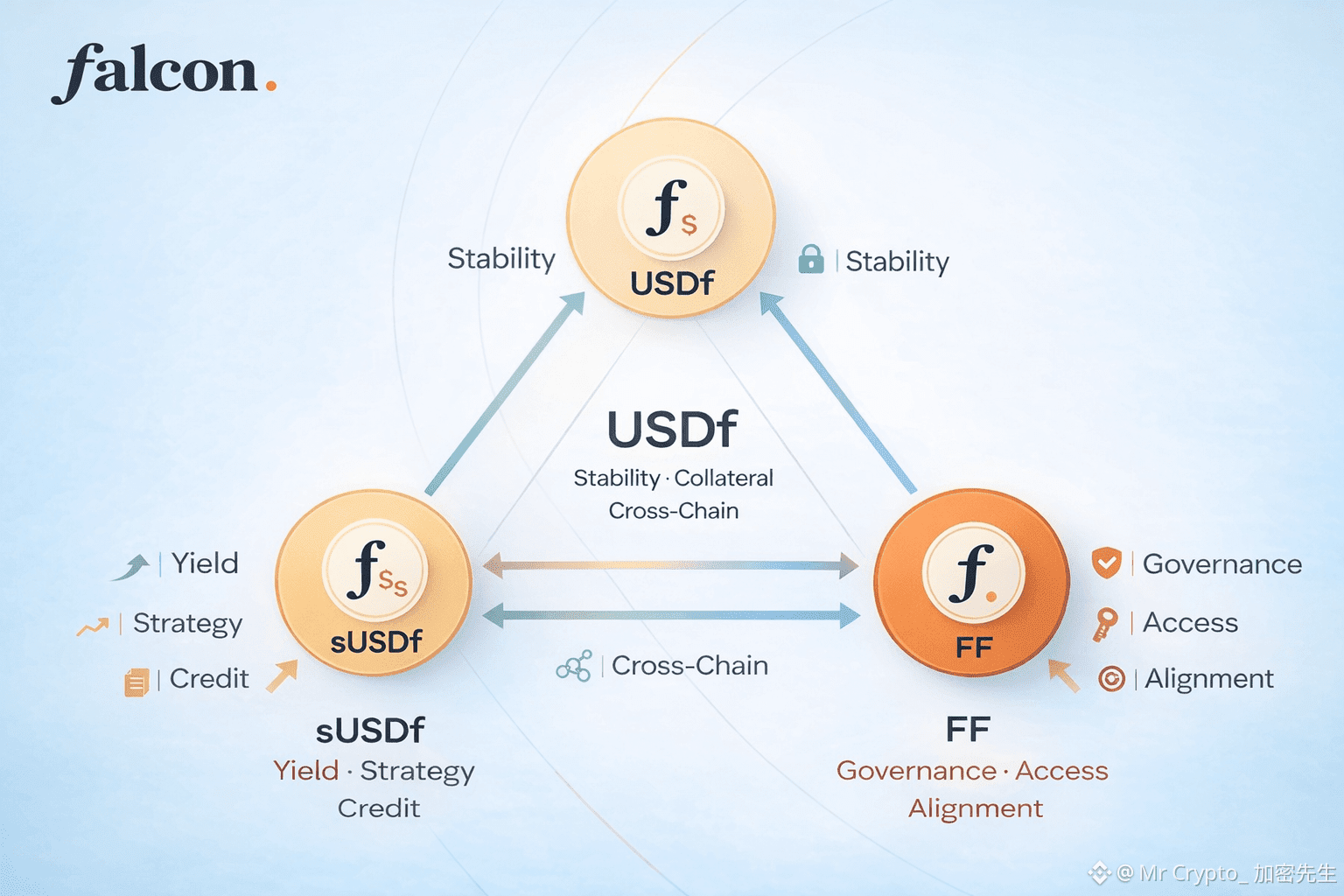
Falcon Finance is built on the assumption that this shift is inevitable. Its architecture quietly rejects the idea of “flat” tokens and instead treats on-chain assets as layered tools with several dimensions of meaning at the same time.
That philosophy shows up immediately in Falcon’s synthetic dollar, USDf. On the surface, it behaves like a stable unit, but its role goes far beyond price stability. USDf is designed to function simultaneously as a unit of account, a settlement layer, a cross-chain liquidity vehicle, and a form of high-quality collateral. When a protocol integrates USDf, it is not just accepting a dollar proxy. It is inheriting Falcon’s collateral logic, overcollateralization standards, cross-chain design, and risk framework. A lending market reads USDf as dependable backing. A decentralized exchange treats it as a base asset that can move between chains. A payment system uses it as a neutral settlement reference rather than inventing its own standard.
The idea becomes even clearer with sUSDf. At first glance, it looks like a simple upgrade: a yield-bearing version of USDf. Under the hood, it is something much richer. sUSDf represents a compressed bundle of strategies that may include delta-neutral positions, funding rate capture, and exposure to tokenized fixed income or structured credit. Instead of forcing users or developers to manage that complexity themselves, Falcon abstracts it into a single token. Holding sUSDf means holding a growing claim on USDf. For individuals, it behaves like a savings instrument with embedded diversification. For smart contracts, it becomes a clean, programmable source of institutional-style yield.
The FF token extends this layered design into governance and incentives. Many governance tokens collapse into a single function: voting weight. Falcon deliberately avoids that trap. FF does provide governance rights, but it also acts as an access credential, an economic signal, and in certain cases a secondary form of collateral. Staking FF can improve capital efficiency when minting USDf, reduce protocol fees, unlock priority access to advanced vaults, and increase reward multipliers. For treasuries and DAOs, holding and staking FF becomes a way to demonstrate alignment. Duration of stake and size of position can influence access to credit, liquidity programs, or ecosystem support. FF is not just a bet on appreciation; it is a lever inside Falcon’s financial system.
This is the core difference between flat tokens and living instruments. Each major Falcon asset behaves like a vector rather than a point. USDf expresses stability, liquidity quality, and portability. sUSDf adds yield, diversification, and credit exposure. FF combines governance power, access rights, and long-term alignment. When systems are designed around these vectors, financial design stops being about price alone and starts being about structure.
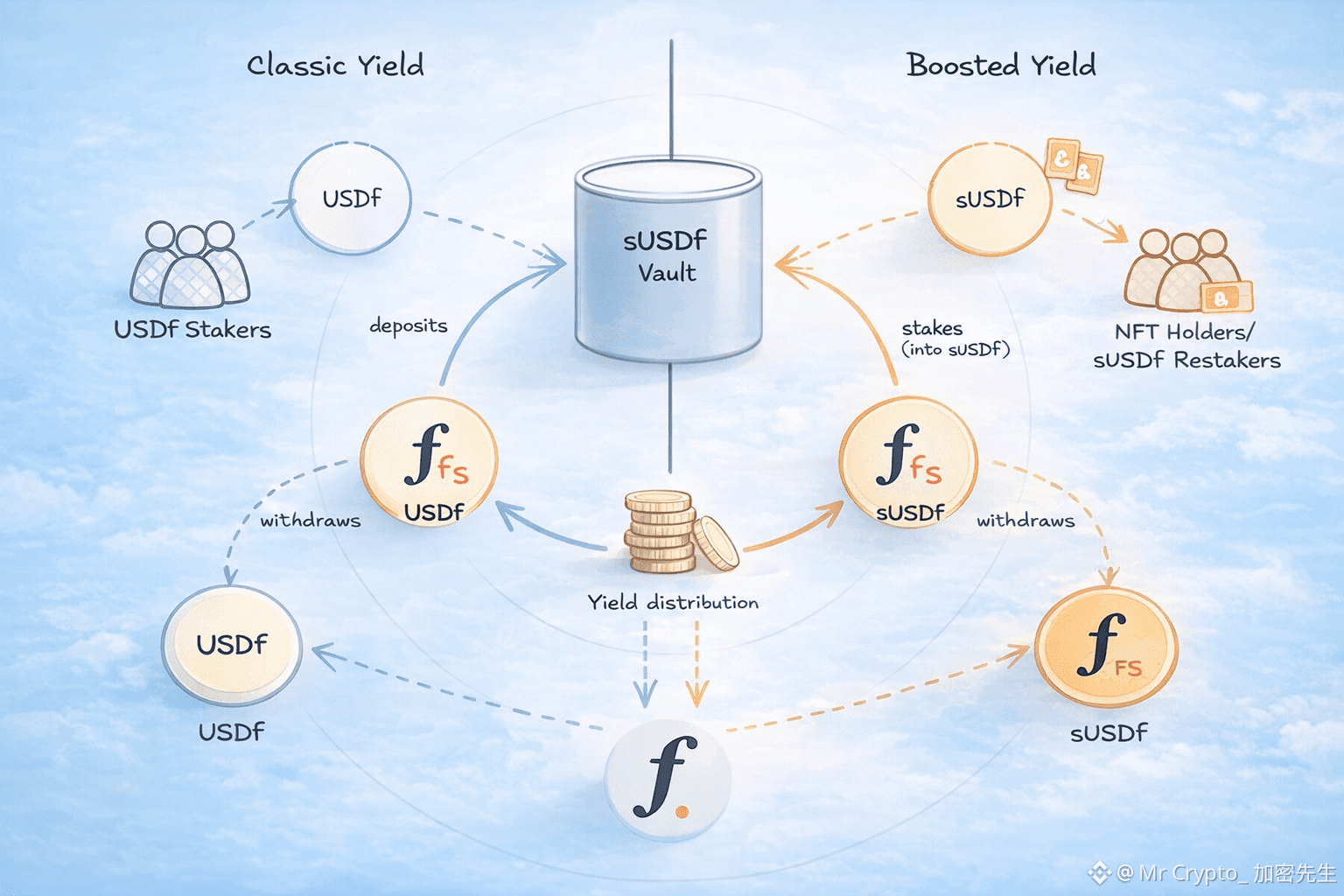
For treasury managers, this opens a simpler but more powerful toolkit. Instead of managing dozens of unrelated tokens, they can decide how much capital they want allocated to stability, productivity, and influence, then express those choices through USDf, sUSDf, and FF. A protocol can define its safest collateral tier with USDf, maintain a yield buffer in sUSDf, and hold FF as a strategic reserve tied to ecosystem direction—all within a single, coherent risk framework.
Credit design benefits even more from this approach. Traditional lending often treats collateral as a blunt number with little nuance. Falcon maps liquidity depth, haircut logic, risk profiles, and off-chain legal structures into its system. As a result, USDf and sUSDf can anchor more advanced credit arrangements than simple overcollateralized loans. One token position can reflect market exposure, credit quality, and structural protections at the same time.
Cross-chain functionality reinforces the point. In older models, assets lost meaning when they moved between chains, becoming generic wrapped versions of themselves. Falcon’s design aims to preserve identity and structure across environments. USDf does not flatten when it crosses chains; it carries its rules and role with it. Liquidity, yield, and governance positions remain consistent regardless of execution layer.
For builders, this changes how products are created. Instead of launching a new token for every feature, they can compose around richer primitives. Settlement and collateral needs point to USDf. Productive reserves lead to sUSDf. Long-term alignment and governance flow through FF. Asset selection itself begins to encode business logic.
There is also a psychological shift. Flat assets encourage shallow thinking because price dominates every conversation. Multi-dimensional instruments force deeper discussion. You cannot talk about sUSDf without addressing strategy design and risk management. You cannot discuss FF without considering governance mechanics and incentive alignment. You cannot evaluate USDf without understanding collateral architecture and real-world asset integration.
Price still matters, but it is no longer the whole story. It becomes one coordinate among many. Falcon Finance is building for that reality by creating assets meant to operate in several roles at once and by surrounding them with infrastructure that respects their complexity.
If this model succeeds, the next phase of DeFi will not be defined by louder tickers or faster speculation. It will be shaped by instruments that quietly carry real economic meaning—tokens that behave less like static numbers and more like structured financial tools translated into code. Falcon’s ecosystem is one of the clearest early expressions of that future.
@Falcon Finance #falconfinance $FF

