

The moment you realize that artificial intelligence has already escaped the laboratory isn't when you see a chatbot write poetry or solve complex math problems. It's when you discover that AI agents are already managing billion-dollar portfolios, coordinating global supply chains, and making split-second trading decisions that human operators couldn't match with entire teams. Yet these same agents, capable of processing thousands of variables in milliseconds, are forced to wait days for a simple international payment to clear. They can analyze global markets but can't buy a data feed without human intervention. This disconnect between AI capability and digital infrastructure has created what industry experts call the "autonomy trap," where the very systems that should enable AI independence instead constrain it. KITE AI emerges as the first comprehensive solution designed from the ground up to liberate AI agents from human-centric infrastructure limitations, creating what amounts to an economic operating system for autonomous intelligence.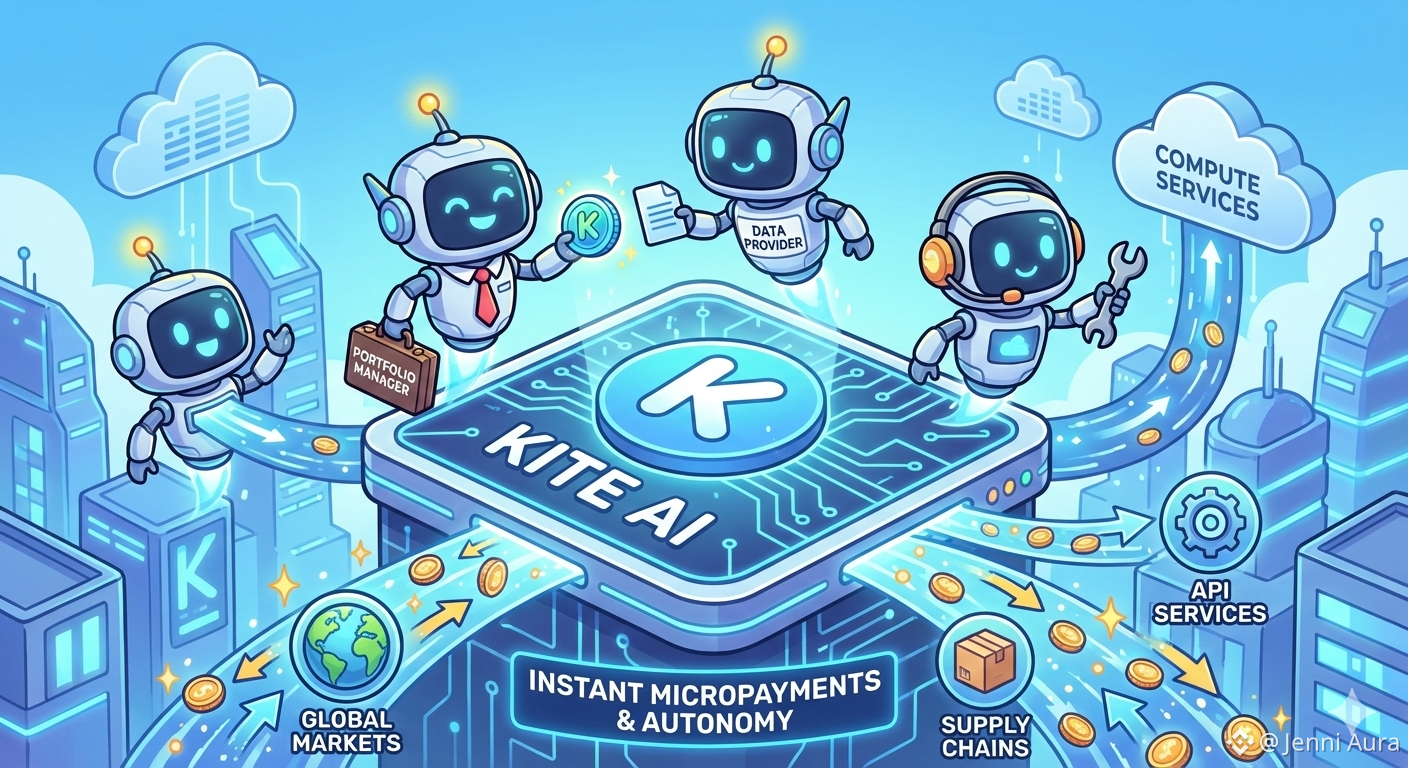
The infrastructure gap becomes immediately apparent when you examine how today's AI agents actually operate in commercial environments. Every autonomous system eventually hits the same wall: financial transactions. An agent can analyze terabytes of market data, identify profitable opportunities, and execute complex trading strategies, but it cannot independently pay for the data feeds it consumes, the compute resources it uses, or the services it integrates with. This creates an impossible choice for organizations deploying AI agents at scale. Either grant agents broad financial authority and risk catastrophic losses from hallucinations or system compromises, or maintain manual oversight for every transaction and eliminate the speed advantage that makes AI valuable in the first place. KITE solves this fundamental dilemma through what they call the SPACE framework, creating the first infrastructure where AI agents can operate with true financial autonomy while remaining mathematically constrained within user-defined boundaries.
The technical innovation behind KITE's approach centers on what blockchain developers call Account Abstraction, but applied specifically to AI agent requirements. Traditional blockchain systems assume that every transaction originates from a human who can evaluate risks, manage private keys, and intervene when necessary. KITE inverts this assumption entirely, treating AI agents as first-class economic actors with their own cryptographic identities, spending authorities, and reputation systems. The architecture implements a three-tiered identity model that separates user authority from agent operations from individual session permissions. A user might own a master wallet containing shared funds, while multiple AI agents operate with their own derived addresses and spending rules, each generating ephemeral session keys for individual transactions. This creates what security experts call "defense in depth" where compromising a single session affects only one transaction, compromising an agent remains bounded by smart contract constraints, and only user key compromise enables unlimited losses.
What makes KITE's payment architecture revolutionary isn't just the technical elegance but the economic transformation it enables. Traditional payment systems charge fixed fees that make small transactions economically absurd, forcing AI agents into inefficient batching or prepayment models that destroy the real-time responsiveness that makes agents valuable. KITE's stablecoin-native approach with state channel optimization achieves something previously impossible: economically viable micropayments at sub-cent costs with instant finality. This enables what industry analysts call "pay-per-inference" economics where every API call, every data query, and every service interaction carries its own payment, creating granular usage-based pricing that scales naturally with agent activity. An AI agent managing a portfolio can pay fractional cents for each market data point, each analytical model run, and each execution service, building detailed audit trails while operating at machine speed without human intervention.
The reputation and trust infrastructure represents perhaps KITE's most sophisticated innovation, addressing a problem that has plagued autonomous systems since their inception. How do you establish trust for entities that have no physical presence, no legal identity, and no human oversight? KITE's solution creates what they term "cryptographic reputation" where every action an AI agent takes contributes to an immutable track record anchored on-chain. Unlike traditional rating systems that can be gamed or manipulated, this reputation derives from verifiable behavior: successful payments, fulfilled service level agreements, compliance with spending constraints, and positive interactions with other agents and services. The reputation becomes portable across the entire ecosystem, solving the cold-start problem where new AI agents must prove trustworthiness from zero. An agent with proven performance on one platform can present cryptographic credentials to new services, bootstrapping trust through mathematical proof rather than promises.
The interoperability strategy reveals KITE's deep understanding of how technology adoption actually occurs in enterprise environments. Rather than creating another isolated protocol that forces developers to choose between existing systems and new capabilities, KITE embraces compatibility with established standards as a core architectural principle. Native support for Google's Agent-to-Agent (A2A) protocol enables KITE agents to coordinate seamlessly with AI systems from other ecosystems. Integration with Anthropic's Model Context Protocol (MCP) ensures compatibility with the entire language model landscape. OAuth 2.1 compatibility means existing services can accept KITE agents with minimal changes to their authentication infrastructure. Most critically, x402 standard support creates a universal payment flow where any compliant agent can interact with any compliant service without custom integration work. This comprehensive compatibility approach transforms adoption dynamics from an either-or decision to an additive enhancement of existing capabilities.
The governance and safety mechanisms address the elephant in the room that has prevented widespread AI agent deployment: the lack of reliable control systems. Current approaches rely on policy documents and API rate limits, but these provide no mathematical guarantee that agents will respect boundaries when market conditions change or system errors occur. KITE implements what they call "programmable governance" where user intentions compile into smart contract code that enforces constraints with cryptographic certainty. A user can specify rules like "total spending across all platforms less than $1,000 per day AND no single transaction greater than $100 AND only verified providers" and these constraints become immutable law that even compromised agents cannot violate. The system supports temporal evolution of trust, where limits automatically increase based on demonstrated performance, and conditional responses to external signals, where constraints tighten automatically during market volatility or security incidents.
The economic implications extend far beyond technical infrastructure improvements to fundamentally reshape how AI services develop and scale. KITE's micropayment capabilities enable business models that were previously impossible, such as pay-per-question AI consultancy, dynamic pricing based on model complexity, and revenue sharing for AI agents that provide value to other agents. The platform creates what economists call "network effects" where each additional agent and service makes the entire ecosystem more valuable. Agents can discover and integrate new services automatically, services can reach millions of potential AI customers without individual business development efforts, and the resulting marketplace creates competitive pricing and innovation pressure that benefits end users. The $KITE token serves multiple roles in this economy: transaction fees that align incentives, staking mechanisms for service providers to demonstrate commitment, and governance tokens for protocol evolution decisions.
The regulatory and compliance advantages of KITE's architecture become increasingly important as AI deployment scales. Traditional AI systems operate as black boxes with limited auditability, making regulatory compliance difficult and expensive. KITE's immutable audit trails provide complete transaction history with cryptographic proof of authorization chains, spending constraint compliance, and service delivery verification. This comprehensive transparency enables automated compliance reporting and provides regulators with unprecedented visibility into AI agent behavior without compromising user privacy through selective disclosure mechanisms. As frameworks like the EU AI Act demand algorithmic accountability, organizations using KITE will find themselves ahead of compliance requirements rather than scrambling to meet them. The infrastructure doesn't just enable AI autonomy; it makes that autonomy auditable, accountable, and aligned with emerging regulatory expectations that will shape the industry for decades to come.

