

@KITE AI For years, talk about autonomous agents has lived in a middle zone: dazzling in demos, brittle in production. An agent can draft an email, compare prices, or book a table, but the moment it needs to spend money or accept responsibility, the mood changes. People start asking unglamorous questions. Who authorized this? What limits were in place? If something goes wrong, can we prove what happened?
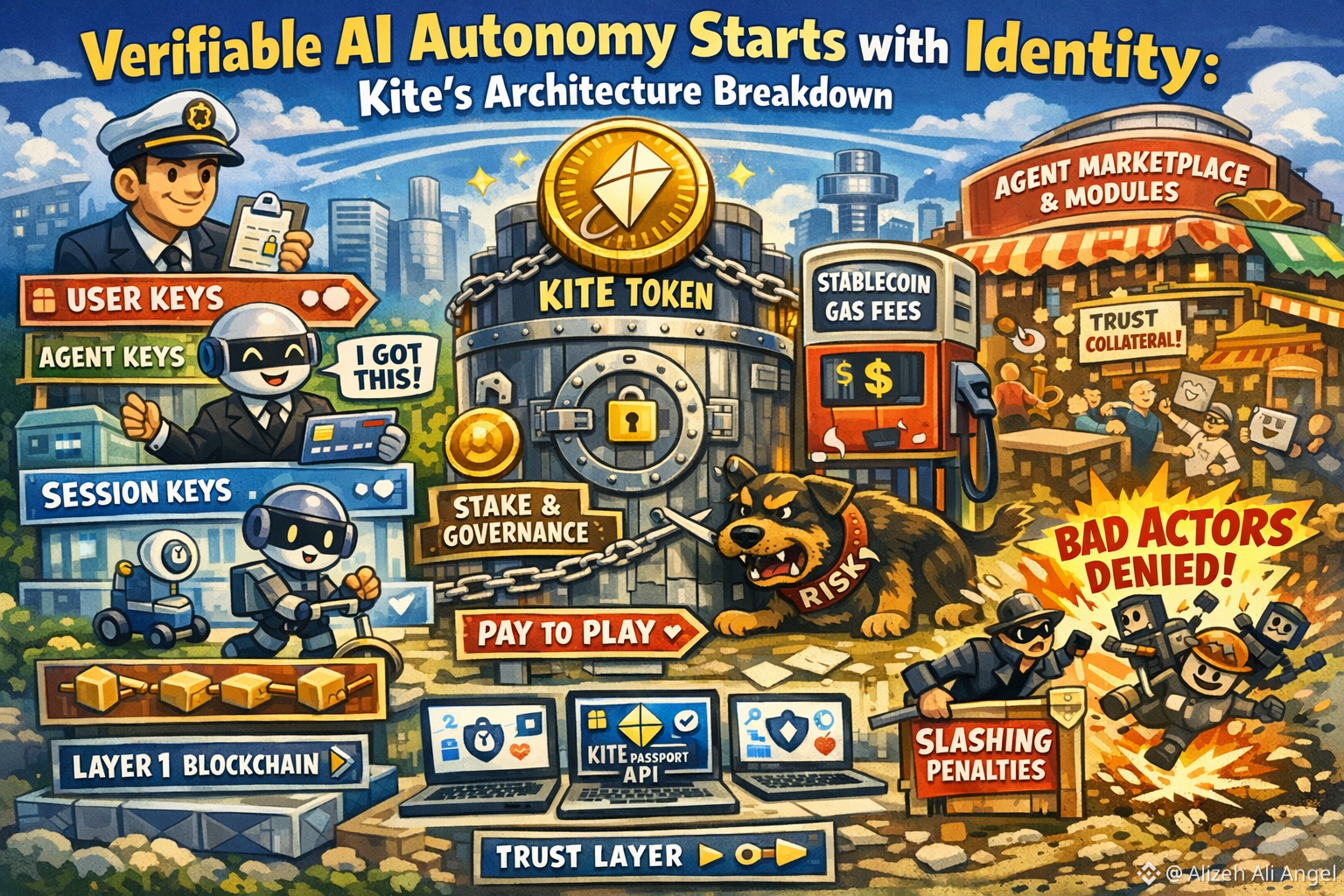
That shift in mood is part of why identity is suddenly the least boring part of the agent conversation. The last year has brought a flood of agent frameworks and “do things for me” interfaces, and with them a more practical fear: delegation without guardrails. The internet still defaults to human accounts, human passwords, and human intent. Agents don’t fit that shape. When they act at machine speed, authentication gaps can become lost, and “trust me” stops being an acceptable security model.
Kite’s architecture leans into that discomfort by treating identity as the starting point for autonomy, not a feature you bolt on later. Its public materials frame the web as infrastructure designed for humans, and position Kite as an “AI payment blockchain” built around identity, stablecoin settlement, governance, and verification so agents can transact without everyone crossing their fingers.
The clearest move is Kite’s three-layer identity model that separates user, agent, and session keys. The user is the root authority. The agent is delegated authority created to act on the user’s behalf. The session is temporary authority—keys that exist for a specific run and then expire. Kite (and Binance Research’s project overview) emphasize this split because it changes blast radius: compromise one layer and you limit damage, instead of losing the whole account.
But here’s the point that gets missed when people skim the identity story: Kite’s identity model is only “verifiable” at scale if there’s a cost to misbehavior and a durable incentive to follow the rules. That’s where the KITE token becomes structurally relevant, not just financially relevant. Stablecoins may be what agents spend, but KITE is what participants stake, lock, and risk so the system can enforce boundaries.
Kite describes a four-layer architecture meant to keep pieces legible: a base EVM-compatible Layer-1; a platform layer of agent-ready APIs; a programmable trust layer with Kite Passport and interoperability standards like OAuth 2.1 and x402; and an ecosystem layer that looks like marketplaces and reputation networks. You can read this as “identity plus payments,” but it’s closer to “identity plus enforcement.” If identity is the claim—this agent is allowed to do X—then the token is part of how the network makes those claims stick.
Kite’s own tokenomics description is blunt about that: the native token drives incentives, staking, and governance across the base chain and its service-specific modules. In practice, that means KITE is tied to who can operate the network and under what conditions. In the MiCA-oriented white paper, KITE is described as the network’s utility token used for staking, reward distribution, and as a prerequisite for certain roles and activities, with slashing penalties designed to create accountability.
This matters because Kite also makes an explicit design choice that sounds small but is actually a big deal for real-world usage: transaction fees (gas) are denominated in stablecoins to keep costs predictable and avoid volatility exposure. That’s attractive for agents, since an agent can be “right” about what to do but still fail if fees spike unpredictably. The trade-off is that if you remove a volatile token from day-to-day fee payment, you need another way to bind participants to network health. Kite’s answer is to push the token’s importance into staking, permissions, and longer-term commitments rather than making every interaction a “pay gas in KITE” moment.
The most concrete example is Kite’s “module” concept. Modules are described as semi-independent communities that interact with the L1 for settlement and attribution, and Kite’s tokenomics page says module owners who have their own tokens must lock KITE into permanent liquidity pools paired with their module tokens to activate those modules. If you’re building a service that agents will rely on—data, a model endpoint, a workflow tool—you don’t just show up and ask to be trusted. You post collateral, in a sense, and you accept that some of it is intentionally illiquid as long as you stay part of the system.
Kite also frames #KITE as a gate for ecosystem access and eligibility: builders and service providers must hold KITE to integrate, and staking is linked to being eligible to perform services for rewards. This is the “identity meets economics” bridge: permissions aren’t only technical, they’re backed by a coordination asset that can be staked, measured, and penalized. If an agent can spin up instantly, and a bad actor can spin up a thousand agents instantly, you need something that’s scarce enough to slow abuse without turning everything into manual approvals. Requiring stake and enforceable commitments is one of the few levers that works when speed is the threat.
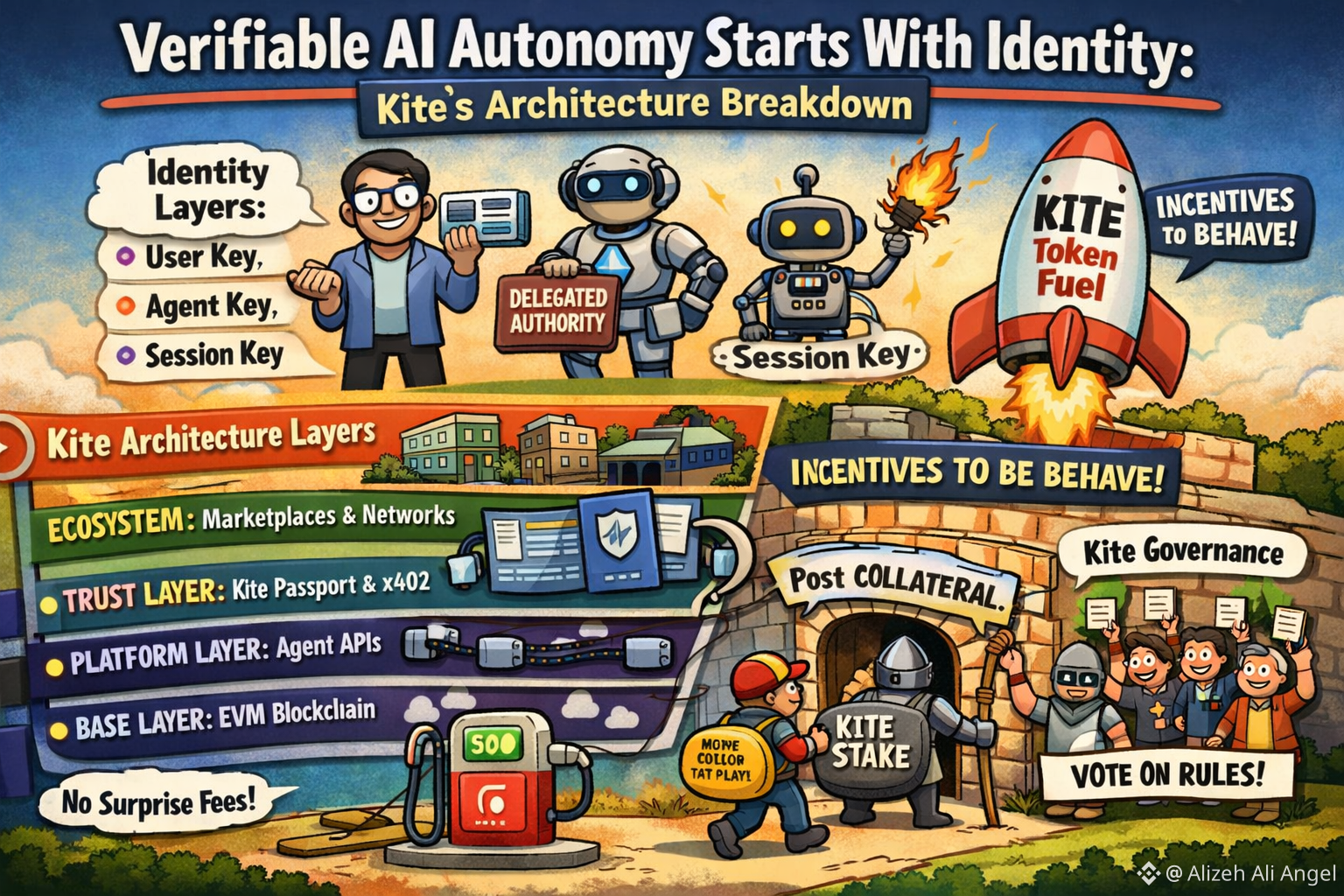
The governance angle is less flashy but arguably the most important over time. Kite’s materials say token holders vote on protocol upgrades and incentive structures. In a system where users define rules like spending limits and constraints, governance is how you decide what the default rule language can express, what gets standardized, and what happens when the ecosystem finds a new kind of exploit. In other words, governance is where “verifiable autonomy” either stays verifiable or slowly turns into a patchwork of exceptions.
This is trending now partly because the token and the infrastructure are arriving into the same public conversation window. Kite’s MiCA white paper was published in mid-November 2025, and it spells out the token’s role as a staking and coordination asset in compliance language, including stablecoin-denominated gas fees and stake-based permissions. Binance Research’s project write-up (November 2025) also emphasizes the three-layer identity design and programmable constraints, which is exactly the kind of framing exchanges and developers echo when a network is trying to be taken seriously beyond crypto-native circles.
None of this eliminates the hardest problems. A well-identified agent can still make a foolish choice. A clean audit trail can still record a bad outcome. But tying autonomy to identity without tying it to incentives is how you end up with rules that exist on paper and fail in practice. Kite’s architecture is interesting precisely because it treats the $KITE token as part of the enforcement surface: not a toll to click “send,” but a way to make participation costly to abuse and valuable to protect. If agents are going to touch money and real stakes, that kind of alignment stops being a crypto obsession and becomes basic infrastructure.

