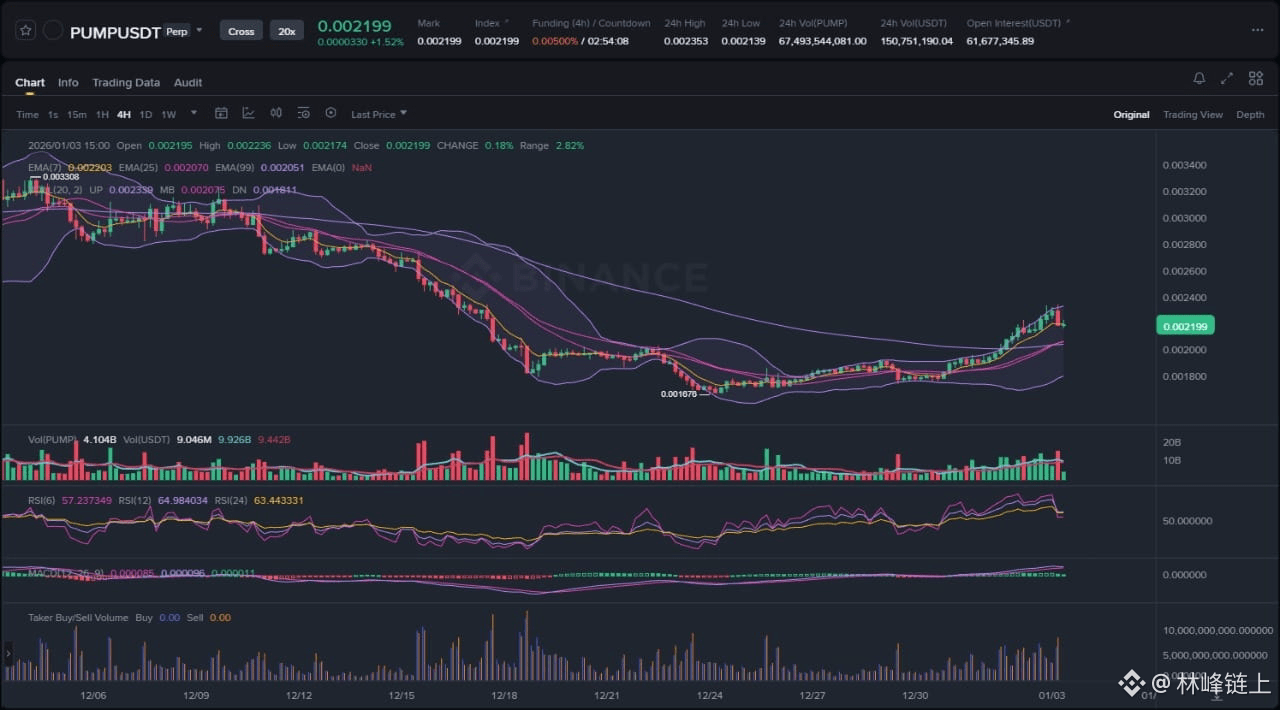
The cryptocurrency market enters 2026 with renewed volatility, and PUMP has emerged as a focal point of speculative interest following a tumultuous fourth quarter in 2025. After suffering a severe correction that saw valuations compressed significantly from previous highs, PUMP is currently orchestrating a technical recovery structure that has captured the attention of momentum traders. As of early January 2026, the asset is trading near 0.002199 USDT, marking a significant bounce from its recent capitulation lows around 0.001676 USDT. However, this price action presents a complex analytical puzzle. While the chart suggests a constructive reversal pattern supported by moving average crossovers, the underlying on-chain data and news sentiment reveal a stark divergence. We are witnessing a classic battle between technical momentum and fundamental distribution, raising the question of whether this rally is a genuine trend reversal or a liquidity exit event for large holders.
Market Snapshot
The broader context for PUMP involves a significant structural shift. The asset spent the latter part of 2025 in a persistent downtrend, characterized by lower highs and lower lows, which decimated speculative open interest. The current market structure, however, indicates a potential change in character. The price action over the last week has broken the monotony of the bearish drift, establishing a local floor and initiating a sequence of higher lows. Volatility, which had compressed significantly during the bottoming phase, is now expanding, evidenced by the widening Bollinger Bands on the 4-hour chart. This expansion suggests that the market is transitioning from a period of consolidation to a period of trend discovery. The immediate focus is whether the bulls can sustain this momentum against a backdrop of institutional skepticism and significant treasury movements.
Chart Read
Analyzing the attached 4-hour PUMP/USDT perpetual chart reveals several critical technical developments that define the current market bias.
First, the market structure has shifted from a steep distribution phase to an accumulation and recovery phase. The steep sell-off that drove prices from the 0.003300 region down to the 0.001676 low has seemingly found a bottom. This bottoming process formed a rounded base, often indicative of gradual accumulation by patient capital or the closing of short positions. The rejection of lower prices at the 0.001676 level was sharp enough to suggest a demand zone or a "liquidity pocket" where limit buy orders were stacked.
Second, the Moving Averages (EMAs) provide a compelling bullish argument in the short term. The chart displays a bullish crossover, where the shorter-term EMAs (likely the 7 and 25 periods) have crossed above the longer-term baseline (99 EMA). Price is currently riding the upper bands of the Bollinger indicator, and the candles are consistently closing above the short-term moving averages. This alignment typically signals strong immediate momentum. The price action is hugging the upper Bollinger Band, a behavior known as "walking the bands," which is characteristic of a strong impulsive move.
Third, volume analysis presents a nuanced picture. While there is buying volume associated with the recovery, it does not yet rival the capitulation volume seen during the drop. This suggests that the current move is driven more by a lack of selling pressure at the lows rather than an influx of massive new aggressive buying. The RSI is trending upward but is not yet deeply overbought, suggesting there is still room for upside oscillation before a necessary mean reversion.
Overall, the technical bias is cautiously bullish in the short term due to the structural break of the downtrend and the EMA support. However, the lack of explosive volume on the breakout warns of potential fragility.
News Drivers
The fundamental landscape offers a conflicting narrative to the bullish price action, creating a divergence that traders must navigate carefully.
The primary bearish driver is the reported whale behavior. Recent data indicates that despite the price recovery and project buybacks, large wallet holders (whales) are engaging in sell-offs. The report that speculative interest crashed by 85% in 2025 and that whales are selling into this current strength is concerning. In technical analysis, when price rises while smart money sells, it is often termed a "distribution rally." This suggests that the current pump might be providing exit liquidity for trapped whales rather than signaling a new organic bull run.
Conversely, the bullish narrative is supported by project-specific factors. Reports highlight that the Pump.fun team has created a "stronger floor" through support mechanisms, likely contributing to the 13% weekly spike and the defense of the 0.0016 level. Price predictions circulating in the media are pivoting to a positive outlook for 2026, anticipating an "explosion" in value. This sentiment can act as a self-fulfilling prophecy, attracting retail capital that chases the "2026 run" narrative, thereby absorbing the whale selling pressure temporarily.
A neutral but volatile driver is the revelation of $615 million in fund transfers during Q4 2025. While the specific intent of these transfers remains a topic of dispute—ranging from operational restructuring to profit-taking—the sheer magnitude of this liquidity movement creates uncertainty. Uncertainty in financial markets often breeds volatility. If the community perceives these transfers as preparation for a dump, it could cap upside potential. If viewed as ecosystem reinvestment, it could bolster confidence. Currently, it serves as a "Sword of Damocles" hanging over the price action.
Scenario A: Bullish Continuation (The Absorption Breakout)
For the bullish case to materialize and for PUMP to validate the "2026 explosion" narrative, the market must prove that retail demand and team buybacks are sufficient to absorb the whale distribution identified in the news.
In this scenario, price action needs to consolidate above the 0.002100 level, turning previous resistance into support. We would look for the price to flag or move sideways while allowing the moving averages to catch up, rather than retracing deeply. The critical confirmation would be a high-volume breakout above the local swing high of 0.002236. If PUMP can clear this level with conviction, it opens the door for a move toward the 0.002500 - 0.002600 region, which represents the next major liquidity block and previous breakdown level.
Structurally, the bulls must keep the price above the middle Bollinger Band (the 20-period SMA). A successful defense of this dynamic support line would confirm that the trend remains strong. We would also expect to see the RSI reset slightly without price dropping significantly—a phenomenon known as "hidden bullish divergence"—before the next leg up. This scenario assumes that the $615 million transfer news is digested by the market without panic and that the whale selling is exhausted or fully absorbed by new entrants.
Scenario B: Bearish Invalidation (The Liquidity Trap)
The alternative scenario aligns with the negative news regarding whale sell-offs and the massive drop in speculative interest. In this view, the current rally to 0.002199 is merely a "dead cat bounce" or a "bull trap" designed to fill sell orders for large holders exiting their positions.
Here, we would expect the price to fail at the current resistance near 0.002200. The invalidation of the current bullish setup would occur if the price closes back below the 99 EMA (roughly around 0.002050) and subsequently loses the 0.001900 psychological support. A loss of the EMA ribbon support would signal that the momentum has dissipated and the dominant downtrend is resuming.
If this breakdown occurs, the target would be a full retest of the 0.001676 lows. Given the "whale sell-off" narrative, a break below 0.001676 could trigger a cascade of stop-losses, pushing the price into price discovery to the downside. This scenario becomes highly probable if the volume on the current rally begins to dry up completely, creating a "rising wedge" structure which is typically bearish.
What to Watch Next
Traders should focus on three specific actionable signals in the coming sessions.
First, observe the volume profile on intraday timeframes (1H or 15m). If PUMP pushes higher toward 0.002300 but volume decreases (divergence), it indicates that buyers are exhausted, favoring Scenario B. Conversely, if volume spikes on green candles, it supports Scenario A.
Second, watch the reaction at the 0.002000 psychological level. This round number aligns closely with the moving average support. A clean bounce from this level offers a low-risk entry for bulls, while a high-volume candle closing below it signals a trend shift.
Third, monitor the on-chain flows regarding the $615 million wallet transfers. Any news update clarifying that these funds are being moved to an exchange for sale would likely be an immediate bearish catalyst, regardless of technical patterns.
Risk Note
Trading assets with high volatility and conflicting on-chain signals involves significant risk. The divergence between the bullish chart pattern and the bearish whale data creates a low-certainty environment. Stop-losses should be strictly adhered to, particularly if the price reverts below the moving average cluster.
The market is currently pricing in a recovery, but the weight of institutional supply remains the primary threat to this trend.