
I’ve been building on Sui for a couple years now, mostly experimenting with storage layers and data availability for apps I’ve prototypured. When Walrus mainnet went live last year, I jumped in early—partly because decentralized blob storage solves a real pain I kept hitting in my own projects. Walrus, the programmable decentralized storage network on Sui powered by the $WAL token, lets anyone store large unstructured data reliably without relying on centralized providers. Right now, with the Binance CreatorPad campaign offering a 300,000 WAL reward pool (running through early February 2026), it feels like the perfect moment to talk about one feature that quietly impressed me: delegated staking.
Have you delegated any WAL yet, or are you still holding off while figuring out the nodes?
My entry point was simple curiosity on mainnet. After the launch, I swapped some SUI for about 2,000 WAL when the price was sitting around $0.14–$0.15. I went straight to the official Walrus staking dApp, connected my Sui wallet, and browsed the node list. I picked one with solid uptime and a reasonable commission rate—nothing fancy, just a node that had been consistently in the active committee. The delegation transaction went through in seconds; I remember approving it and immediately seeing the new staked object in my wallet. No need to spin up hardware, configure erasure coding, or worry about availability checks. That was the first thing that stood out: I was earning yields without any of the operational headache of running a storage node myself.
Think of delegated staking on Walrus like backing a professional moving-and-storage company. You provide the capital (your staked WAL), which gives the operator economic skin in the game to store and serve data reliably. Customers pay rent (storage fees in WAL) for putting their stuff in the warehouse—images, videos, AI datasets, whatever—and you get a cut of those fees proportional to your stake, minus the operator’s commission. The node handles all the heavy lifting: encoding blobs with RedStuff (their erasure coding scheme), distributing shards, repairing data, the works. If the node performs poorly, everyone loses out on rewards, so incentives stay aligned.
During the CreatorPad campaign, I leaned on this experience for a few posts. One task encouraged sharing genuine protocol insights, and having real skin in the game changed how I approached it. After delegating, I watched my rewards accrue over a couple epochs. Hold on—that caught me off guard at first. I expected slow drips, but with network activity picking up, the yields felt meaningful faster than I anticipated. I’d delegated roughly $300 worth at the time, and seeing those small but steady WAL additions made the mechanism click: this isn’t just passive holding; it’s direct exposure to actual storage demand.
Of course, it’s not perfect. Node commissions can be steep—some sit around 50-60%, which eats into your share. There’s slashing risk if your chosen node drops the ball on availability or durability, though I haven’t seen aggressive slashing yet. Yields are variable too; they rise with more blobs being stored but can dip if usage slows. And like any delegated system, you’re trusting the node operator not to centralize too much power. I mitigate that by splitting stakes across two nodes now—one established, one newer with lower commission.
One non-obvious angle I only appreciated after a few weeks: delegation lowers the barrier so much that it quietly boosts network decentralization over time. More everyday users staking means more WAL locked up across diverse nodes, which strengthens durability guarantees for the blobs we all rely on. In my own builder work, that translates to confidence when pinning large files for prototypes. A quick chart comparing effective yields across top nodes (after commission) would show this clearly—some delegators are netting noticeably better returns just by shopping around.
Looking ahead, delegated staking fits Walrus’s role in the Sui ecosystem beautifully. As AI agents and on-chain media grow, blob demand should keep climbing, supporting sustainable yields without endless emissions. Reliability feels solid so far—my delegated blobs have stayed available without hiccups. For the campaign, it’s a reminder that the best CreatorPad content often comes from people actually using the protocol, not just reading about it.
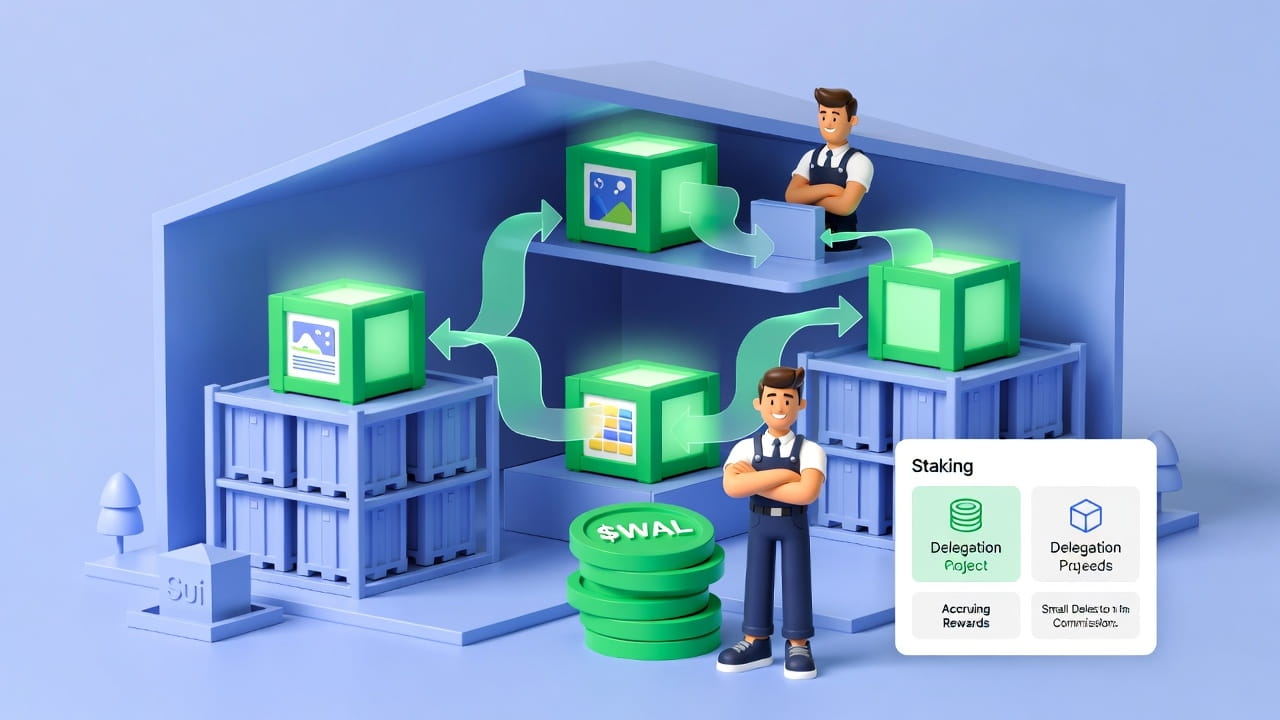
Personally, I’m a fan of the hands-off yield without node ops, though I remain cautious about over-concentrating on a single node. It’s a practitioner-friendly mechanism that delivers real utility.
What’s been your biggest surprise when delegating on Walrus? Which node are you using, and how are the yields treating you? Drop your experiences below—I’m genuinely curious.
A simple tx flow diagram or a screenshot of the staking dashboard (showing delegation objects and pending rewards) could make this even clearer for anyone on the fence.


