
I’ve been prototyping data-heavy apps on Sui for a while now, leaning on decentralized storage to avoid the usual centralized bottlenecks. Walrus, the decentralized blob storage layer on Sui powered by the $WAL token, has become my go-to for pinning large files reliably. With the ongoing Binance CreatorPad campaign—running from January 6 to February 6, 2026, with a 300,000 WAL reward pool—it’s timely to dive into something I’ve been tracking closely: how the network’s epochs evolve to handle changing storage demands.
Have you watched an epoch transition on Walrus yet, or caught a price shift that changed how you plan uploads?
My starting point was practical necessity. Last year on mainnet, I needed to store a batch of prototype datasets—around 500MB total—for an AI agent experiment. I uploaded via the aggregator, paid the upfront fee in WAL, and got the blob certified quickly. But what hooked me was monitoring the transition into the next epoch. I pulled up Walruscan (the community explorer) and watched the committee rotate: a few nodes dropped out as their stake share shifted, new ones joined, and the storage price per GB per epoch adjusted slightly upward. Hold on—that surprised me initially. I’d assumed costs were static, but seeing that small bump tied directly to node votes made the adaptability click.
Think of Walrus epochs like a cooperative warehouse collective holding seasonal town hall meetings. Each “meeting” (epoch) lasts a set period, during which the operators (storage nodes in the committee) vote on rental rates (storage price per unit per epoch) and how much each warehouse bay holds (shard size, which influences total capacity). The rate isn’t an average—it’s the 66.67th percentile of their proposals, weighted by stake, so most nodes have to agree it’s reasonable. This keeps prices from swinging wildly while letting the network respond to more (or less) stuff being stored. Demand climbs, nodes vote higher rates to signal need for more capacity; stake flows in, committee grows or stabilizes accordingly.
In practice, during the CreatorPad campaign, this shaped a few of my posts. One task rewarded deep protocol breakdowns, so I shared screenshots from a blob I’d stored—paying roughly the equivalent of $0.15 per GB-year at current WAL prices around $0.15. After that upload, I swapped another small amount of SUI for WAL to extend a couple blobs when I noticed the next epoch’s voted price edging up. That trade shifted my view: I stopped treating storage as a fixed cost and started timing larger uploads around epoch boundaries when rates looked favorable.
It’s not flawless, though. The voting happens in advance, so rapid demand spikes can mean a lag before prices or capacity catch up. Stake concentration among top nodes could theoretically skew votes, though the percentile mechanism and future slashing help counter that. There’s also the risk of over-provisioning—if nodes vote too conservatively on shard sizes, capacity sits idle briefly. For campaign creators, mismatched timing could mean higher costs for media-heavy posts right after an upward adjustment.
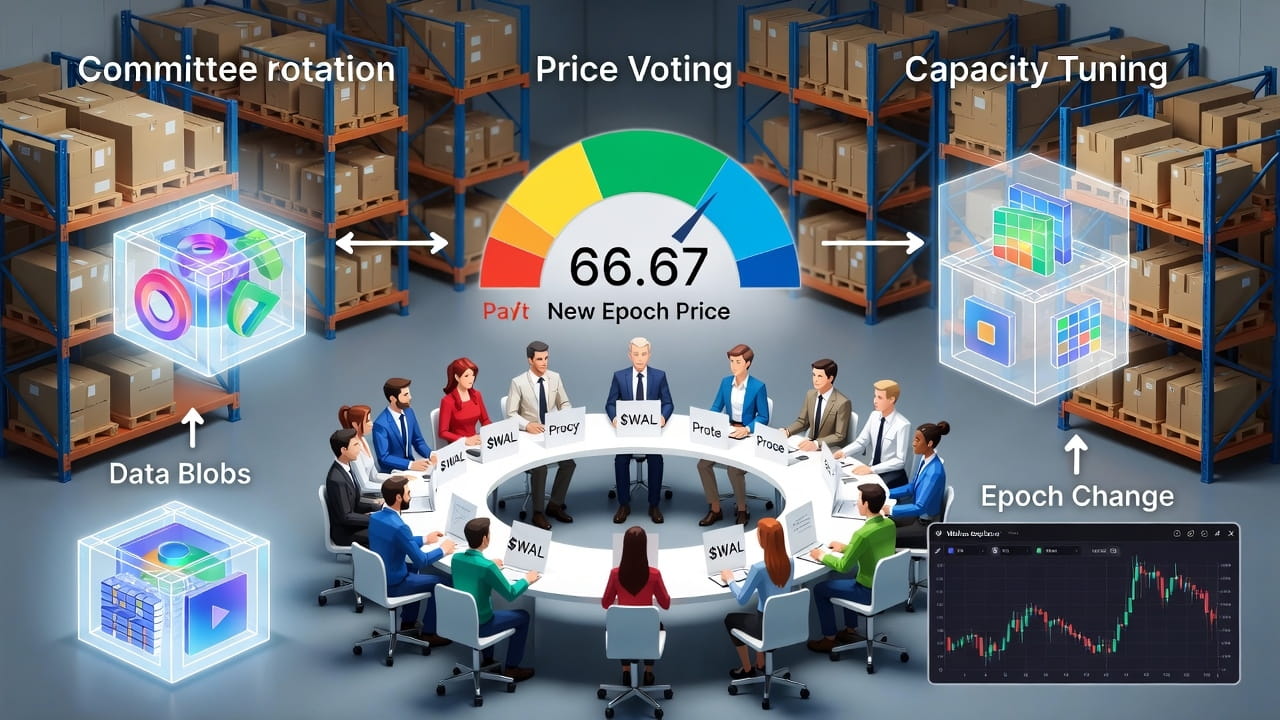
One angle I only picked up after a few epochs: the reconfiguration handshake during transitions is remarkably smooth. I once had a blob spanning an epoch change—reads routed seamlessly from old committee to new without downtime. That quiet reliability means builders can treat storage as always-on, which changes how aggressively we pin data for long-term apps. A simple timeline chart of price votes across recent epochs would illustrate this evolution clearly.
Moving forward, this epoch-based tuning fits the Sui ecosystem’s push for scalable data layers perfectly. As on-chain media and AI datasets grow, the voting should guide sustainable capacity without heavy central coordination. Reliability has held up in my use—no lost availability proofs yet. For the campaign, it underscores why hands-on monitoring beats speculation for solid content.
I appreciate the measured way the network adapts—practitioner-friendly without overpromising infinite cheap storage. Still skeptical about how it’ll handle massive spikes, but so far it’s delivered.
What’s the biggest epoch shift you’ve seen—price, committee, or otherwise? Which aggregator do you use for uploads, and how are costs trending for you? Share below; always good to compare notes.


