
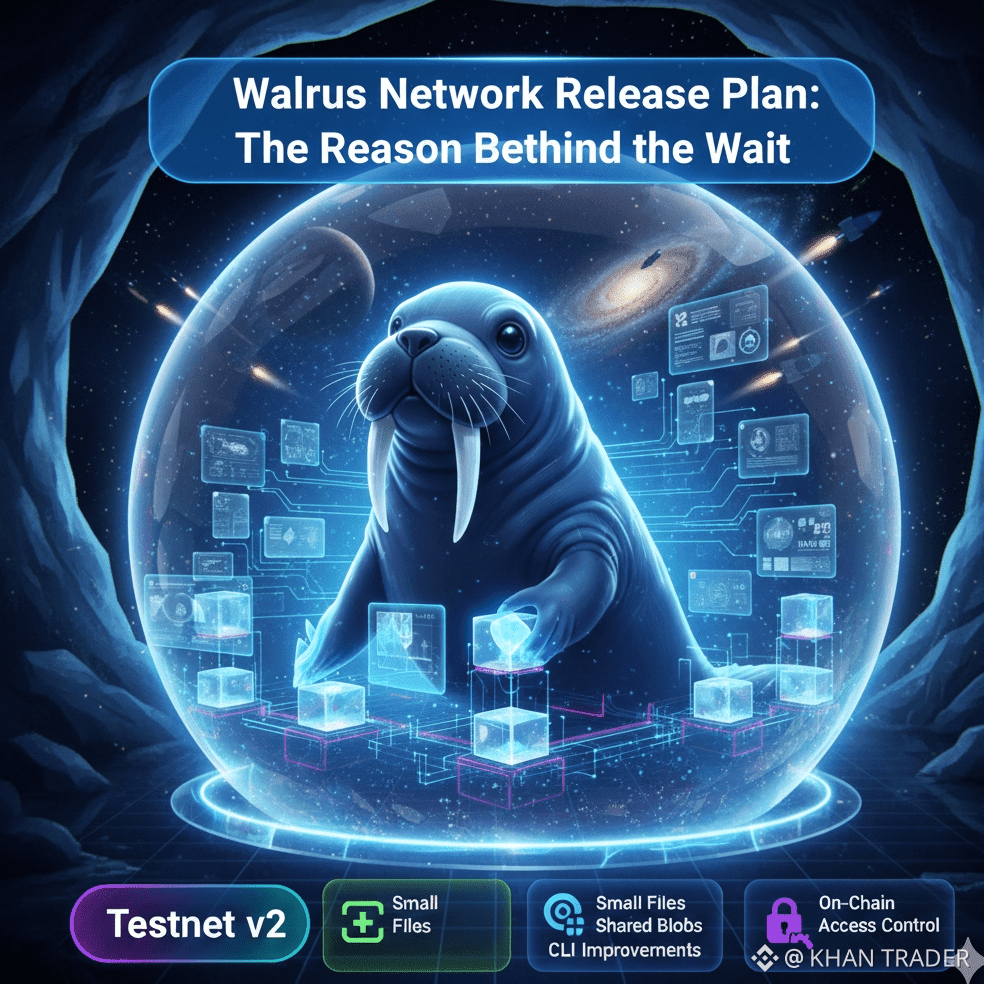
Most Web3 projects move fast—flashy launches, big timelines, everything announced at once. It looks exciting, but that excitement often hides the truth: nothing is permanent yet, so rushing is easy.Walrus took a different approach. Instead of releasing everything together, it has been rolling out its network carefully, step by step. It may appear slow or uneventful, but storage infrastructure isn’t something you can hurry if trust matters.Walrus isn’t just launching code. It is responsible for data meant to last years. Once uploaded, there’s no redo. Failures don’t trigger complaints—they erode trust@Walrus 🦭/acc 
Running a storage network is very different from launching a token or a simple smart contract. Problems rarely appear on day one. At first, everything seems fine. Then months pass, some nodes drop out, incentives behave differently than expected, traffic changes, and gradually availability starts to decline.
Walrus was built expecting these challenges. Its release plan avoids hype, introducing responsibility step by step instead of pushing everything at once. The idea is simple: if the system withstands stress, it earns growth.
Early on, Walrus wasn’t chasing users—it was seeking answers. The key question: if parts of the network fail, does the data remain intact? That focus led to erasure coding, availability proofs, and coordination between independent operators. It wasn’t about adoption; it was about survival.
When Walrus entered mainnet, storage became serious. Uploaded data wasn’t just testing—it was real, valuable data. That’s when $WAL gained real significance: payments, node rewards, and availability guarantees all came together. Walrus became infrastructure holding responsibility.
The release schedule also shows that Walrus is never “finished.” Data grows, use cases change, access control matters more over time. Upgrades are part of the system, not emergency patches, giving builders confidence that their data will remain safe even as the network evolves.
$WAL reflects this long-term vision. Its value grows as the network takes on real responsibility. Most Web3 failures don’t happen at launch—they happen later, when attention fades and incentives weaken. Storage networks are especially exposed to this risk.
By moving cautiously, assigning responsibility gradually, and prioritizing durability over speed, Walrus is building infrastructure meant to last. In a fast-moving ecosystem that forgets quickly, Walrus aims to remember. That’s what a true data layer looks like.😘#walrus #WalrusProtocol