
Financial privacy is weird right now. On one hand, we have grown to expect everything we do online to be tracked, logged and analyzed. On the other, we still cling to the idea that our money matters should be just that. Ours. This tension sits at the heart of every debate about digital assets and their place in the regulated world. The thing is, most solutions force you to pick a side. Transparent blockchain where everyone sees everything, or dark corners where compliance becomes impossible. The middle ground feels like a ghost town.
That is where the conversation gets interesting. What if the middle ground is not a compromise but an actual destination? What if privacy and regulation are not enemies but partners that just never had the right interpreter?
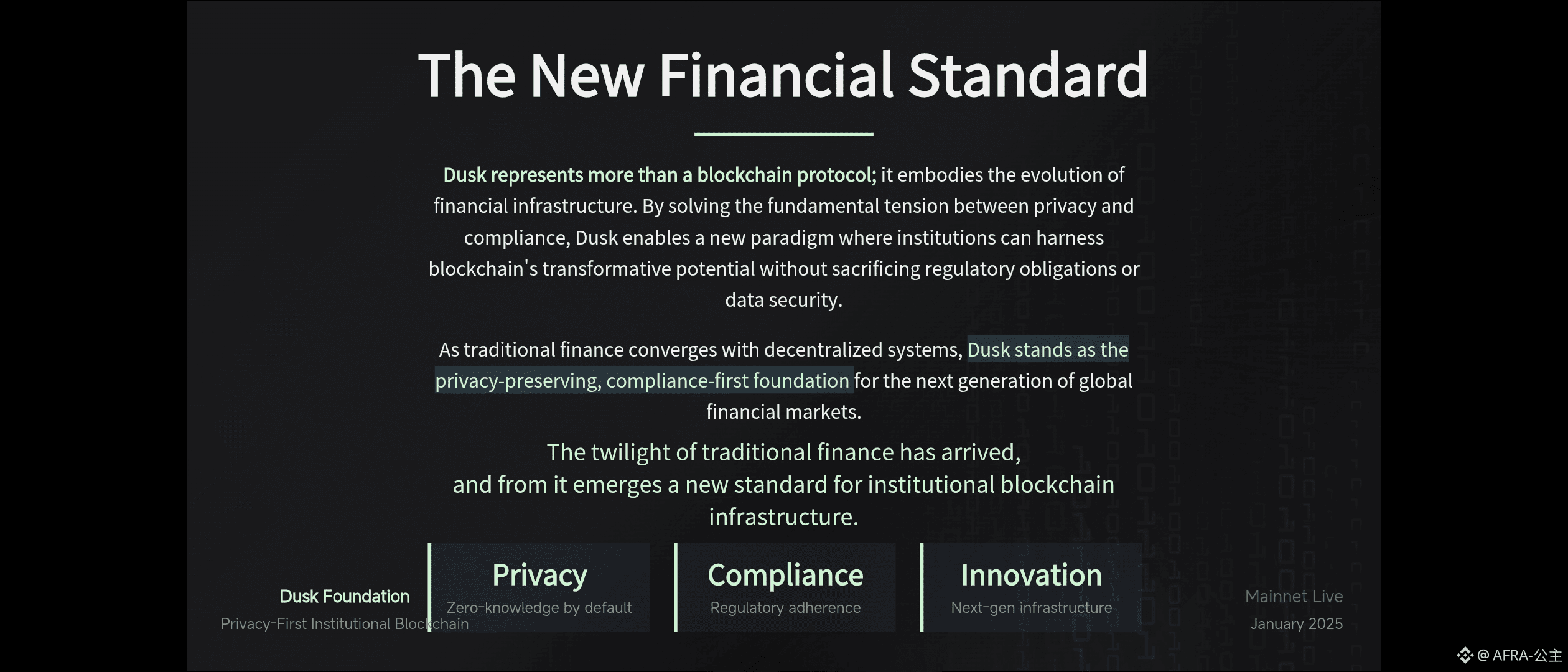
Dusk has been building that interpreter. Not with flashy announcements or promises to overthrow the system, but with the quiet persistence of a team that understands something fundamental. The future of finance will not be anonymous. It also will not be a surveillance state. It will be selective transparency. You will share what you need to share, when you need to share it, and with whom the law says you must. The rest stays with you.
This sounds simple until you try to build it. Traditional blockchains are public by default. Every transaction, every smart contract interaction, every wallet balance sits there for anyone to examine. Great for transparency, terrible for business. Companies cannot operate with their financial strategies broadcast to competitors. Individuals should not have their purchasing habits available to anyone with a block explorer and time to kill.
Privacy coins went the other direction. Full anonymity, no questions asked. Regulators hate them because they cannot see when laws are broken. Institutions cannot touch them because they cannot explain the transaction history to auditors. They became digital islands cut off from the mainland economy.
Dusk looked at this landscape and asked a different question. What if privacy was programmable? What if compliance was built into the protocol itself, not layered on top as an afterthought?
The blockchain uses zero knowledge proofs, but not just for the sake of technology. The implementation lets you prove things without revealing everything. Prove you are compliant without showing your entire transaction history. Prove you have sufficient funds without exposing your net worth. Prove you meet regulatory requirements without handing over the keys to your financial life.
Think about what this unlocks. Securities can trade freely because ownership is verifiable without being public. Companies can manage treasury operations without broadcasting their strategy to the world. Exchanges can operate with real settlement finality, not just IOUs moving around on a screen.
The regulated financial infrastructure angle is not marketing talk. Financial markets run on rules. Those rules exist for reasons, however frustrating they can feel. Anti money laundering requirements, know your customer checks, capital adequacy rules. These are not bugs in the system. They are features that let institutions trust each other enough to move trillions of dollars daily.
The problem has always been that blockchain and these rules seemed incompatible. How can you comply with transparency requirements when your technology defaults to public? How can you meet privacy regulations when everything is visible? The answer was always going to be a blockchain that understood both sides of that equation.
Dusk became that blockchain by building privacy into the base layer while keeping compliance as a core feature, not an add on. The native token handles gas fees and staking like any other chain, but the smart contract layer is where things get interesting. Confidential smart contracts mean business logic can execute privately. Data stays encrypted even from the nodes processing transactions. Yet the system can still generate proof of compliance for regulators when required.
This distinction matters. Add on privacy solutions feel clunky. They require extra steps, extra trust in third parties, extra complexity that introduces its own risks. When privacy is the foundation, everything built on top inherits those properties by default. Developers do not need to become cryptography experts to build compliant private applications. They write standard smart contracts and the privacy happens automatically.
The use cases write themselves once you understand this. Tokenized securities have been talking point for years, but they keep hitting the same wall. Who wants their share holdings public? Dusk solves the ownership privacy problem while keeping settlement fast and final. The same goes for private equity, debt instruments, any asset that currently trades through layers of intermediaries partly because those intermediaries provide a veil of privacy.
Trade finance presents another massive opportunity. Global supply chains involve countless parties sharing sensitive commercial information. Purchase orders, invoices, shipping documents. Right now this moves through banks and centralized platforms that add cost and friction. A private by default blockchain lets counterparties share data directly, execute smart contracts automatically, and maintain commercial confidentiality throughout.
Central bank digital currencies are coming. Most implementations look like slightly upgraded versions of traditional banking. They miss the peer to peer innovation that makes blockchain interesting. Dusk shows a path where CBDCs could have privacy features built in. You could receive your digital salary or benefits privately, yet the central bank maintains monetary sovereignty and regulatory oversight.
The institutional custody story is huge. Right now, big money stays out of crypto partly because custody solutions feel like a step backwards in security practices. Multisig wallets and cold storage are clever but do not match the sophistication of traditional custody. Dusk confidential smart contracts allow for institutional grade custody structures that look familiar to traditional finance while keeping the benefits of blockchain settlement.
Even decentralized finance starts to make sense for institutions on this infrastructure. Right now, DeFi is a non starter for regulated entities. The entire point is public by default. Protocols like Aave and Compound are amazing innovations, but they require participants to operate in the open. Dusk confidential smart contracts could recreate these same mechanisms with privacy. Lending pools where terms and participants stay private but the logic executes transparently. Automated market makers where strategies remain confidential.
The network effects are starting to compound. Developers who want to build real world financial applications need privacy. Regulators who want to supervise digital asset markets need compliance tools. Users who want the efficiency of blockchain without sacrificing confidentiality need both. As the ecosystem grows each new application makes the platform more valuable for the next developer
The token economics reflect this focus on sustainable growth rather than speculative hype Staking rewards encourage long term holding and network security Gas fees stay reasonable because the architecture prioritizes efficiency There is no artificial scarcity narrative or promises of exponential returns. Just a straightforward utility token for a network designed to handle serious financial activity.
Market timing plays a role here too. The crypto industry spent years proving blockchain works. Now it needs to prove blockchain works within the existing financial system. Infrastructure that cannot handle regulatory requirements will remain niche. Infrastructure that embraces compliance while preserving privacy becomes the default choice for any serious institutional player.
