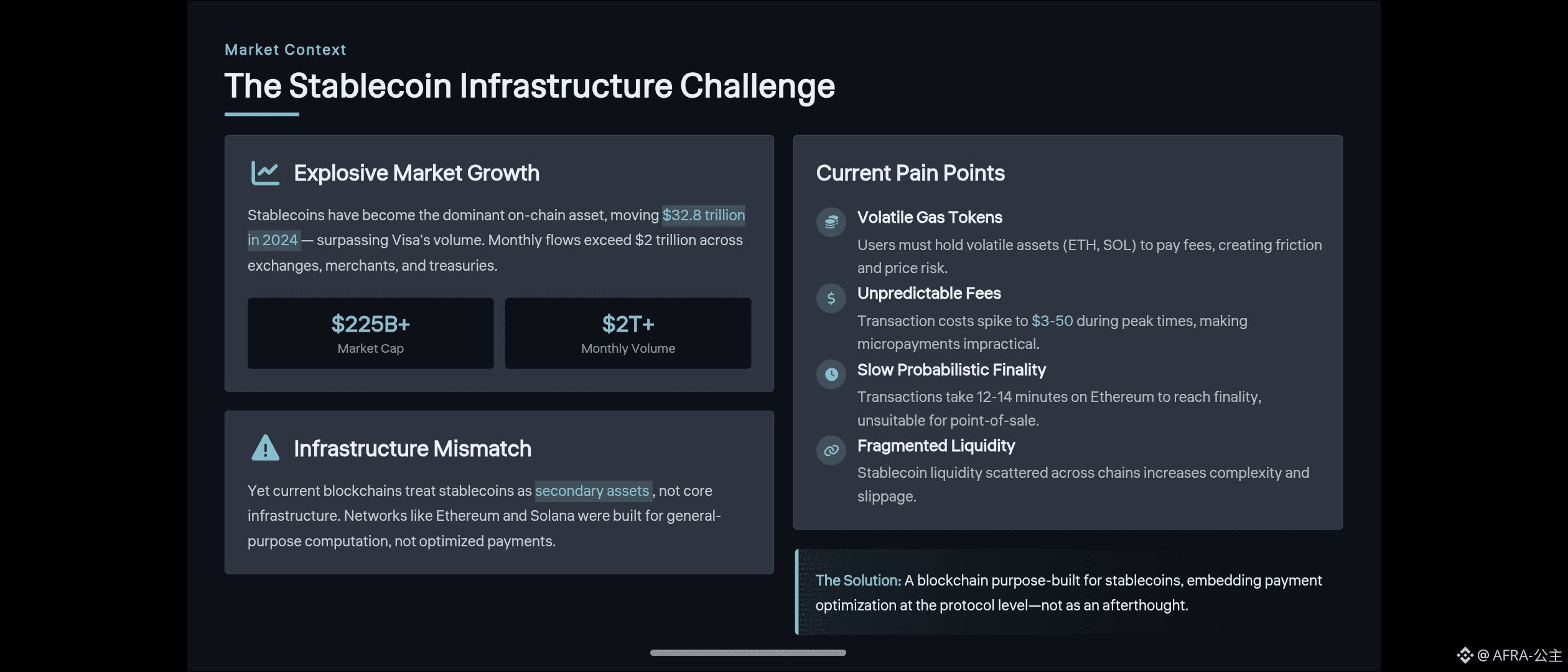
Stablecoins are supposed to be the killer app The thing that finally bridges crypto and actual commerce Yet here we are in 2026 and sending USDT still feels like driving a Ferrari through a school zone The infrastructure underneath these digital dollars was never designed for them Plasma fixes this mismatch at the protocol level and honestly it's about time someone did
What Plasma built isn't another generic Layer 1 chasing the fastest TPS trophy It's a settlement layer architected specifically for stablecoins from day one The team looked at the current landscape saw Ethereum's congestion issues Solana's reliability concerns and the fact that most chains treat stablecoins as an afterthought and said nah we can do better
The core insight is simple but powerful Stablecoins don't need meme coin speculation mechanics They need predictable finality reasonable costs and a security model that doesn't make CFOs lose sleep Plasma delivers this by combining three elements that rarely coexist full EVM compatibility via Reth sub-second finality through their custom PlasmaBFT consensus and a Bitcoin-anchored security approach that adds genuine neutrality
Let's talk about that EVM compatibility because it's crucial Plasma didn't reinvent the smart contract wheel They forked Reth which means every tool every Solidity contract every hacky script you've written works out of the box No learning curve No almost EVM compatible caveats that lead to weird bugs at 3am For developers building payment systems or financial infrastructure this is massive You can port existing DeFi logic compliance tools or accounting systems without rewriting everything The ecosystem inherits fifteen years of Ethereum developer knowledge overnight

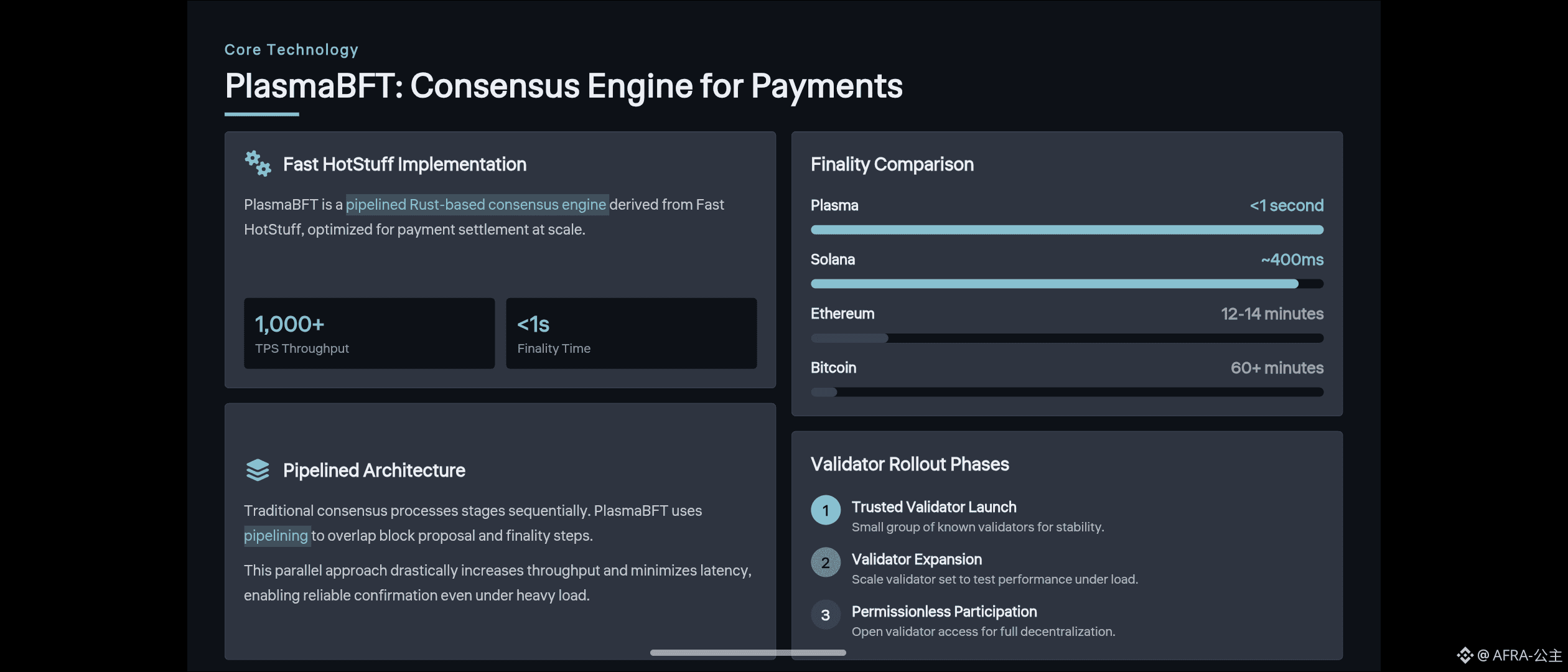
But here's where it gets interesting While most EVM chains slap on some variant of Proof of Stake and call it innovation Plasma rolled their own consensus PlasmaBFT isn't just a clever acronym It's a practical solution to the time to finality problem that plagues stablecoin transactions We're talking sub-second finality Not a few seconds if network conditions are perfect but consistently under a second For payment processors exchanges or any platform moving serious stablecoin volume this changes operational dynamics completely You can confirm customer deposits before they refresh their balance You can stream micropayments without the UX nightmares of pending transactions
The stablecoin features are where Plasma's specialization really shows Gasless USDT transfers sound like a gimmick until you realize how much friction they remove New users don't need to buy native tokens just to move their stablecoins They can sweep dust from dozens of small transactions without losing half the value to fees For businesses this translates to cleaner accounting and happier customers No more I can't send my USDT because I'm 00001 ETH short support tickets
Then there's the stablecoin-first gas mechanism Instead of forcing users to hold yet another volatile token for transaction fees Plasma lets you pay gas directly in stablecoins The economics are transparent The fee estimation makes sense When your CFO asks what will this cost you can give an actual dollar amount that won't swing 40% overnight This seems minor but it's one of those paper cuts that makes enterprise adoption painful on other chains
Security is where things get contrarian While everyone else debates Proof of Stake vs Proof of Work Plasma anchored their chain to Bitcoin Not in some wrapped token way but at the protocol level Block hashes from Plasma get committed to Bitcoin creating an immutable checkpoint system that leverages Bitcoin's mining power without trying to compete with it This isn't about maximalism it's about pragmatism Bitcoin's security budget is orders of magnitude larger than any other chain Tapping into that for settlement finality gives Plasma a neutrality that corporate compliance departments actually respect
The target user mix is telling Plasma isn't just courting crypto natives They're building for retail adoption in high stablecoin penetration markets think Southeast Asia parts of Latin America and increasingly Africa These are places where people already use USDT for remittance savings and daily commerce The infrastructure just needs to not suck A five cent fee and three second confirmation for a 20 remittance is workable Five dollars and three minutes is now
On the institutional side payment processors and fintech companies are the real prize These entities need programmable money without the reputational risk of building on chains that double as casino floors Plasma's architecture lets them deploy compliant payment rails implement proper KYC/AML at the application layer and process volumes that would make most DeFi protocols buckle The Bitcoin anchoring gives their risk committees a story they can sell internally It's not some new blockchain it's Bitcoin-secured settlement infrastructure
The ecosystem development reflects this focus While other chains court NFT marketplaces and onchain games Plasma's early builders are payment gateways remittance platforms and institutional custody solutions The dApps launching on Plasma look more like traditional fintech products than crypto experiments That's not a bug it's the whole point Mass adoption won't come from convincing everyone to ape into JPEGs It'll come from making digital dollars work as seamlessly as the old banking system but globally and without the predatory fees
Looking at token economics the XPL token serves purposes that actually make sense within this framework It's not trying to be money It's a utility token for securing the network through staking governing protocol upgrades and coordinating validator incentives The supply mechanics are designed for long term sustainability rather than short term yield farming games You stake to help secure stablecoin transactions not to chase 20% APY that'll collapse next cycle This is boring in the best possible way
The roadmap shows similar restraint No promises of infinite scaling or world computer dreams Just iterative improvements to settlement throughput validator decentralization and stablecoin specific features The team seems to understand that in infrastructure reliability beats novelty every time You don't want your payment network to be exciting You want it to be predictable
Critics will argue that specializing this heavily limits Plasma's addressable market Maybe But the opposite view is more compelling In a world where every chain is a general purpose platform the specialized solution often wins Visa didn't beat Mastercard by being a worse Mastercard It won by focusing on specific use cases and nailing them Plasma is applying that logic to blockchain settlement
The competitive landscape is crowded no doubt Established Layer 2s are getting cheaper New Layer 1s promise absurd throughput But none of them are built from the ground up for stablecoins They're adapted retrofitted or just happen to be good enough Plasma is the first major attempt to say stablecoins deserve their own infrastructure and then actually build it properly
For developers tired of explaining crypto quirks to traditional finance partners Plasma offers something rare A blockchain story that doesn't require three paragraphs of caveats Yes it's fast Yes it's secure Yes it works with your existing tools Yes the fees are stable These simple yeses matter more than any technical spec sheet
The Bitcoin anchoring deserves another mention because it's politically smart In an era of regulatory uncertainty being able to point to Bitcoin's established regulatory treatment as part of your security model is valuable It's not a magic shield but it changes the conversation from unproven technology to innovation built on proven infrastructure For companies navigating compliance across multiple jurisdictions this framing helps
Market timing works in Plasma's favor Stablecoin usage is no longer theoretical Trillions in volume flow through these tokens annually The infrastructure strain is showing Ethereum's L2 ecosystem is a patchwork solution Alternative L1s have their own issues There's a real opportunity for a purpose built chain to capture significant market share especially in B2B payments where reliability trumps all other metrics
The community building around Plasma feels different too Less speculation more builders solving actual payment problems The Discord discussions lean heavily into compliance frameworks enterprise integration patterns and stablecoin liquidity management It's not the usual token price chatter This culture shift is subtle but important It attracts a different kind of contributor one more likely to build sustainable businesses than short lived forks
Looking ahead the success metric for Plasma won't be all time high prices or viral marketing campaigns It'll be transaction volume from real commerce Every remittance platform that switches every neobank that integrates every payment processor that adds it as a settlement option These are quiet wins that don't generate hype tweets but do generate sustainable value
The crypto space needs more of this Less grand vision more practical execution Less changing the world more making current systems work better Plasma's approach of combining battle tested Ethereum tooling with Bitcoin security and stablecoin specific features might not sound revolutionary on paper But in practice it's exactly what the most important use case in crypto actually needs
If stablecoins truly are the Trojan horse for mainstream crypto adoption then Plasma might be the first blockchain that actually fits inside the horse properly Not too big not too small not trying to be everything Just focused on being the best possible settlement layer for digital dollars In an industry obsessed with complexity that kind of focus is almost radical
The infrastructure arms race in crypto has been about abstract performance metrics for years Plasma shifts the conversation back to what matters for actual usage Can I send money quickly Is it cheap enough Will it definitely get there Is the cost predictable Yes yes yes and yes That's the whole pitch Everything else is just noise
For payment industry veterans watching crypto from the sidelines Plasma is probably the first chain that speaks their language The technical decisions map to business requirements instead of philosophical debates The tradeoffs are transparent and defensible The security model aligns with traditional risk management principles This isn't accidental It's a product of building for users who don't care about blockchain they care about moving value reliably
The question isn't whether Plasma can outcompete Ethereum or Solana at their own games It's whether being the best stablecoin settlement layer is a big enough prize With global remittance markets in the hundreds of billions and digital payments in the trillions the answer seems obvious You don't need to be the everything chain You just need to be the best at the thing people actually use crypto for Plasma @Plasma gets this The market is starting to notice #Plasma $XPL