
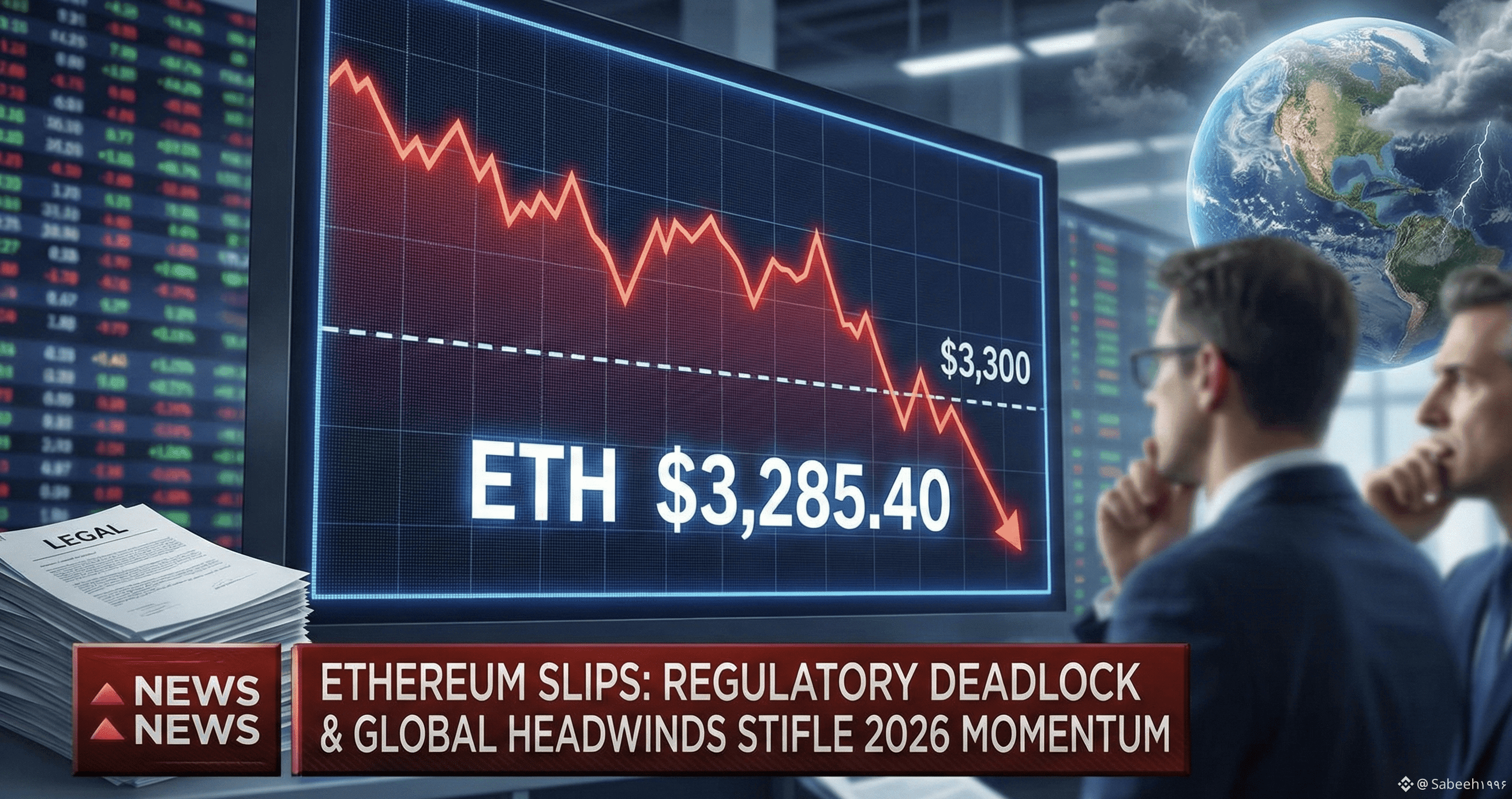
The cryptocurrency markets closed a turbulent week on Saturday with a deceptive calm. While market data indicates Ethereum (ETH) recorded a narrowed 0.38% increase over the last 24 hours, trading at approximately $3,298, the underlying structure tells a story of significant fragility. The world’s second-largest asset has slipped below the critical psychological support of $3,300, a move driven by a "perfect storm" of stalled US legislation, looming trade tariffs, and new barriers to liquidity in South Korea.
The "Hollow" Green Candle
To the casual observer, Ethereum's performance on January 17 might appear stable. Binance Market Data recorded the asset trading at $3,298.92, marking a fractional gain for the day. However, analysts are characterizing this as a "hollow" signal—a volatility compression that often precedes a sharper move.
The slide below $3,300 is significant because it invalidates the consolidation channel that ETH had maintained since early January. Throughout the week, Ethereum tested highs of $3,402 but failed to sustain momentum, ultimately succumbing to sell pressure as volume decoupled from price. Trading volumes for Ethereum cooled by 32% to $54 billion, indicating that institutional buyers are stepping back to assess the shifting regulatory landscape.
Legislative Collapse: The Coinbase Catalyst
The primary driver of this week's bearish sentiment is the sudden destabilization of the "CLARITY Act," a bill intended to provide regulatory certainty for the US crypto market. On January 16, Coinbase, a bellwether for the industry, formally withdrew its support for the legislation.
Coinbase CEO Brian Armstrong cited a "de facto ban on tokenized equities" within the draft as a dealbreaker, stating the company would "rather have no bill than a bad bill." This provision is particularly damaging to Ethereum, as the tokenization of real-world assets (RWA) has been a central thesis for its growth in 2026.
"The withdrawal of support serves as a reality check," notes a report from The Block. "Legal hurdles remain sticky and complex, even under a theoretically pro-crypto administration." The Senate Banking Committee’s subsequent decision to delay the markup of the bill has left the market in a state of regulatory limbo, forcing a repricing of assets that had baked in a legislative victory.
The Asian Liquidity Shock
Compounding the US legislative woes is a silent crisis unfolding in South Korea, a critical hub for retail crypto liquidity. Reports confirm that starting January 28, the Google Play Store will block downloads for unregistered overseas cryptocurrency exchanges, effectively cutting off easy access to global platforms like Binance and OKX for Korean users.
The regulation requires exchanges to register as Virtual Asset Service Providers (VASPs), a hurdle most foreign entities cannot clear. This policy creates friction for the "Kimchi Premium" arbitrage trade and isolates one of the most active retail trading populations from the global liquidity pool. The anticipation of this ban has likely contributed to the "wait-and-see" approach adopted by whales and retail traders alike.
Macro Shadows: Tariffs and the Fed
Beyond the crypto-specific headwinds, the macroeconomic environment remains hostile. The market is currently digesting the implications of President Trump’s proposed 2026 tariffs, which escalate from 10% to 25%. These trade tensions have sparked a broad "risk-off" wave, slashing the total crypto market capitalization by an estimated $800 billion since the start of the year.
Simultaneously, unexpected friction between the White House and the Federal Reserve has rattled investor confidence. Fed Chair Jerome Powell recently warned of attempts to undermine central bank independence, a development that introduces uncertainty into the monetary policy outlook.
Technical Outlook: The Path to $3,000?
With the $3,300 support broken, technical analysts are eyeing lower levels. The immediate "line in the sand" lies at $3,280. A sustained break below this trendline could see Ethereum drift toward the 55-day Simple Moving Average (SMA) at approximately $3,025.
"The tape is not collapsing, but momentum is muted," notes an analysis from Investing.com. "The short-term picture remains tactically bearish as long as price trades below the recent $3,306 pivot."
However, not all indicators are bearish. On-chain data reveals a divergence between price and utility. The creation of new Ethereum wallets hit an all-time high this week, averaging 327,000 per day, driven by the "Fusaka" protocol upgrade which has significantly reduced transaction fees. This suggests that while the asset price struggles, the network's fundamental adoption curve remains intact.
Conclusion
As the market heads into late January, Ethereum finds itself decoupling from the "safety trade" of Bitcoin, which has managed to hold the $95,000 level more firmly. For Ethereum to reclaim its bullish trajectory, it will likely need a resolution to the legislative standoff in Washington or a cooling of global trade tensions. Until then, the "green" daily close of January 17 may be remembered as a misleading pause in a broader repricing even

