

@Dusk When someone calls a token the “core asset” of a network, I think the cleanest test is also the least flattering one: what stops working if the token disappears? On Dusk, DUSK isn’t a decorative unit that sits next to the protocol. It’s wired into the system as the currency for network fees, the asset used to secure consensus through staking, and the incentive that keeps validators (Dusk calls them provisioners) showing up and behaving. That combination is what makes it “core” in a practical sense, not a rhetorical one.
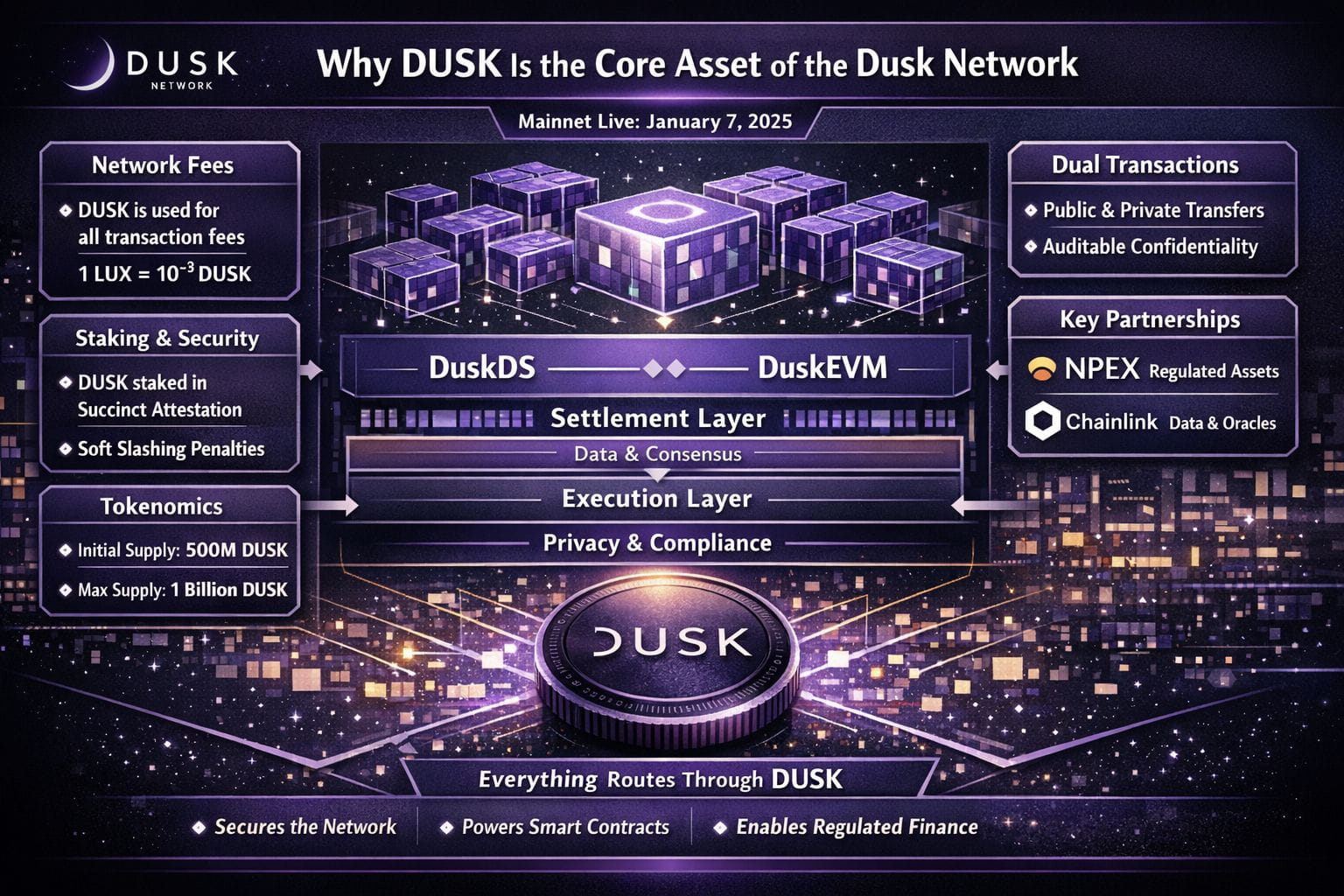
Dusk keeps coming up again because it has moved past the “one day” phase. Mainnet became operational on January 7, 2025, and that shift matters: once a network is producing final blocks, questions about governance, uptime, fees, and security stop being abstract. At the same time, the wider market is paying more attention to regulated on-chain assets—things like funds and stablecoins—where privacy can’t be treated as a luxury, but compliance can’t be shrugged off either. That’s the tension Dusk is building for, and it’s why the token’s role feels more consequential right now.
Start with fees, because fees are where “network demand” becomes measurable. Dusk’s documentation is explicit that DUSK is used to pay network fees, and that every transaction consumes gas. It even spells out the unit relationship: gas prices are expressed in LUX, with 1 LUX equal to 10⁻⁹ DUSK. That detail sounds small, but it’s the kind of plumbing that turns a token into an operating input. If people are issuing assets, trading, or settling on-chain, they have to budget for block space in DUSK terms. There isn’t an alternate fuel hiding under the hood.
Then there’s security, which is where the “core asset” claim either holds up or collapses. Dusk runs a proof-of-stake consensus design called Succinct Attestation, built around committees that propose, validate, and ratify blocks for deterministic finality. To participate, provisioners stake DUSK, and the protocol uses slashing to discourage negligence and misbehavior. What’s interesting is the shape of that slashing: Dusk describes “soft slashing” that doesn’t burn the stake, but instead suspends it from committee selection and stops it from earning rewards for a period, with repeated faults increasing the penalty. That design choice says a lot about priorities. It aims to be strict enough to protect settlement, but structured in a way that feels compatible with institutional expectations around operational risk.
Token supply is the slow background force that makes both fees and staking behave. Dusk’s tokenomics describe an initial supply of 500 million DUSK and an additional 500 million emitted over 36 years to reward Stakeholders, with a maximum supply of 1 billion. I’m cautious about treating emissions as either “good” or “bad” by default. Early networks rarely generate enough fees to pay for security, so emissions often act like training wheels. The real question is whether usage—actual transactions that matter—eventually carries more of the load than subsidies.
DUSK also matters because Dusk is deliberately splitting itself into layers, and the token is what ties those layers together. The docs describe DuskDS as the consensus, data availability, and settlement layer, and DuskEVM as the Ethereum-compatible execution layer where DUSK is the native gas token. The point here isn’t buzzwords; it’s adoption friction. If developers can use familiar EVM tooling while the base layer provides final settlement designed for regulated markets, DUSK becomes the shared denominator across the stack.
Privacy is the other half of the story, and it’s where Dusk’s protocol choices make the token’s role feel more anchored in real use. Dusk describes dual transaction models—public when transparency is needed, shielded when confidentiality is the responsible default—with the ability to reveal information to authorized parties when required. On the EVM side, Dusk introduced Hedger as a privacy engine for DuskEVM, aiming for confidential transactions that are still auditable—an explicit nod to regulated finance rather than underground anonymity.
Finally, there’s the “so what” of real progress: partnerships that imply actual rails, not just aspiration. Dusk’s commercial partnership with NPEX has been framed around issuing, trading, and tokenizing regulated instruments, and Dusk later highlighted NPEX’s licensing footprint as part of its compliance story. The Chainlink partnership announcement in November 2025 adds another practical layer—market data and integration patterns that traditional finance expects when it moves beyond pilots.
So, is DUSK the core asset? In a plain reading of the protocol, yes—because it pays for activity, secures settlement, and incentives the actors who keep the chain alive. The more delicate question is whether Dusk can make those mechanics feel invisible to end users while still capturing real usage underneath. If that happens, DUSK’s “core” status won’t be a slogan. It’ll be the quiet fact that everything routes through.
