

@Dusk In the early days of DeFi, “public” felt like a feature you could celebrate without caveats. You could trace flows, verify reserves, and watch markets clear in real time. But the longer public ledgers sit next to real businesses and regulate money, the more that same visibility starts to feel like fluorescent lighting in a room where people are trying to do careful work. Traders leak intent, companies leak relationships, and everyday users leak patterns they never agreed to share. The question isn’t whether privacy belongs onchain anymore. It’s what kind of privacy can exist without breaking auditability, and whether anyone can actually adopt it without turning the system into a black box.
This is trending now because tokenization is no longer just pilots and conference decks. BlackRock’s tokenized money market fund, Build, launched in March 2024 and passed $1 billion in AUM as reported in March 2025. At the same time, large financial institutions have been building tokenized plumbing for money market funds and settlement, including collaborations like Goldman Sachs and BNY Mellon to represent fund shares as tokens. When the assets start to look like “normal finance,” the privacy question stops being philosophical and becomes operational: who can see what, when, and with what consequences?
Policy is basically catching up with the direction of travel. MiCA became fully applicable EU-wide on December 30, 2024, which finally puts a more consistent framework around crypto services and some token categories. Then FATF, in June 2025, reinforced the same theme by revising R.16—pushing for better information to travel with cross-border payments so it’s harder for bad activity to hide. Even the Tornado Cash episode underlines the moment we’re in: the U.S. Treasury removed the economic sanctions in March 2025, but did so while reiterating concerns about illicit finance. The industry is being asked, in effect, to grow up: protect legitimate privacy, but keep credible paths for oversight.
Public-ledger finance still has a genuine advantage that shouldn’t be minimized. Auditability is native. The ledger is the record, and you don’t need special access to verify that something happened. Open systems do serve a purpose: they create accountability, and that can put pressure on bad behavior. But the problems they introduce are often invisible at first, and then suddenly very personal. Settlement becomes a spectacle. Positions become targets. Compliance becomes awkward, because firms either accept exposure that would never fly in traditional markets, or they retreat into permissioned silos that lose the original point.
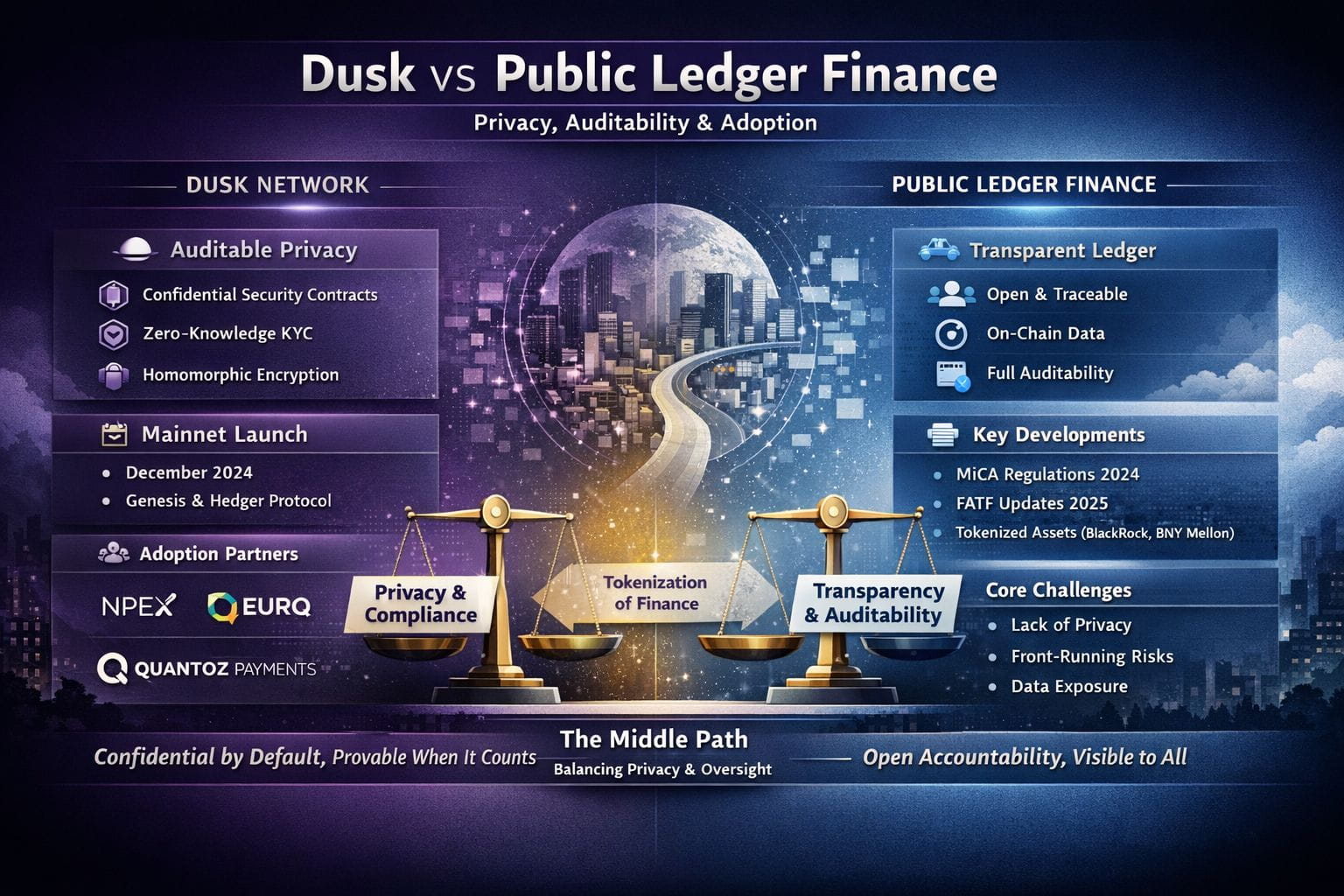
Dusk’s bet is that this trade-off is unnecessary. Instead of treating privacy as an add-on you bolt onto a public chain, Dusk frames “auditable privacy” as the default for regulated finance: keep sensitive details confidential by default, but make it possible to prove that rules were followed. Its XSC (Confidential Security Contract) standard is explicitly aimed at issuing and managing tokenized securities where ownership and transfers can be kept private without abandoning enforceability. If that sounds like splitting the difference, it is—and in my view, that’s exactly why it’s interesting. The market doesn’t need secrecy for its own sake; it needs selective disclosure that maps to how compliance actually works.
What makes the Dusk approach more than a slogan is the way it’s been packaged into concrete building blocks. The project began a mainnet rollout in December 2024, with plans laid out publicly for genesis onramping and the first immutable block in early January. It also published third-party security work, including an Oak Security audit of its consensus and economic protocol. On the execution side, Dusk has described Hedger as a privacy engine for its EVM layer, combining homomorphic encryption and zero-knowledge proofs to support confidential transactions in a way intended to stay compatible with regulated use cases. Then there’s identity. Citadel, introduced earlier, is framed as a zero-knowledge KYC approach where users can control what they disclose while still meeting compliance checks.
Adoption is where “public vs private” stops being an argument and becomes a test. Dusk has leaned into partnerships that look like actual rails: an agreement with NPEX to build toward a blockchain-powered security exchange, and later writing about how that partnership connects to specific licensing concepts and the DLT pilot regime environment in Europe. It has also announced work with Quantoz Payments and NPEX to bring EURQ onto Dusk, which hints at the unglamorous but essential stablecoin side of real markets. And it has pointed to interoperability efforts with Chainlink standards, which matters if tokenized assets are going to move between venues rather than living in one walled garden.
None of this guarantees that Dusk “wins.” Liquidity, developer habits, and network effects are brutal forces, and public ledgers have years of head start. But the direction of travel is hard to ignore. As tokenization grows and compliance expectations harden, the industry is being pulled toward systems that can offer privacy without forfeiting accountability. Dusk is best understood as one clear attempt at that middle path: not maximal transparency, not total opacity, but something closer to how financial markets already behave when they’re functioning well—confidential by default, provable when it counts.
