

@Walrus 🦭/acc There’s a moment in every tech cycle where “storage” stops being a background utility and becomes the bottleneck everyone argues about. Walrus is landing in that moment because web3 apps are starting to look like real applications: they ship media, they ship datasets, and they increasingly ship AI workflows that don’t fit inside a transaction. When someone says decentralization feels slow, they’re often reacting to everything around consensus—images, model files, logs, and the lingering fear that what you uploaded today won’t actually be retrievable tomorrow.
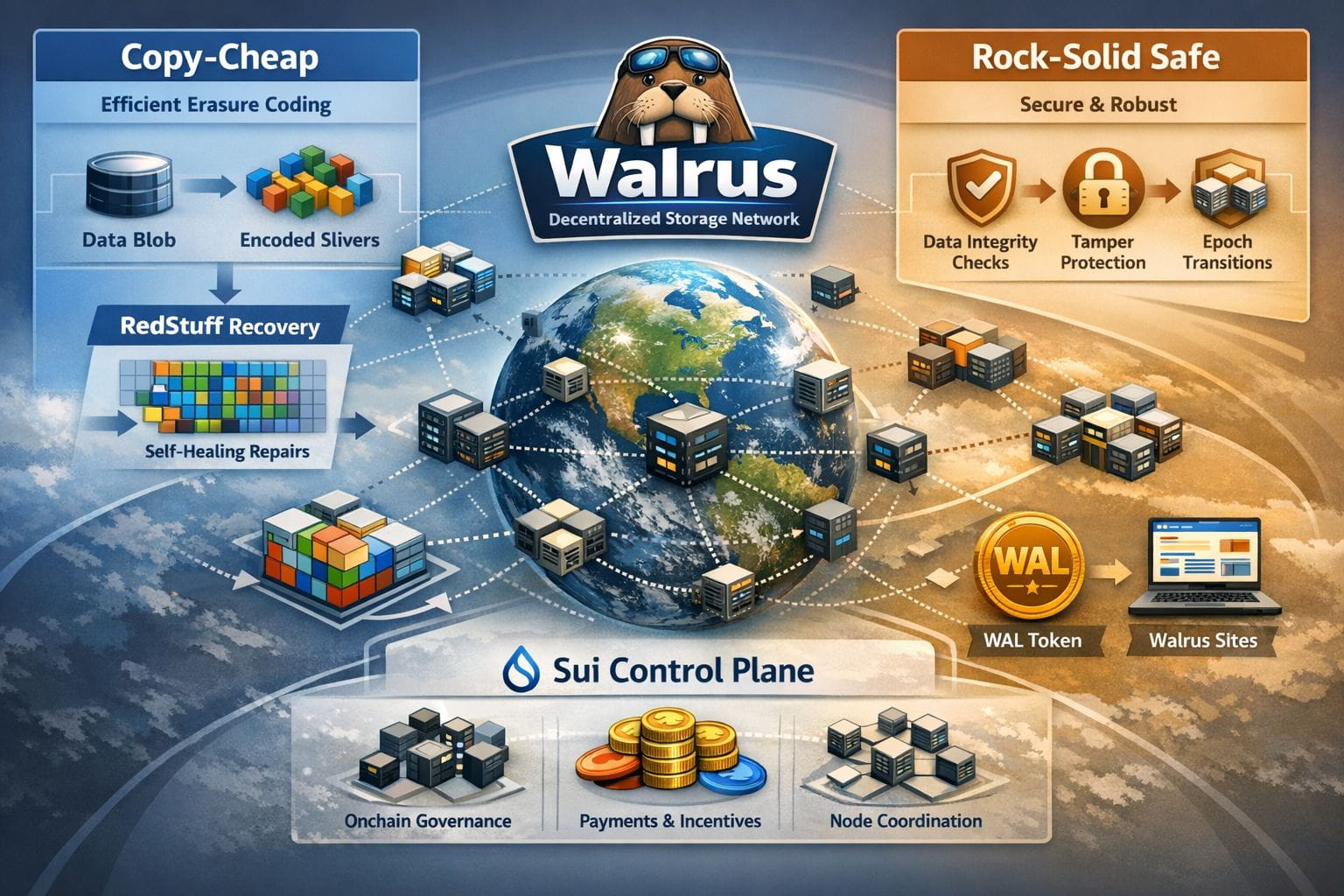
Walrus is a decentralized “blob” storage protocol that uses Sui as its control plane. In plain terms, the chain coordinates ownership, payments, and the rules of participation, while Walrus handles the heavy bytes across storage nodes built for that job. This split is the whole point: onchain storage is pricey and fully replicated by default, while purely offchain storage can turn into a trust exercise unless verification is cheap enough to feel routine.
The title phrase sounds like a slogan, but it maps cleanly onto the protocol’s core trade-offs. “Copy-Cheap” is a quiet critique of brute replication, the old habit of storing full copies everywhere and paying for every duplicate forever. Walrus leans on erasure coding, encoding each blob into many smaller “slivers” plus redundancy so the original can be reconstructed from only a subset. Mysten describes the resilience goal bluntly: reconstruction should still work even if a large fraction of slivers are missing.
What makes that “cheap” more than a marketing word is recovery. The Walrus research introduces RedStuff, a two-dimensional erasure coding design aimed at self-healing in a way that doesn’t require pulling down the entire blob just to repair losses. That nuance rarely makes it into timeline discourse, but it matters in practice because real networks lose small pieces all the time. A storage system that treats every nick as a full restart becomes expensive in a thousand tiny ways.
“Rock-Solid Safe” is about assuming the network is messy on purpose. Walrus is designed around asynchronous conditions, where messages can be delayed or arrive out of order, and it treats that as normal rather than exceptional. The papers emphasize storage challenges that still work under those conditions, so an operator can’t “look honest” just by exploiting timing. It also uses authenticated data structures and consistency checks to defend against tampering and “split views,” where different readers could otherwise be tricked into reconstructing different data from the same blob reference.
Churn is the other unglamorous reality. Storage networks don’t sit still: nodes go offline, operators rotate keys, and incentives pull participants in and out. Walrus runs in epochs with committees of storage nodes, and the design describes multi-stage epoch changes intended to keep availability stable during transitions. You only fully appreciate this after you’ve watched systems that look sturdy in calm conditions wobble the first time something operational goes sideways.
Walrus is also trending because it’s not just a paper anymore. The Walrus docs announced mainnet in late March 2025, noting a decentralized network of 100+ storage nodes, WAL token usage for fees, and features like publishing/retrieving blobs and “Walrus Sites.” Once builders can actually ship with it, the conversation stops being theoretical and becomes comparative: retrieval reliability, behavior under load, tooling sharp edges, and whether cost is predictable as data volumes grow.
And cost really is where the title gets stress-tested. Walrus has leaned into simple headline numbers in community conversation, but the more grounded reference point is its own cost documentation and calculator tooling, which break down what you’re paying for (storage resources, uploads, and associated onchain actions) and how those costs are measured. The WAL token design also explicitly aims to reduce long-term volatility for users by structuring payments over time, which is a pragmatic answer to the “token-priced storage” anxiety that keeps resurfacing across web3.
If Walrus succeeds, it won’t be because storage became exciting. It’ll be because reliability became boring—copy-cheap through efficient redundancy, rock-solid safe through verification that still holds when networks are noisy, and usable enough that developers stop thinking about storage as a gamble and start treating it like infrastructure.


