
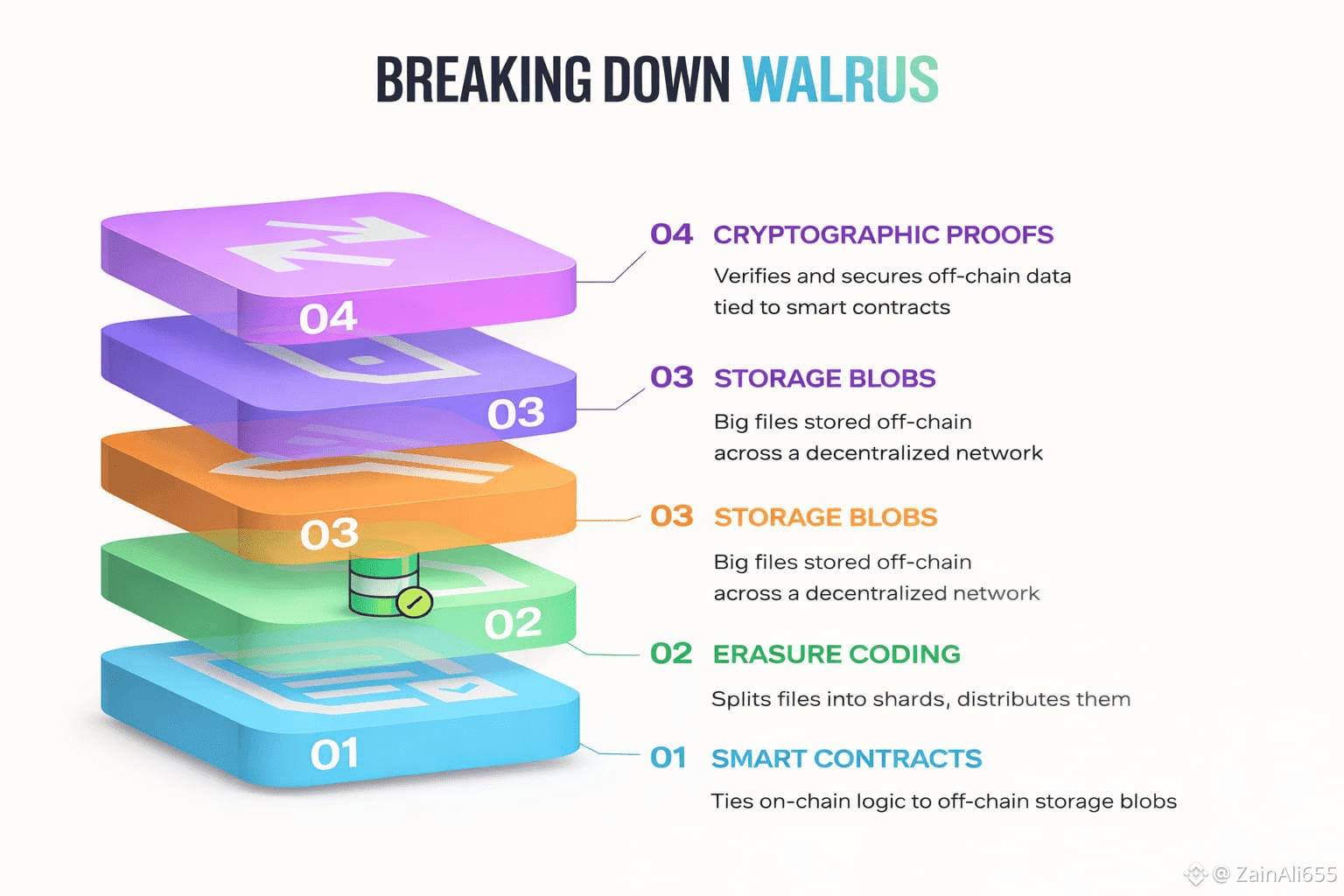
Let me explain Walrus the way I’d explain it to a smart friend who’s been around crypto long enough to be skeptical because honestly, that skepticism is earned. Web3 has never really had a clean answer for data. Tokens? Easy. Transactions? Fine. But real files videos, AI datasets, game assets, front ends those are huge, and blockchains were never meant to store them directly. For years, we kind of pretended otherwise, then quietly leaned on centralized servers when things broke. That’s why Walrus Protocol actually feels relevant right now, especially in 2026. Walrus isn’t trying to turn a blockchain into a hard drive. It’s doing something more practical. It lets large files live off-chain, but still be verifiable and controlled by on-chain logic. The protocol focuses on what it calls “blobs” big chunks of unstructured data and ties them back to smart contracts on Sui using cryptographic proofs. So contracts don’t store the data itself. They just know where it is, who owns it, and whether it’s still available. That separation matters more than people realize. Under the hood, @Walrus 🦭/acc uses erasure coding (often referred to as the “Red Stuff” design). Instead of copying entire files across every storage node, it breaks them into shards and distributes them across many operators. You don’t need every shard to recover the data just enough of them. That’s what keeps things resilient and affordable at the same time. And cost is the whole game here.
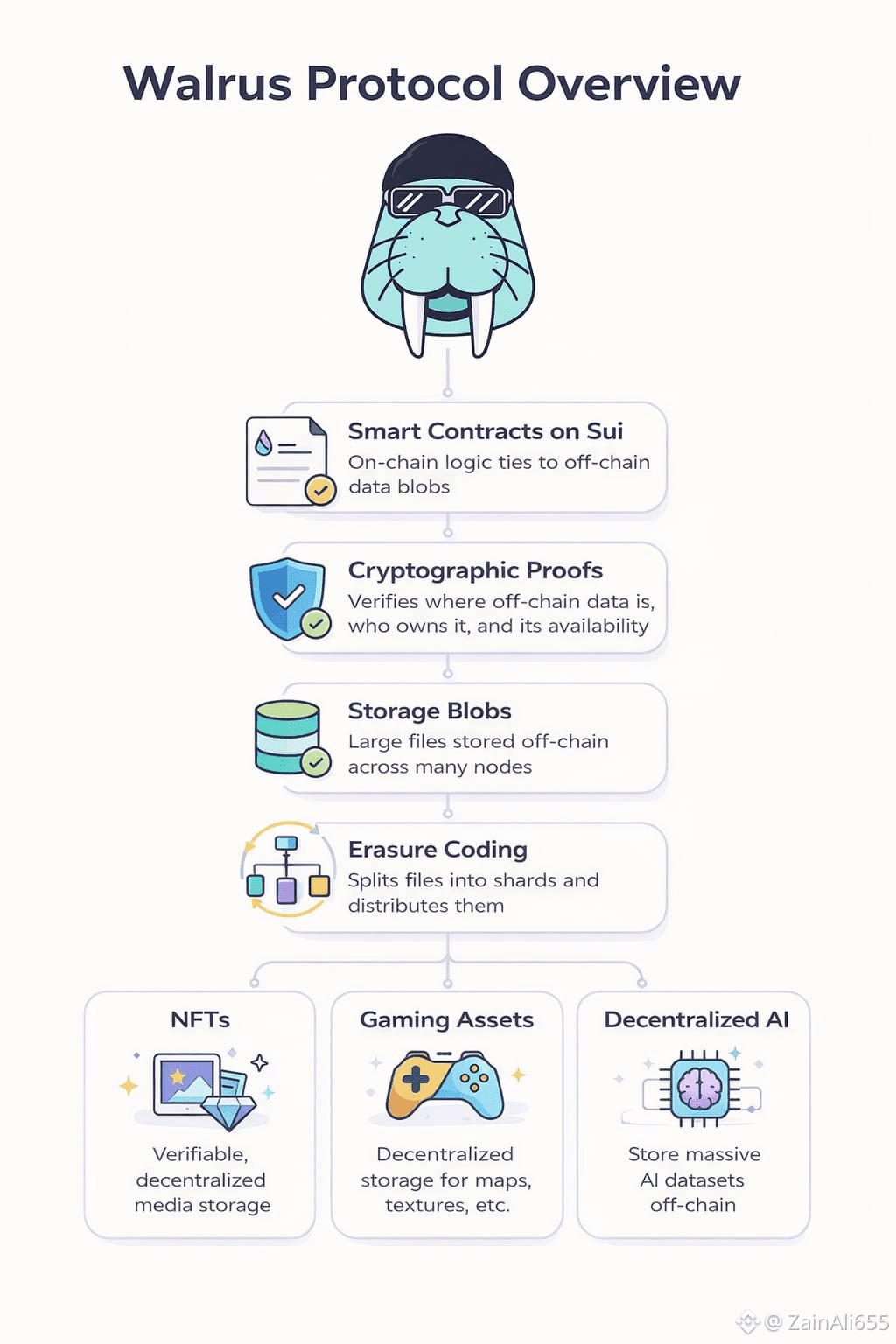
Full replication sounds safe, but it’s expensive and wasteful once datasets get big. Walrus’ design is why it’s often discussed as significantly cheaper for large-scale storage than older, full-replication networks. When storage gets cheaper, builders stop cutting corners. That’s when decentralization actually sticks. You can see this shift starting to happen in real use cases. NFTs are a good example. A lot of NFTs still rely on centralized servers or brittle IPFS gateways for their media. That’s awkward if you care about permanence. Walrus lets NFT images and videos live as verifiable blobs, directly tied to on-chain ownership logic. The same goes for decentralized social apps. User content is heavy photos, videos, feeds. When storage is expensive, teams quietly centralize. Walrus gives them a realistic alternative. Gaming is another obvious fit. Maps, textures, audio files none of this is small. Historically, Web3 games relied on Web2 storage because they had no choice. Walrus gives them a way to keep assets decentralized without killing performance or blowing up costs. AI is where things get especially interesting. Training data and model checkpoints are massive, and centralized storage creates trust and censorship risks. Walrus’ blob model works well for storing large AI datasets while letting on-chain logic manage access, ownership, or usage rights. That’s not a hypothetical we’re already seeing early AI-focused teams integrate Walrus as their data layer. Now let’s ground this with actual numbers, because vibes alone don’t cut it.
Recently, $WAL has been trading roughly in the $0.14–$0.15 range, with a market cap around $200–$230 million and a circulating supply of about 1.58 billion WAL. Daily trading volume has stayed in the millions, which tells me this isn’t a ghost token barely hanging on. It’s firmly in that mid-cap infrastructure zone big enough to be taken seriously, still early enough that adoption actually matters. There’s also serious backing behind this. Walrus raised $140 million in private funding ahead of mainnet, with participation from major crypto funds and institutional players. That kind of capital doesn’t show up for experiments. It shows up when investors believe something could become foundational infrastructure. But here’s the part people miss. Storage tokens don’t explode because of hype cycles. They grow when apps ship. When teams quietly depend on them. When removing them would break things. That’s slow, unsexy progress and that’s usually the good kind. Of course, there are risks. Decentralized storage only works if node operators are properly incentivized over the long term. Walrus has to keep those economics healthy. Competition is real too Arweave, Filecoin, IPFS-based systems aren’t standing still. And once data is stored somewhere, switching costs are real. #walrus has to win on reliability, tooling, and developer experience, not just price. There’s also the attention problem. Storage isn’t flashy. No one’s tweeting about shard repair rates. Progress can feel invisible but that’s often how the best infrastructure grows. What I personally like about Walrus is that it doesn’t pretend blockchains can do everything. It respects their limits. It treats decentralization as a stack, not a single layer. Chains verify and coordinate. Storage networks distribute data. Walrus connects those layers cleanly. So when I look at Walrus in 2026, I don’t see a “storage narrative.” I see a protocol quietly becoming part of the plumbing. And in crypto, the things everyone eventually relies on without thinking about them are usually where the real value ends up living.


