
@Walrus 🦭/acc is a decentralized storage and data availability protocol built on the Sui blockchain, created to solve one of Web3’s most practical problems: how to store and serve massive amounts of real world data without relying on centralized cloud providers. Unlike traditional blockchains that struggle with large files, Walrus is optimized for “blobs” such as videos, images, AI training data, gaming assets, NFTs, and application media. Its goal is to make decentralized storage fast, reliable, censorship resistant, and affordable at scale.
Why this matters is simple. Modern applications, especially AI-driven and consumer facing Web3 products, depend heavily on large datasets. Centralized storage introduces single points of failure, censorship risks, opaque pricing, and trust assumptions. Walrus addresses this gap by offering a decentralized alternative that can compete with Web2 style storage while remaining native to blockchain infrastructure.
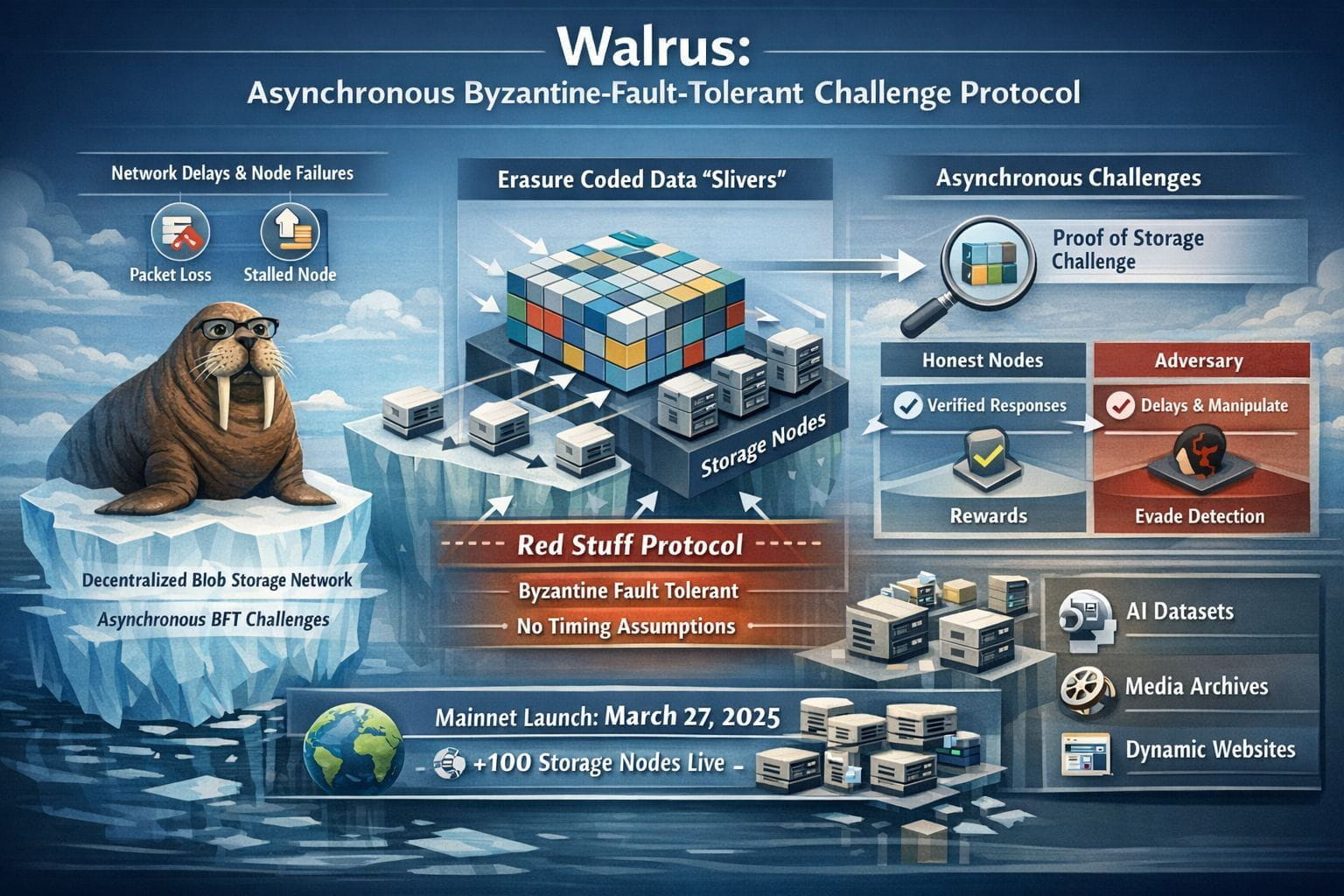
Technically, Walrus works by splitting files into many encoded fragments using erasure coding. These fragments are distributed across independent storage nodes. The system does not require every fragment to be online at the same time; only a subset is needed to reconstruct the original data. This design significantly improves resilience and lowers costs compared to full replication. The Sui blockchain plays a coordinating role by managing storage state, payments, availability proofs, and programmable access rules. Because blob objects are native to Sui, smart contracts can directly interact with stored data, enabling use cases like permissioned access, verification, revocation, and automated deletion. On top of this, encryption layers such as Seal allow applications to protect sensitive data while still benefiting from decentralized availability.
The WAL token is central to the protocol’s operation. It is used to pay for storage over time, rewarding node operators who provide space and prove availability. WAL can also be staked to support network security and align long term incentives. Governance mechanisms give token holders a voice in protocol upgrades and parameter changes. Importantly, Walrus is designed with cost stability in mind, aiming to keep storage pricing predictable relative to fiat rather than exposing users to extreme token volatility.
Since launching mainnet in early 2025, Walrus has moved from a research heavy phase into active ecosystem growth. Backed by roughly $140 million in funding from major crypto investors, the protocol has attracted teams building across AI, NFTs, and data markets. Integrations with projects like Talus AI, Itheum, TradePort, and other Web3 platforms highlight its role as backend infrastructure rather than a consumer facing app. Developer tooling has steadily improved, with more reliable SDKs, automation through GitHub Actions, and efficiency upgrades such as Quilt for handling many small files.
Looking ahead into 2026, the roadmap focuses on scaling storage throughput, expanding programmable access control, and enabling multichain support so applications on Ethereum, Cosmos, and Solana can use Walrus as a shared data layer. This direction aligns closely with growing demand for decentralized AI infrastructure and cross chain applications.
Challenges remain. Competition in decentralized storage is intense, multichain integration is complex, and token driven incentive models must remain balanced in volatile markets. Adoption will depend on whether developers choose Walrus over established alternatives and whether real world usage grows beyond experimentation.
Overall, Walrus represents a serious attempt to turn decentralized storage into practical infrastructure. It is no longer just an idea but a live network with real users, partners, and a clear vision. If decentralized applications and AI truly need open, censorship-resistant data layers, Walrus is positioning itself to be a core part of that future.