
I’m watching something remarkable unfold in the blockchain space, and it’s happening quieter than you might expect. While most cryptocurrency projects shout their innovations from the rooftops, Dusk Network has been building something fundamentally different. They’re not just creating another blockchain. They’re architecting a solution to one of the most pressing problems in modern finance: how do we maintain privacy while satisfying regulatory requirements?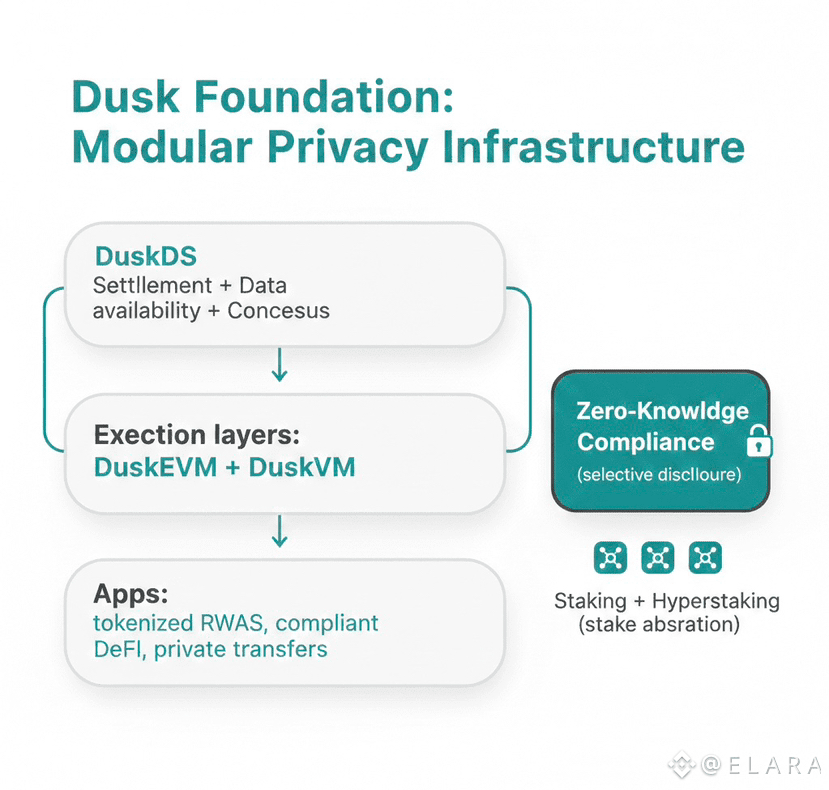
If you’ve been following the evolution of blockchain technology, you know that privacy and compliance have always stood at opposite ends of the spectrum. Bitcoin gave us transparency. Monero gave us privacy. But no one had really cracked the code on giving us both until now. Dusk Network represents a bridge between two worlds that many thought could never coexist.
The foundation of this project rests on a simple but powerful premise. Financial institutions need blockchain technology. They’re seeing the benefits of decentralization, immutability, and efficiency. But they can’t use public blockchains where every transaction is visible to everyone. Imagine a bank settling securities on Ethereum where competitors could see every move, every strategy, every client transaction. It becomes impossible. This is where Dusk enters the picture.
 Understanding the Core Problem
When I first started researching Dusk, I needed to understand what problem they were actually solving. The cryptocurrency space is filled with solutions looking for problems. But Dusk identified something real. Traditional financial institutions handle trillions of dollars in securities. These include stocks, bonds, real estate, and countless other assets. Moving these onto blockchain could save enormous amounts of time and money. Settlement times could drop from days to minutes. Costs could plummet. Transparency could increase where needed.
But there’s a catch. Financial regulations require selective disclosure. A company issuing bonds needs to know who owns them for compliance purposes. Investors need privacy from competitors. Regulators need access during audits. Public blockchains can’t handle this nuanced requirement. They’re either completely transparent or completely private. The financial world needs something in between.
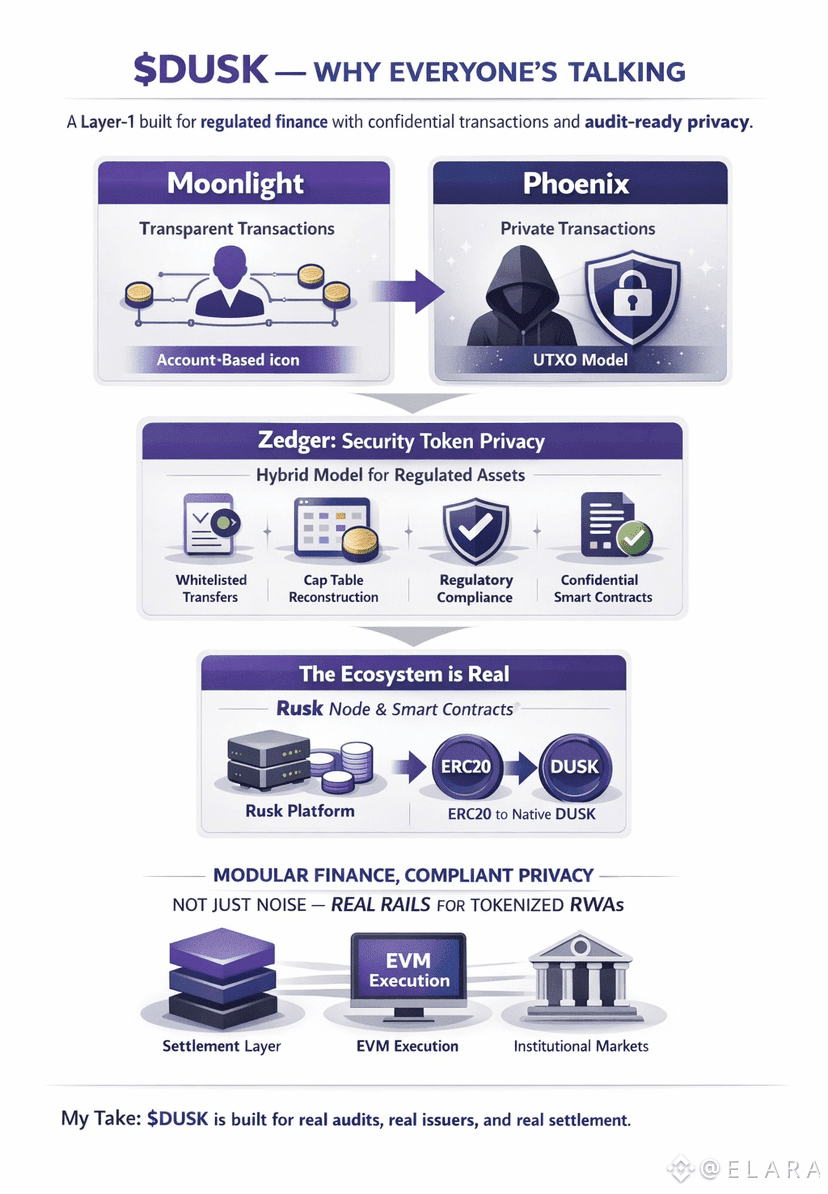
We’re seeing Dusk tackle this through what they call confidential security contracts. These are smart contracts that can handle regulated financial instruments while maintaining privacy where appropriate. Think of it as a sophisticated permission system built into the blockchain itself. Different parties can see different levels of information based on their role and regulatory requirements.
The Technology Behind the Vision
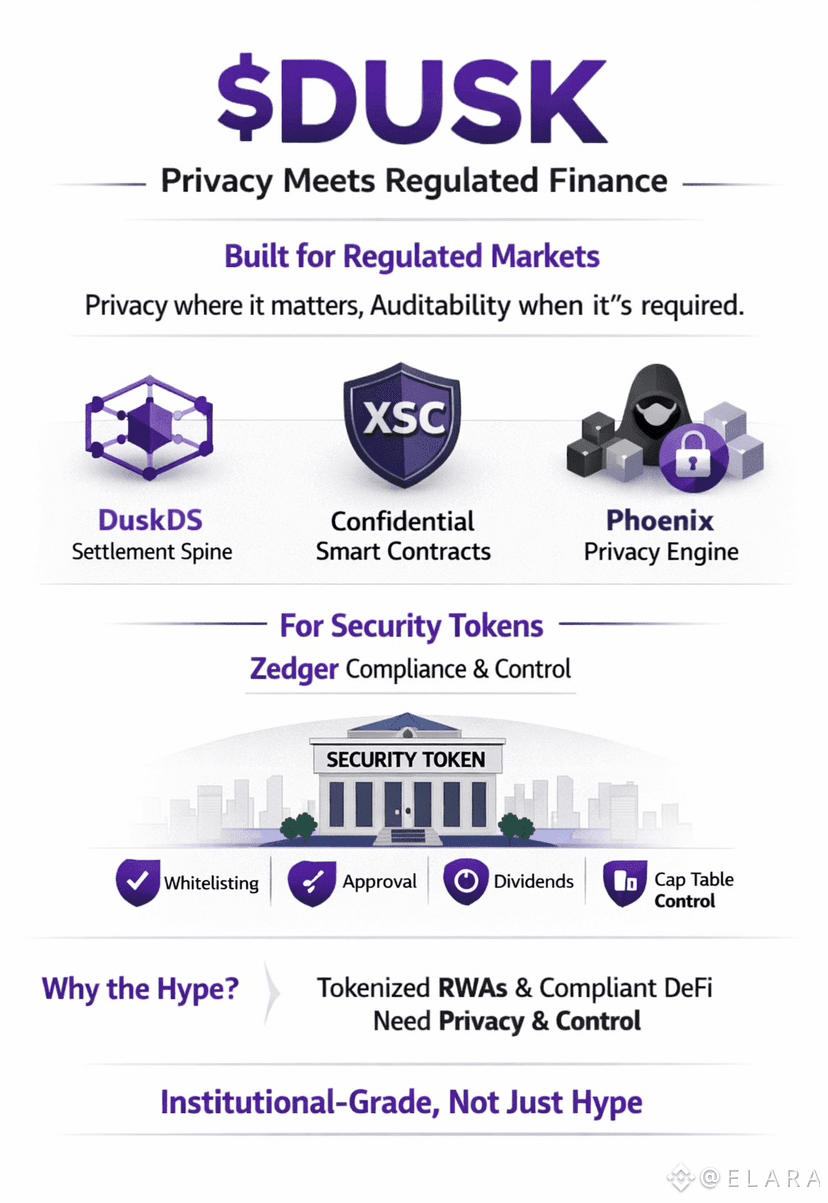
Dusk Network operates on a unique technological foundation. They’ve developed their own blockchain from the ground up, specifically designed for financial applications. At its heart lies something called Zedger. This isn’t just a clever name. It represents zero-knowledge ledger technology that enables confidential transactions.
Zero-knowledge proofs are mathematical methods that let one party prove to another that something is true without revealing any information beyond the validity of the statement itself. Imagine proving you have enough money to buy a house without showing your bank balance. That’s the kind of magic zero-knowledge proofs enable. Dusk has implemented these proofs at the protocol level, making privacy a default feature rather than an add-on.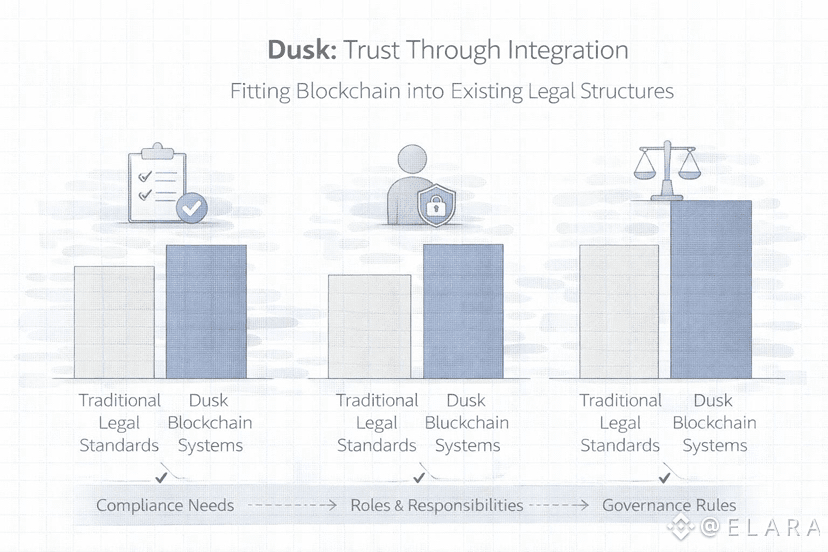
The consensus mechanism they use is called Succinct Attestation. It’s a variation of proof-of-stake that’s been optimized for speed and efficiency. Unlike traditional proof-of-stake systems where validators are chosen based on how much they stake, Succinct Attestation uses a verifiable random function to select block producers. This adds another layer of security and fairness to the network.
If it becomes necessary to understand the technical depth here, you need to know that Dusk isn’t using off-the-shelf components. They’ve built custom cryptographic protocols. Their transaction model is based on Phoenix, a protocol that enables confidential transactions with strong privacy guarantees. Every transaction on Dusk can be confidential by default, but the system allows for selective disclosure when regulations require it.
The Real World Applications
Understanding technology is one thing. Seeing how it applies to real-world problems is another. Dusk has identified several key areas where their blockchain can make an immediate impact. The most obvious is securities tokenization. This means taking traditional financial instruments and representing them as digital tokens on a blockchain.
Consider corporate bonds. Today, when a company issues bonds, the process involves multiple intermediaries. There are underwriters, custodians, clearing houses, and settlement systems. Each adds time and cost. Each introduces potential points of failure. Each requires trust. By tokenizing these bonds on Dusk, companies could issue them directly to investors. Settlement could happen in real-time. Costs could drop dramatically. But critically, all regulatory requirements could still be met through the blockchain’s built-in compliance features.
Real estate presents another compelling use case. Property ownership is essentially a registry maintained by government institutions. Transferring property involves lawyers, title companies, and extensive paperwork. The process can take weeks or months. They’re seeing interest in tokenizing real estate on Dusk because it could streamline this entire process. Property tokens could be transferred instantly while maintaining all necessary legal protections and regulatory compliance.
Another area is trade finance. International trade involves complex financial instruments like letters of credit. These require multiple parties to trust each other and verify information. The process is slow and paper-intensive. Dusk’s confidential smart contracts could automate much of this while keeping sensitive business information private. Competitors wouldn’t be able to see trade details, but all parties to a transaction would have the transparency they need.
 The Team and Development Journey
Behind every successful blockchain project is a team that understands both technology and the problem they’re solving. Dusk Network was founded by individuals with deep backgrounds in both cryptography and finance. They understood from the start that building a privacy-preserving blockchain for financial institutions wasn’t just a technical challenge. It required understanding regulatory frameworks, compliance requirements, and the actual needs of financial institutions.
The project has been in development for several years now. This isn’t a team that rushed to launch a minimum viable product. They’ve taken the time to build solid foundations. The development has been methodical and focused on creating something that financial institutions would actually want to use. This approach might seem slow compared to the fast-moving cryptocurrency space, but it reflects the seriousness of their mission.
Throughout their journey, they’ve maintained a focus on academic rigor. The cryptographic protocols underlying Dusk have been peer-reviewed. The team regularly publishes research papers detailing their innovations. This academic approach builds credibility in an industry often criticized for making bold claims without solid backing.
Regulatory Alignment and Compliance
One of the most interesting aspects of Dusk Network is how they’ve approached regulation. Many blockchain projects view regulators as obstacles to be circumvented or challenged. Dusk sees them as stakeholders to be satisfied. This fundamental difference in perspective shapes everything about the project.
Financial regulations exist for good reasons. They protect investors, prevent fraud, ensure market stability, and combat money laundering. Any blockchain hoping to be used by traditional financial institutions must work within these frameworks. Dusk has designed their technology with this reality front and center.
Their confidential security contracts can be programmed with compliance requirements built in. For example, a tokenized security could automatically enforce transfer restrictions. It could ensure that only accredited investors can purchase certain instruments. It could automatically report required information to regulators while keeping other details private. This programmable compliance is potentially revolutionary for financial institutions that currently handle these requirements through manual processes.
We’re seeing Dusk engage directly with regulatory bodies in Europe. They’re not waiting for regulations to come to them. They’re participating in the conversation about how blockchain technology should be regulated in financial markets. This proactive approach positions them well as regulations inevitably tighten around digital assets.
The Token Economics and Network Design
Like most blockchain projects, Dusk has its own native token, appropriately called DUSK. Understanding how this token functions within the network reveals a lot about the project’s design philosophy. The token serves multiple purposes within the ecosystem.
First and foremost, DUSK is used for transaction fees. When someone wants to execute a transaction or deploy a smart contract on the Dusk blockchain, they pay fees in DUSK. This gives the token fundamental utility. It’s not just a speculative asset but a necessary component of using the network.
Second, DUSK is used for staking. The network’s consensus mechanism requires validators to stake tokens as collateral. In return for securing the network and processing transactions, validators earn rewards in DUSK. This creates an economic incentive for honest behavior. If validators act maliciously, they risk losing their staked tokens.
The token distribution was designed to balance various stakeholder interests. A portion was allocated to the team and early investors with vesting schedules that align long-term incentives. Another portion was reserved for ecosystem development. The rest entered circulation through various means including public sales and liquidity provisions.
Challenges and Competition
No honest assessment of any blockchain project would be complete without acknowledging challenges and competition. Dusk Network operates in a space with significant obstacles. The blockchain industry itself remains in its early stages. Despite all the progress, mainstream adoption is still limited. Convincing traditional financial institutions to adopt blockchain technology requires overcoming deep institutional inertia.
Financial institutions are inherently conservative. They move slowly and carefully, especially when it comes to core infrastructure. Even if Dusk has built superior technology, getting banks and investment firms to actually use it represents a massive challenge. It requires not just technical excellence but also building relationships, establishing trust, and demonstrating regulatory compliance over time.
Competition in the blockchain space is fierce. While Dusk has a unique approach to privacy and compliance, they’re not the only project targeting financial institutions. Other blockchain platforms are developing their own solutions to similar problems. Some existing platforms with large networks and established developer communities are adding privacy features. Dusk needs to move quickly enough to establish themselves before competitors catch up.
They’re also facing the broader challenges affecting all cryptocurrency projects. Market volatility impacts token prices regardless of technical merit. Regulatory uncertainty in many jurisdictions creates hesitation among potential users. Public perception of cryptocurrency remains mixed, with ongoing concerns about fraud, speculation, and environmental impact.
Recent Developments and Momentum
Despite these challenges, recent developments suggest Dusk is making real progress. They’ve moved beyond pure research and development into practical implementation. The mainnet has been running for some time now, proving the technology works in practice, not just in theory.
Partnerships are beginning to emerge. While many of these remain under wraps due to the confidential nature of financial industry relationships, there are indications that financial institutions are taking Dusk seriously. Pilot programs exploring the tokenization of various assets are underway. These real-world tests are crucial for identifying issues and refining the technology.
The development community around Dusk has been growing. More developers are building on the platform, creating tools and applications that extend its capabilities. A healthy developer ecosystem is essential for any blockchain platform. It creates network effects where each new application makes the platform more valuable, attracting more developers in a virtuous cycle.
Educational initiatives have also expanded. Dusk has been working to explain their technology not just to developers but to financial professionals who might use it. This kind of education is often overlooked by blockchain projects but is crucial for adoption. Financial professionals need to understand not just that the technology works but how it works and why it benefits them.
The Broader Context of Financial Innovation
To fully appreciate what Dusk is attempting, it helps to step back and consider the broader context of innovation in finance. The financial industry has been undergoing digital transformation for decades. Trading that once happened on physical exchange floors now occurs in microseconds through electronic systems. Banking that required visiting a branch now happens on smartphones. This transformation continues accelerating.
Blockchain represents the next phase of this evolution. Just as electronic trading revolutionized stock markets and online banking changed retail banking, blockchain has the potential to transform how financial assets are issued, transferred, and managed. The key word is potential. Realizing this potential requires solving real problems, not just demonstrating technical capabilities.
Privacy represents one of those real problems. In an increasingly digital world, privacy is becoming both more important and more difficult to maintain. Financial privacy isn’t about hiding wrongdoing. It’s about protecting competitive advantages, personal information, and business strategies. Companies don’t want competitors seeing their capital allocation decisions. Investors don’t want others knowing their trading strategies. Privacy serves legitimate purposes.
At the same time, the need for regulatory compliance has never been greater. Financial crimes from money laundering to terrorist financing require sophisticated detection and prevention systems. Regulators around the world are demanding greater transparency and stronger controls. Any technology hoping to serve the financial industry must address these requirements.
Dusk is attempting to thread this needle. If they succeed, they could unlock enormous value. The tokenization market alone could be worth trillions of dollars. Every stock, bond, real estate property, and other asset could potentially be tokenized. The efficiency gains and new possibilities this creates are difficult to overstate.
Looking Forward
As I consider where Dusk Network might go from here, several scenarios seem possible. The optimistic scenario sees them successfully onboarding major financial institutions. Securities begin trading on their blockchain. Real estate gets tokenized at scale. The efficiency gains become obvious, creating pressure on institutions not using the technology to adopt it or risk competitive disadvantage. The DUSK token becomes an essential infrastructure component of modernized finance.
A more modest scenario has them carving out a niche. Perhaps they become the go-to solution for specific types of assets or certain jurisdictions with favorable regulatory environments. They don’t achieve universal adoption but establish themselves as a legitimate player in a multi-chain future where different blockchains serve different purposes.
The challenging scenario acknowledges that adoption could be slower than hoped. Financial institutions might take longer to move than expected. Competitors might develop similar capabilities. Regulatory frameworks might evolve in unexpected ways that reduce Dusk’s advantages. The technology might work perfectly while still struggling to achieve market traction.
Most likely, the reality will fall somewhere between these scenarios. Technology adoption rarely follows smooth, predictable paths. There will be breakthroughs and setbacks. Unexpected opportunities will emerge alongside unforeseen challenges. What matters is whether the team can adapt, whether the technology proves robust, and whether the fundamental value proposition remains compelling.
The Deeper Question
Beyond the specifics of Dusk Network lies a deeper question about the future of finance itself. Should financial transactions be completely transparent? Should they be completely private? Or is there some middle ground that serves society better? These aren’t just technical questions. They’re philosophical and political questions about the kind of financial system we want to have.
Traditional finance operated largely in private. Only the parties to a transaction knew its details. This privacy enabled commerce but also enabled fraud and abuse. The regulatory response has been to demand more transparency, more reporting, and more oversight. Public blockchains then emerged with complete transparency. Every transaction is visible to everyone forever. This solves some problems but creates others.
Dusk’s approach suggests a third way. Selective transparency where information is revealed to those who need it and hidden from those who don’t. Compliance without surveillance. Privacy without impunity. Whether this balance can be achieved in practice remains to be seen. But the attempt itself is valuable. It forces us to think carefully about what we actually want from our financial infrastructure.
As blockchain technology matures, these questions become increasingly urgent. The decisions made now about privacy, transparency, and control will shape financial systems for decades. Projects like Dusk aren’t just building technology. They’re proposing visions for how finance should work in a digital age. Whether their specific vision prevails or not, the conversation they’re contributing to matters enormously.
The next few years will tell us a great deal. We’ll see whether financial institutions truly adopt blockchain technology or whether it remains primarily a speculative asset class. We’ll see whether privacy-preserving techniques can satisfy regulators or whether they face pushback. We’ll see whether the technical solutions being built today can handle the scale and complexity of real-world finance. Dusk Network has positioned itself at the center of these questions. Their success or failure will offer insights that extend far beyond one project.
