
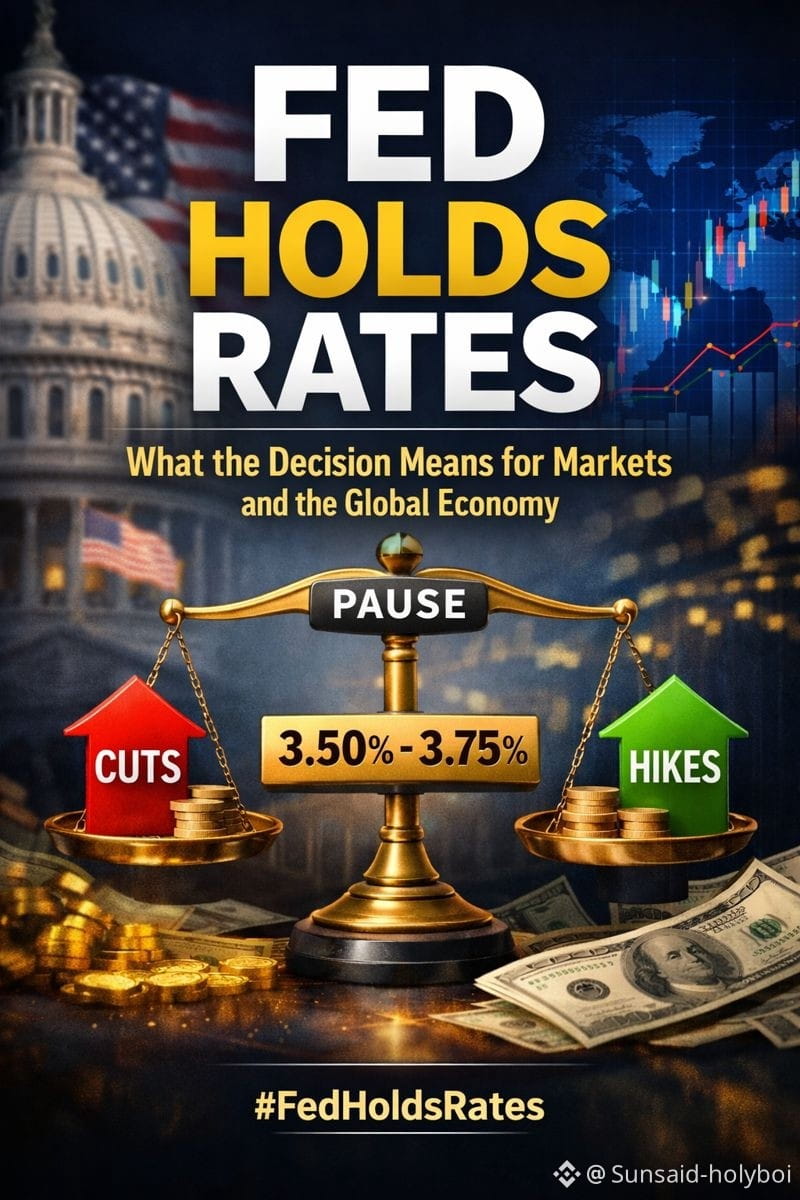
The U.S. Federal Reserve has once again chosen to hold interest rates steady, a move that has captured the attention of global markets, policymakers, and investors alike. Under the banner #FedHoldsRates, this decision reflects a strategic pause as the central bank weighs inflation progress against economic resilience.
At its core, the Fed’s choice signals caution rather than complacency. Inflation has moderated compared to previous peaks, but it remains above the central bank’s long-term target. Cutting rates too soon could reignite price pressures, while hiking further risks slowing economic momentum. Holding rates, therefore, is the middle ground — a calculated balance between restraint and support.
From an economic perspective, the U.S. economy continues to show underlying strength. Consumer spending remains stable, employment levels are relatively healthy, and business activity has not collapsed under higher borrowing costs. These conditions give the Fed room to pause and assess incoming data without rushing into policy shifts.
For financial markets, the message is clear: volatility may cool, but expectations must be managed. Equity markets often interpret rate holds as neutral to mildly positive, while bond markets adjust to the idea that cheaper money is not immediately around the corner. In the crypto space, stable rates reduce uncertainty, but the absence of aggressive easing limits the kind of liquidity-driven rallies seen in past cycles.
Borrowers and businesses should not expect dramatic relief in financing costs in the short term. Mortgages, loans, and credit conditions are likely to remain relatively tight until inflation shows more convincing signs of returning to target levels. Savers, on the other hand, continue to benefit from higher yields compared to the ultra-low-rate era.
Looking ahead, the Fed’s next move will depend heavily on data. If inflation continues to cool and economic growth slows meaningfully, rate cuts could re-enter the conversation. If inflation proves stubborn, this holding pattern may persist longer than markets hope.
In summary, Fed Holds Rates is less about inaction and more about discipline. It underscores a central bank committed to data-driven decisions, prioritizing long-term stability over short-term market pressure. For investors and businesses alike, this is a moment to stay patient, stay informed, and plan strategically rather than expect quick policy pivots.