
In the crypto world, “coin” and “token” are words you hear every day — but mixing them up can cost you money, lead to confusion, and affect how you trade or invest.
Let’s break it down.....
1️⃣ What is a Coin?
A coin is the native cryptocurrency of its own blockchain. Think of it as the official currency of a country — it has its own economy, rules, and infrastructure.
Key features of coins:
Runs on its own independent blockchain (Layer-1)
Used to pay transaction fees (gas)
Secures the network via mining (PoW) or staking (PoS)
Often has a fixed supply (e.g., Bitcoin = 21M)
Acts as digital money — store of value, medium of exchange
Has its own consensus mechanism
Popular coins:
Bitcoin (BTC) — digital gold
Ethereum (ETH) — smart contract powerhouse
BNB — native coin of BNB Chain
Solana - SOL , Cardano - ADA , Polkadot - DOT, Avalanche- AVAX
2️⃣ What is a Token?
A token is a digital asset built on top of another blockchain. It doesn’t have its own blockchain — it uses someone else’s network, like Ethereum, BNB Chain, or Solana.
Think of tokens like apps on your phone: the phone provides the infrastructure, and the app runs on it.
Key features of tokens:
Created via smart contracts (ERC-20, BEP-20, SPL, etc.)
Depends on the host blockchain’s security and consensus
Pays fees in the host blockchain’s coin (ETH, BNB, SOL…)
Can have flexible supply (mintable, burnable, deflationary)
Used for utility, governance, stablecoins, rewards, NFTs, and more
Popular tokens:
Stablecoins: USDT, USDC, DAI
DeFi: UNI, AAVE, LINK
Meme coins: SHIB, PEPE
Governance: MKR, COMP
Most new ICO/IDO altcoins
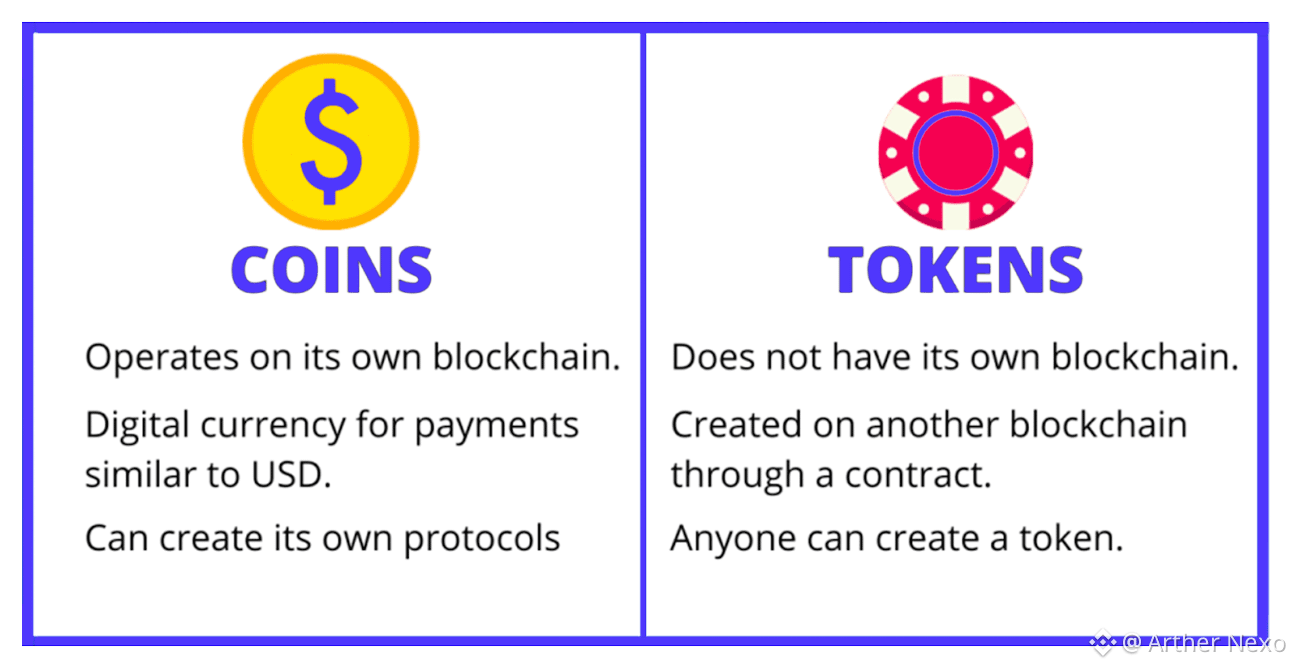
⚡ 3️⃣ Coins vs Tokens — The Critical Difference Every Trader Should Know
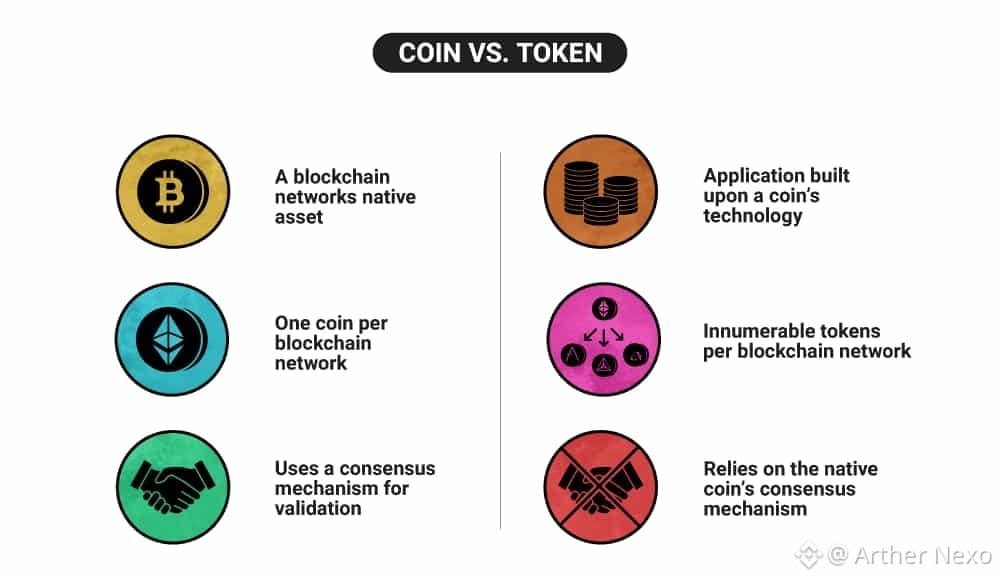
Understanding the difference between coins and tokens can save you from costly mistakes. Here’s the breakdown:
Blockchain:
Coins run on their own independent network, while tokens depend on another blockchain like Ethereum or BNB Chain.Consensus & Security: Coins secure their network via Proof-of-Work or Proof-of-Stake, but tokens rely on the host chain’s security.
Transaction Fees:
Coins pay fees in themselves (e.g., ETH for Ethereum), while tokens pay fees in the host coin (e.g., ETH for ERC-20 tokens).Creation Process:
Coins are mined or staked on their native chain. Tokens are deployed via smart contracts on an existing blockchain.Supply & Scarcity:
Coins usually have a fixed or predictable supply, whereas tokens can be minted, burned, or have flexible supply rules.Purpose & Use:
Coins are primarily money, value storage, and network security. Tokens serve multiple purposes: governance, utility, NFTs, stablecoins, or rewards.Examples:
Coins: BTC, ETH, SOL, BNB
Tokens: USDT, UNI, SHIB, PEPE, most new altcoins
💡 Trader Insight: Think of coins as the “infrastructure” you can rely on, and tokens as the “opportunities” riding on that infrastructure — high potential, but higher risk.
4️⃣ Real-World Analogy
Coins = Independent countries
Own government, currency, laws, security. Bitcoin = USA/USD, Ethereum = EU/Euro.Tokens = Companies or products inside those countries
Use the infrastructure (roads, electricity) but create their own value.
Example: USDT is like a company-issued gift card, running globally but still under Ethereum/BNB jurisdiction.
5️⃣ Why It Matters for Traders/Investors
Coins: Strong fundamentals, network utility, long-term value. Slower to innovate but more secure.
Tokens: Faster launches, huge potential for gains (especially memes & DeFi), but higher risk. Most new Binance listings? Tokens dominate.
💡 Pro Tip: Diversify! Stack blue-chip coins for safety, and selectively trade high-potential tokens for explosive growth.
Which do you prefer? Are you a coin hodler or a token trader? Share your thoughts below! 👇
#BitcoinETFWatch #USPPIJump #CZAMAonBinanceSquare #Token #coin