
Last year, around the holidays, I tried sending some stablecoins to a friend overseas. Just paying back a shared trip expense. Nothing important. It should have taken a minute. Instead, I sat there watching my wallet screen while the transaction just sat pending. Network congestion again. Fees suddenly higher than they should have been for a simple transfer. I kept checking back, wondering if it would go through without me reopening the app. It was not some big realization. Just irritation. That quiet kind. Why does moving digital money still feel like it fights you when it should be easy?
That stuck with me because it keeps happening. I have been around crypto long enough to know the pattern. When things get busy, speed drops. Reliability becomes uncertain. Pending transactions linger just long enough to make you uncomfortable. Costs sneak in where they should not matter. And the UX often feels like it was designed by people who already understand everything, not people who just want to send money. It is not about chasing yields or hype cycles. It is the everyday act of using these systems that slowly drains patience.

The bigger issue is how most blockchains treat payments, especially stablecoins that are supposed to behave like real money. These networks are general-purpose by design. They try to handle everything at once. DeFi, NFTs, new experiments, all competing for block space. Payments end up sharing the same lanes. Things back up. Validators chase higher fees. Settlements stretch out. Users feel it immediately. Transfers that should clear in seconds take minutes. Fees make small payments feel pointless. There is always that low-level tension of waiting for confirmation. Merchants cannot rely on instant settlement. Institutions hesitate because scaling is unclear. Regular users get stuck babysitting interfaces just to move value.
It is like using freight rail for daily commuting. It moves heavy loads well, but it is not built for quick, cheap trips. You end up waiting, adjusting plans, working around the system instead of the system working for you.
That is where Plasma’s approach starts to click. It is not trying to be everything. It is focused. Stablecoins first. Payments first. Plasma behaves like a dedicated rail rather than a general-purpose playground. Fast finality and throughput matter more than feature sprawl. The custom PlasmaBFT consensus overlaps stages so blocks finalize quickly, roughly around a second. Less waiting. Less guessing. They intentionally avoid loading the chain with things like heavy NFT traffic or gaming workloads. EVM compatibility stays so developers can port payment-focused apps without friction. For real usage, that matters. Transfers feel immediate. Merchants can plan around it. Institutions get something closer to predictable rails. Since the September 2025 mainnet launch, features like zero-fee USDT transfers through a paymaster contract pushed this idea further. The network covers gas for specific payments, so users do not need to juggle another token just to send money.
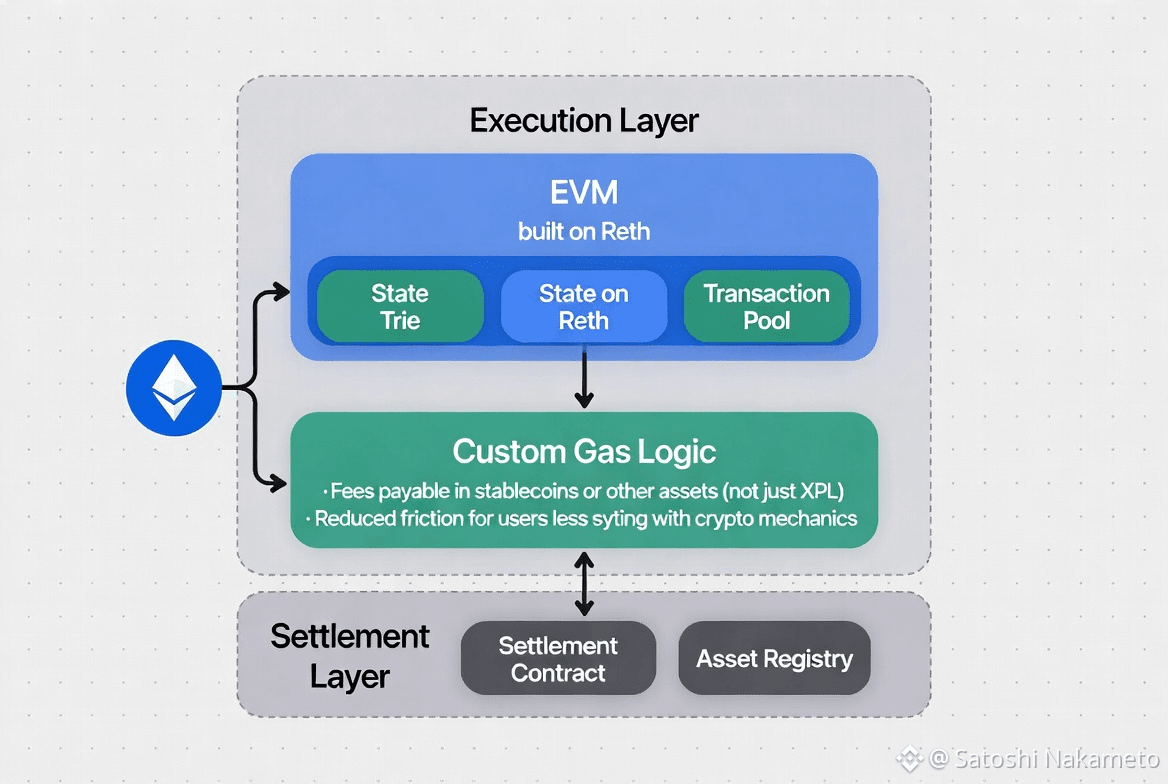
Execution design follows the same thinking. Plasma uses a modular EVM built on Reth, keeping Ethereum compatibility while allowing custom gas logic. Fees can be paid in stablecoins or other assets, not just XPL. That sounds small, but it removes a lot of friction for people who are not deep into crypto mechanics.
XPL itself does not try to be anything fancy. It is staked to secure the network. Holders delegate to validators and earn rewards. Transactions that are not gasless use XPL or equivalents, with part of the fees burned to manage supply growth. Validators rely on it for incentives. Governance exists, but it is not the headline. Slashing keeps bad behavior in check. That is it. No extra layers pretending to be something else.
As of late January 2026, circulating supply is around 2.2 billion XPL. Market cap sits near 234 million. Daily volume around 80 million shows people are actually moving it. The network processes roughly forty thousand USDT transfers per day. Not massive, but real.
Short term price action still follows noise. Announcements, partnerships, market fear. That does not say much about infrastructure. Long term value comes from habit. If settlements stay fast and predictable, people come back. Merchants integrate. Institutions get comfortable. The token moves, but the real value builds quietly underneath.
There are risks. If stablecoin volume spikes too quickly, for example from merchant adoption, the zero-fee paymaster system could hit limits. Rate controls might kick in. Users could see delays or fallback fees, breaking the experience Plasma is built around. Competition is real. Other chains could add payment optimizations without forcing migration. Regulation is another wildcard. Changes around stablecoins could complicate institutional integration.

In the end, it is about repetition. Not the first transfer, but the ones after. Whether people keep using it without thinking, or drift back to what they already know. That only shows up with time.
@Plasma #Plasma $XPL