As of February 2, 2026, the Bitcoin network and its primary software, Bitcoin Core, have seen some significant updates and policy shifts over the last few months.
Here is a breakdown of the most recent "new updates" regarding Bitcoin’s technology and development:
1. Bitcoin Core v30.2 (January 2026)
The latest stable release of the reference software, Bitcoin Core 30.2, was launched in early January 2026. This is primarily a maintenance and security release, but it follows the major v30.0 update from late 2025.
Critical Fix: It addresses a wallet migration bug that previously caused some users to lose unrelated wallet files during the transition from legacy (BerkeleyDB) to modern descriptor-based (SQLite) wallets.
Security: Includes patches for potential DoS (Denial of Service) attacks related to unconfirmed transaction processing.
2. Major Changes in the v30 Series
If you haven't updated since 2025, the v30 series introduced some of the most debated changes in years:
OP_RETURN Limit Increase: In a controversial move, the soft limit for OP_RETURN (data storage in a transaction) was increased significantly. This allows for more data-intensive applications (like advanced Ordinals or Layer 2 proofs) to be anchored directly on-chain.
BIP324 (Encrypted P2P): Bitcoin Core now supports v2 transport protocol, which encrypts the communication between nodes. This makes it much harder for Internet Service Providers (ISPs) or governments to see that you are running a Bitcoin node.
End of Legacy Wallets: The ability to create new "legacy" wallets (the old format used for years) has been officially removed. All new wallets must now use Descriptors, which are more flexible and secure.
3. Layer 2 and Protocol Development
Bitcoin Inquisition: Developers are increasingly using "Bitcoin Inquisition," a separate testing network that allows them to experiment with new features like Covenants (OP_CAT) and CheckTemplateVerify (CTV) without risking the main network.
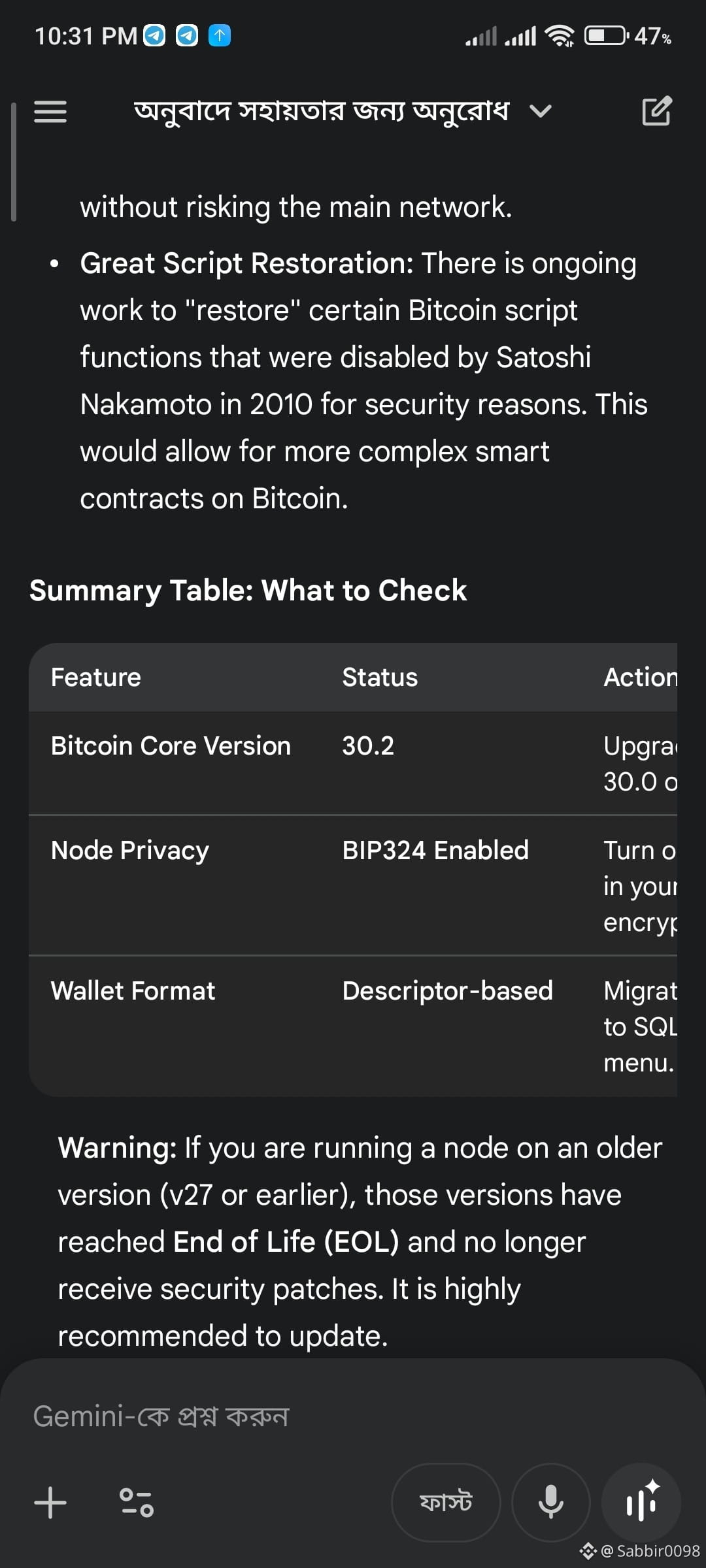
Great Script Restoration: There is ongoing work to "restore" certain Bitcoin script functions that were disabled by Satoshi Nakamoto in 2010 for security reasons. This would allow for more complex smart contracts on Bitcoin.
Summary Table: What to Check
As of February 2, 2026, the Bitcoin network and its primary software, Bitcoin Core, have seen some significant updates and policy shifts over the last few months.
Here is a breakdown of the most recent "new updates" regarding Bitcoin’s technology and development:
1. Bitcoin Core v30.2 (January 2026)
The latest stable release of the reference software, Bitcoin Core 30.2, was launched in early January 2026. This is primarily a maintenance and security release, but it follows the major v30.0 update from late 2025.
Critical Fix: It addresses a wallet migration bug that previously caused some users to lose unrelated wallet files during the transition from legacy (BerkeleyDB) to modern descriptor-based (SQLite) wallets.
Security: Includes patches for potential DoS (Denial of Service) attacks related to unconfirmed transaction processing.
2. Major Changes in the v30 Series
If you haven't updated since 2025, the v30 series introduced some of the most debated changes in years:
OP_RETURN Limit Increase: In a controversial move, the soft limit for OP_RETURN (data storage in a transaction) was increased significantly. This allows for more data-intensive applications (like advanced Ordinals or Layer 2 proofs) to be anchored directly on-chain.
BIP324 (Encrypted P2P): Bitcoin Core now supports v2 transport protocol, which encrypts the communication between nodes. This makes it much harder for Internet Service Providers (ISPs) or governments to see that you are running a Bitcoin node.
End of Legacy Wallets: The ability to create new "legacy" wallets (the old format used for years) has been officially removed. All new wallets must now use Descriptors, which are more flexible and secure.
3. Layer 2 and Protocol Development
Bitcoin Inquisition: Developers are increasingly using "Bitcoin Inquisition," a separate testing network that allows them to experiment with new features like Covenants (OP_CAT) and CheckTemplateVerify (CTV) without risking the main network.
Great Script Restoration: There is ongoing work to "restore" certain Bitcoin script functions that were disabled by Satoshi Nakamoto in 2010 for security reasons. This would allow for more complex smart contracts on Bitcoin.
Summary Table: What to Check$BTC