
When a chain makes a stablecoin the fee primitive, it isn’t just choosing a convenient unit of account. It is choosing a policy perimeter. USDT is not a neutral commodity token. It is an instrument with an issuer who can freeze and blacklist. The moment Plasma’s “pay fees in stablecoin” and “gasless USDT” become the default rails, the chain’s core liveness story stops being about blockspace and starts being about whether the fee asset remains spendable for the sender. That is the mispricing: people talk about settlement speed and UX, but the real constraint is that the fee primitive can be administratively disabled for specific addresses at any time.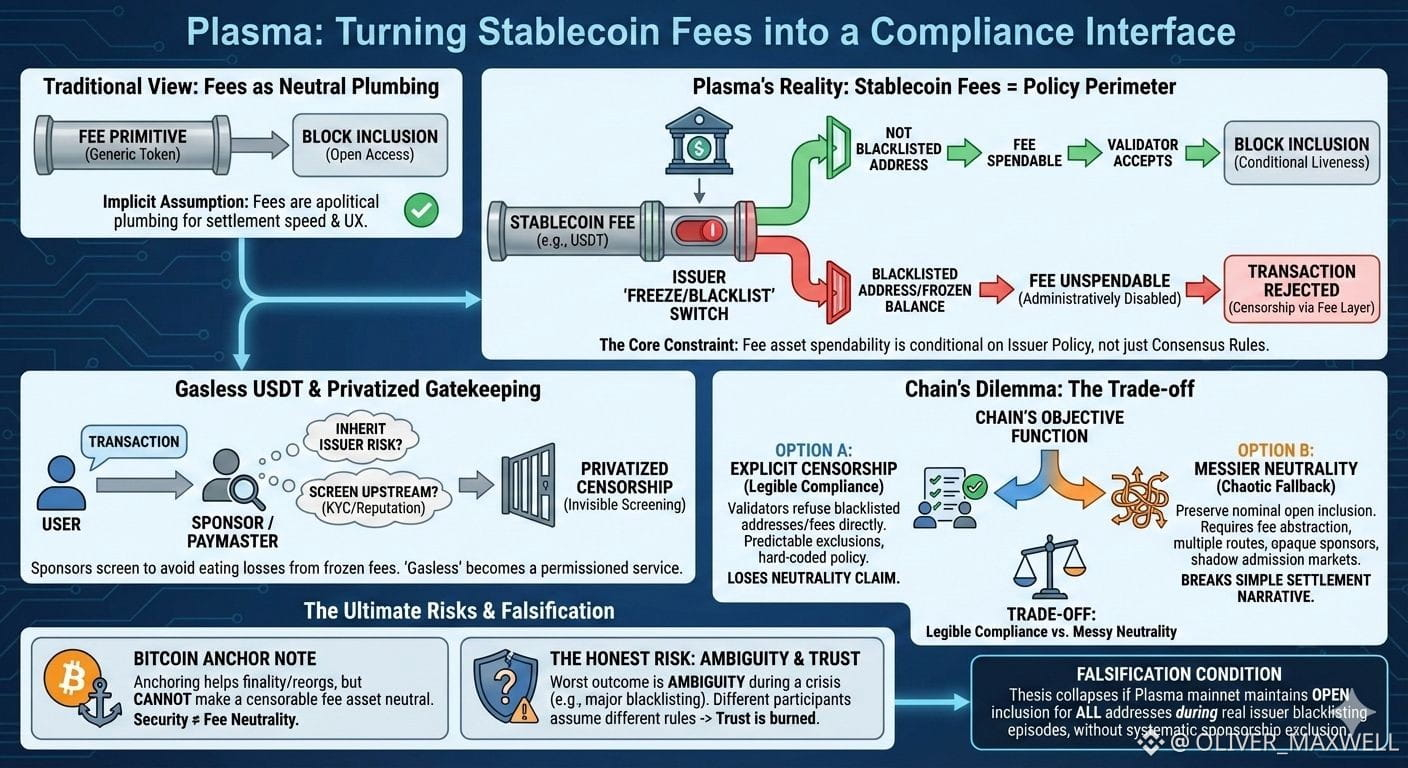
I think a lot of buyers implicitly assume “fees are apolitical plumbing.” On Plasma, fees become a compliance interface because the fee token itself has an enforcement switch. If an address is blacklisted or a balance is frozen, it’s not merely that the user can’t move USDT. The user can’t reliably buy inclusion. Even if the underlying execution environment is perfectly happy to run the transaction, the system still has to decide what it means to accept a fee that could be frozen before the validator or sponsor can move it. This is where stablecoin-first gas stops being a UX choice and starts being a consensus-adjacent governance choice.
From a mechanism standpoint, Plasma has to answer a question that most L1s never have to answer so explicitly: what is the chain’s objective function when the default fee instrument is censorable? There are only a few coherent options. One is to make censorship explicit at the inclusion edge: validators refuse transactions from issuer-blacklisted addresses, or refuse fees that originate from issuer-blacklisted addresses. That path is “clean” in the sense that it is legible and enforceable, but it hard-codes policy into the transaction admission layer. The chain becomes predictable for institutions precisely because it is predictable in its exclusions, and you can’t pretend neutrality is untouched. Another option is to preserve nominal open inclusion by allowing transactions regardless of issuer policy, but then you have to solve fee settlement when the fee token can be frozen. That pushes you into fee abstraction, where inclusion is funded at block time by an alternate fee route or a sponsor and settled later, which pulls screening and exceptions into the fee layer. Each of those moves the system away from the simple story of “stablecoin settlement,” because now you’ve reintroduced an extra layer of trust, screening, and off-chain coordination that looks a lot like the payment rails you claimed to simplify.
Gasless USDT makes this tension sharper, not softer, because a sponsor or paymaster pays at inclusion time and inherits the issuer-policy risk. If the issuer freezes assets after the transaction is included, who eats the loss? The sponsor’s rational response is to screen upstream: block certain senders, require KYC, demand reputation, or only serve known counterparties. That screening can be invisible to casual observers, but it is still censorship. It’s just privatized and pushed one hop outward. Plasma can keep the chain surface looking permissionless while the economic gatekeeping migrates into the fee-sponsorship layer. The market often prices “gasless” as pure UX. I price it as a subtle reallocation of compliance risk to whoever is funding inclusion.
This is also where the Bitcoin-anchored security narrative can collide with the fee-primitive reality. Anchoring can help with finality disputes and reorg economics, but it cannot make a censorable fee asset neutral. The chain can be cryptographically hard to rewrite and still economically easy to gate, because inclusion is not only about consensus rules. It’s about whether transactions can satisfy the economic constraints of block production. If fees are stablecoin-denominated and stablecoin-spendability is conditional, then the strongest security story in the world doesn’t prevent transaction admission from becoming conditional too. Neutrality isn’t just “can you reorg me,” it’s “can you pay to be included without asking anyone’s permission.” Plasma risks importing a permission layer through the side door.
There’s a trade-off here that I don’t think Plasma can dodge forever: legible compliance versus messy neutrality. If Plasma embraces explicit policy-enforced censorship at the consensus edge, it may win institutional confidence while losing the ability to claim that base-layer inclusion is neutral. If Plasma tries to preserve permissionless inclusion, it probably has to tolerate chaotic fee fallback behavior: multiple fee routes, sponsors with opaque policies, and moments where some users are included only through privileged intermediaries. That breaks the clean settlement narrative because the “simple stablecoin settlement” system now contains a shadow admission market. Neither branch is “bad” by default, but pretending you can have stablecoin-as-gas and be untouched by issuer policy is naïve.
The honest risk is that Plasma’s most differentiated feature becomes its most expensive liability. Stablecoin-first gas looks like standardization, but it also standardizes the chain’s exposure to issuer interventions. A single high-profile blacklisting event can force the entire network to reveal its real governance posture in real time. Either validators start enforcing policy directly, or the sponsor ecosystem tightens and users discover that “gasless” actually means “permissioned service.” The worst outcome is not censorship per se. It’s ambiguity. Ambiguity is where trust gets burned, because different participants will assume different rules until a crisis forces a unilateral interpretation.
My falsification condition is simple and observable. If Plasma’s mainnet, during real issuer-driven blacklisting episodes, still shows inclusion remains open to all addresses, without allowlists, without privileged relayers, and without systematic exclusion emerging in the sponsorship layer, then this thesis collapses. That would mean Plasma found a way to make a censorable stablecoin the fee primitive without importing its compliance surface into transaction admission.

