

When people say a blockchain is “private” I usually tense up a little. Not because privacy is bad. Because most of the time it is treated like a blanket you throw over everything. That works for hiding. It does not work for finance. Real finance lives on receipts. It lives on approvals. It lives on the ability to prove something to the right party at the right moment.
Dusk has always felt like it started from that uncomfortable truth. It is not trying to make the world invisible. It is trying to make visibility optional and precise.
The easiest way I can explain it is this. Imagine a building with two entrances that lead to the same vault. One entrance is a glass corridor. Everyone can see you walk through it. The other entrance is a curtained corridor. People can see that someone entered the building. They do not get a free movie of what you carried. Both routes still end at the same vault. Same locks. Same guards. Same final settlement.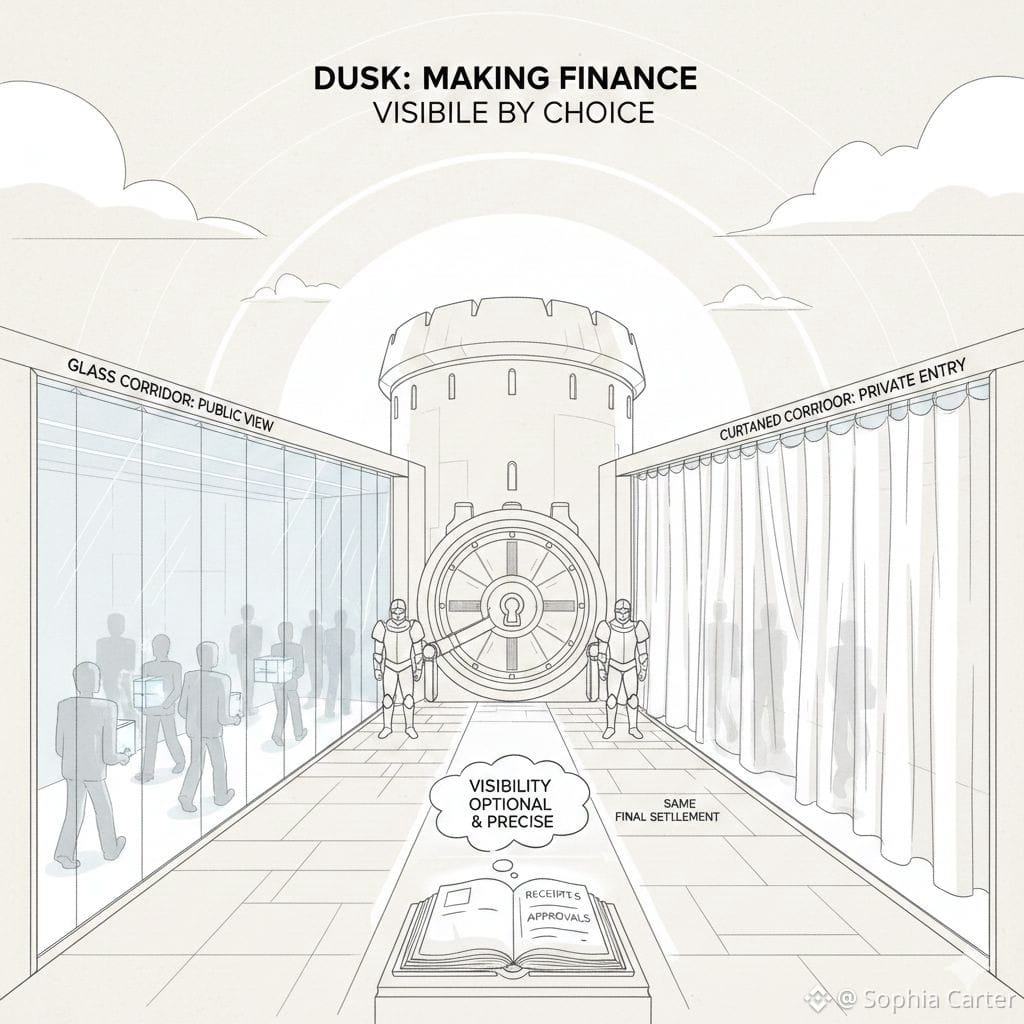
That is basically the Moonlight and Phoenix idea in human terms. DuskDS supports two native transaction models. Moonlight is public and account based. Phoenix is shielded and note based using zero knowledge proofs. They settle on the same chain but they reveal different things to observers.
What I like here is not the vocabulary. It is the posture. Dusk is admitting that regulated finance rarely runs in a single mode. Some flows must be transparent. Some flows must be confidential. A lot of flows want selective disclosure. Dusk puts that choice inside the core transfer system instead of forcing people to bolt on a separate privacy network later. The documentation is very direct about this. Transactions on DuskDS are managed by a Transfer Contract and that contract supports both models for handling transfers and gas payments and acting as a contract execution entry point.
If you have ever watched a company try to use a fully transparent chain for anything sensitive you know the pain. Salaries. Treasury moves. Counterparty relationships. Market makers. Even simple inventory planning. The ledger becomes a surveillance feed. That is great for some things and awful for others. Dusk feels like a deliberate attempt to stop that default leakiness while still keeping a path for audit.
Now zoom out a bit. The project describes itself as a privacy blockchain for regulated finance and it leans on a modular approach. There is DuskDS as the settlement layer and there is DuskEVM as an execution environment so builders can work with familiar EVM tools while still settling into the Dusk stack.
I think that separation matters more than most people realize. Institutions hate uncertainty at the bottom. They can tolerate experimentation at the edges. A modular design is only useful when it lets the foundation stay boring while the application layer evolves. That is the vibe Dusk is aiming for.
Then there is the token. If you strip away the trading chatter and look only at what the network says it needs. DUSK is the fuel for fees and it is the stake that anchors consensus. The tokenomics documentation gives concrete numbers that feel more like infrastructure budgeting than hype. Maximum supply is 1 billion DUSK. The initial supply was 500 million. The remaining 500 million is emitted over time with a schedule described as 36 years. Gas is denominated in LUX where one LUX equals 10 to the minus 9 DUSK.
Two details here make it feel real to me.
First the minimum staking amount is 1000 DUSK. That number is not symbolic. It is a threshold that shapes who can participate directly. The same page also states a stake maturity period of two epochs which it quantifies as 4320 blocks.
Second the circulating supply story is unusually crisp across major market trackers right now. CoinMarketCap lists a circulating supply of 496999999 DUSK and the same max supply of 1000000000.
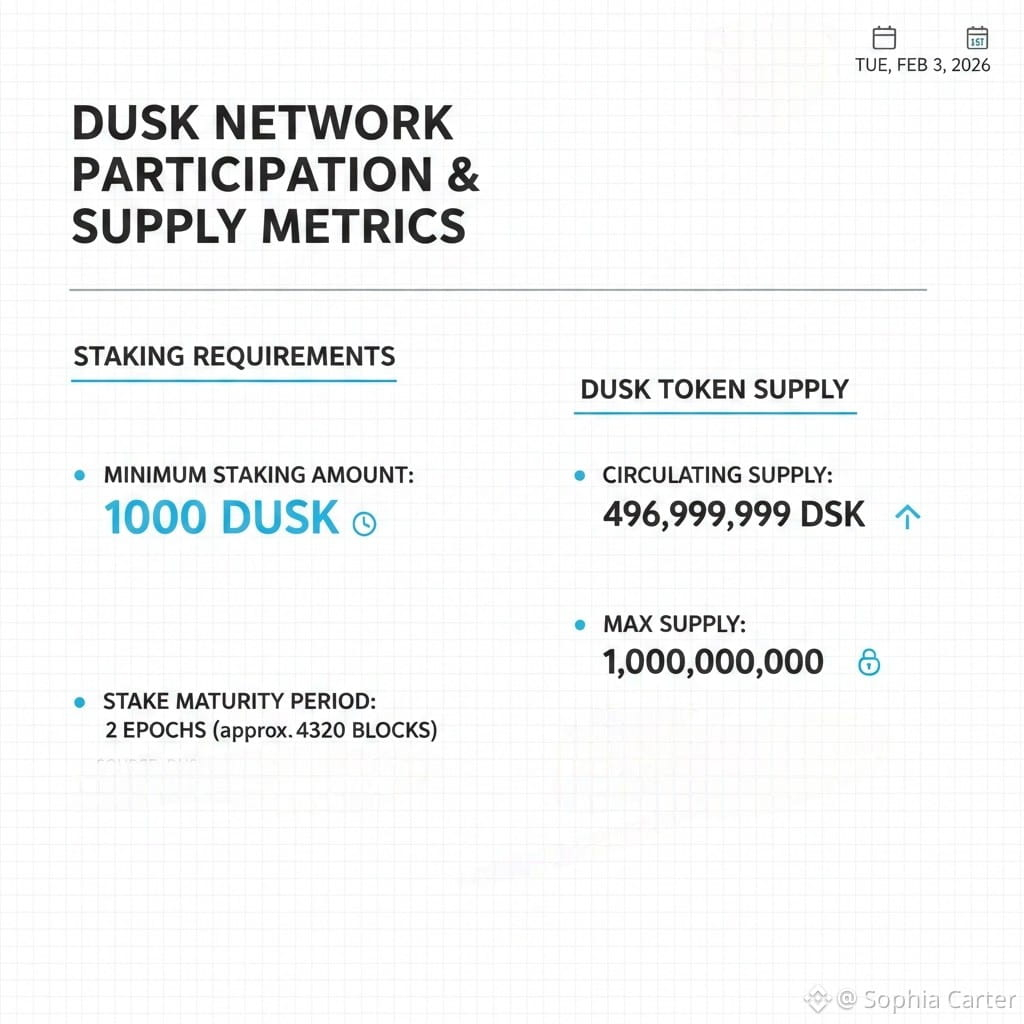
Those numbers matter because they frame the network as something that is already past the “maybe someday” phase. Roughly half the max supply is already in circulation. The rest is an explicit long runway for security incentives. That is the kind of structure you want if you are aiming for a chain that has to survive quiet years as well as loud ones.
If you want a simple way to judge whether this is alive beyond words. Look at what node operators see. The official node installer repository shows a release tagged v0.5.13 dated 30 Jan 2026. The operator docs also describe a non destructive upgrade flow using the installer script and mention that it gracefully shuts down the node software during upgrades.
That is not a flashy “announcement” kind of update. It is the kind of update you ship when you care about uptime and repeatability. It also lines up with a Dusk Foundation post that says a new node installer was released with new Rusk and wallet binaries along with bug fixes and new features. 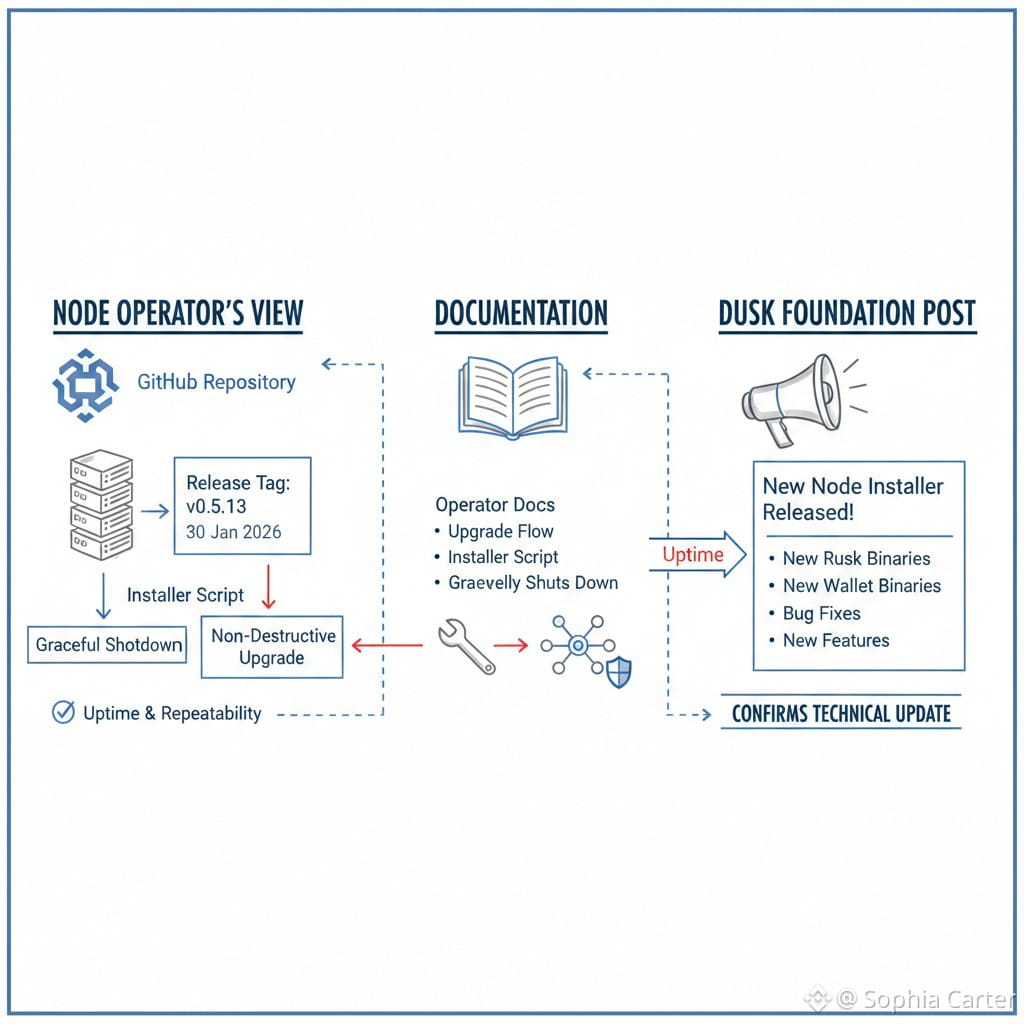
There is also a small but meaningful ecosystem signal that I think deserves attention. Dusk released an updated block explorer and described it as showing blocks and transactions plus a snapshot of network statistics including market cap the number of nodes and the amount of DUSK staked. When a team talks about node counts and staked amounts as first class dashboard items it tells you what they think success looks like. Not just price. Operational health.
One more timeline detail helps anchor the narrative. Dusk published a mainnet rollout plan that included on ramp activation in late December 2024 and a milestone that points to the first immutable blocks on January 7 2025. Again this is not something you need to celebrate like a trophy. It is useful because it shows the project treating launch like a staged migration and not a single dramatic switch.
So why does any of this matter in plain language.
Because the future version of on chain finance is not going to be a single public spreadsheet. It is going to be a set of markets where different participants have different visibility rights. A regulator might need proof that a rule was followed. A counterparty might need proof of solvency. A user might need privacy for balances and flows. The public might only need aggregate confidence that settlement is honest.
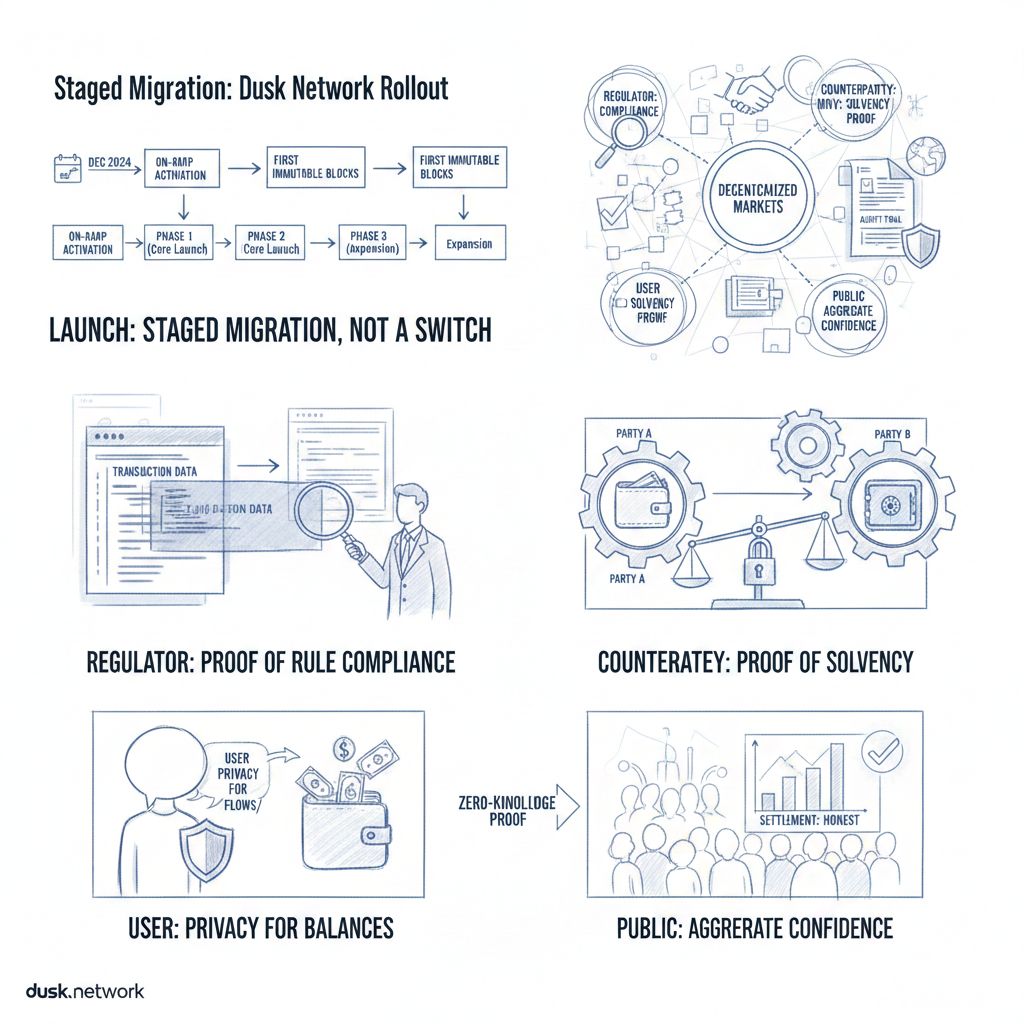
Dusk is trying to make that messy reality feel native. Two transaction lanes on one settlement layer. A transfer system designed to handle both transparent and shielded flows. A modular execution story that invites builders without asking them to abandon familiar tools. Token mechanics that read like long term security planning. Operator tooling that keeps getting maintained rather than abandoned.
Dusk is not pitching secrecy as a vibe. It is pitching controlled disclosure as a product.