
When I look at Walrus today, I do not start from emotion or storytelling. I start from the problem it is trying to solve in a very practical sense. Modern applications generate massive amounts of data, yet most blockchains were never designed to store large files reliably. At the same time, traditional cloud storage concentrates control in the hands of a few providers. Walrus sits exactly in the middle of this gap. It is not trying to be a financial playground or a consumer app. It is building decentralized storage infrastructure that can actually handle real data at scale without sacrificing availability or neutrality.
Walrus is built on the Sui blockchain, and that choice matters. Sui is used as the coordination and accountability layer, not as the place where data lives. When data is uploaded into the Walrus system, it does not get written directly onto the blockchain. Instead, it is processed using erasure coding. This technique takes a large file and mathematically splits it into many smaller pieces. Only a subset of those pieces is required to reconstruct the original file. Each individual piece on its own is useless. Together, they form a resilient structure where data survives even if multiple storage providers go offline.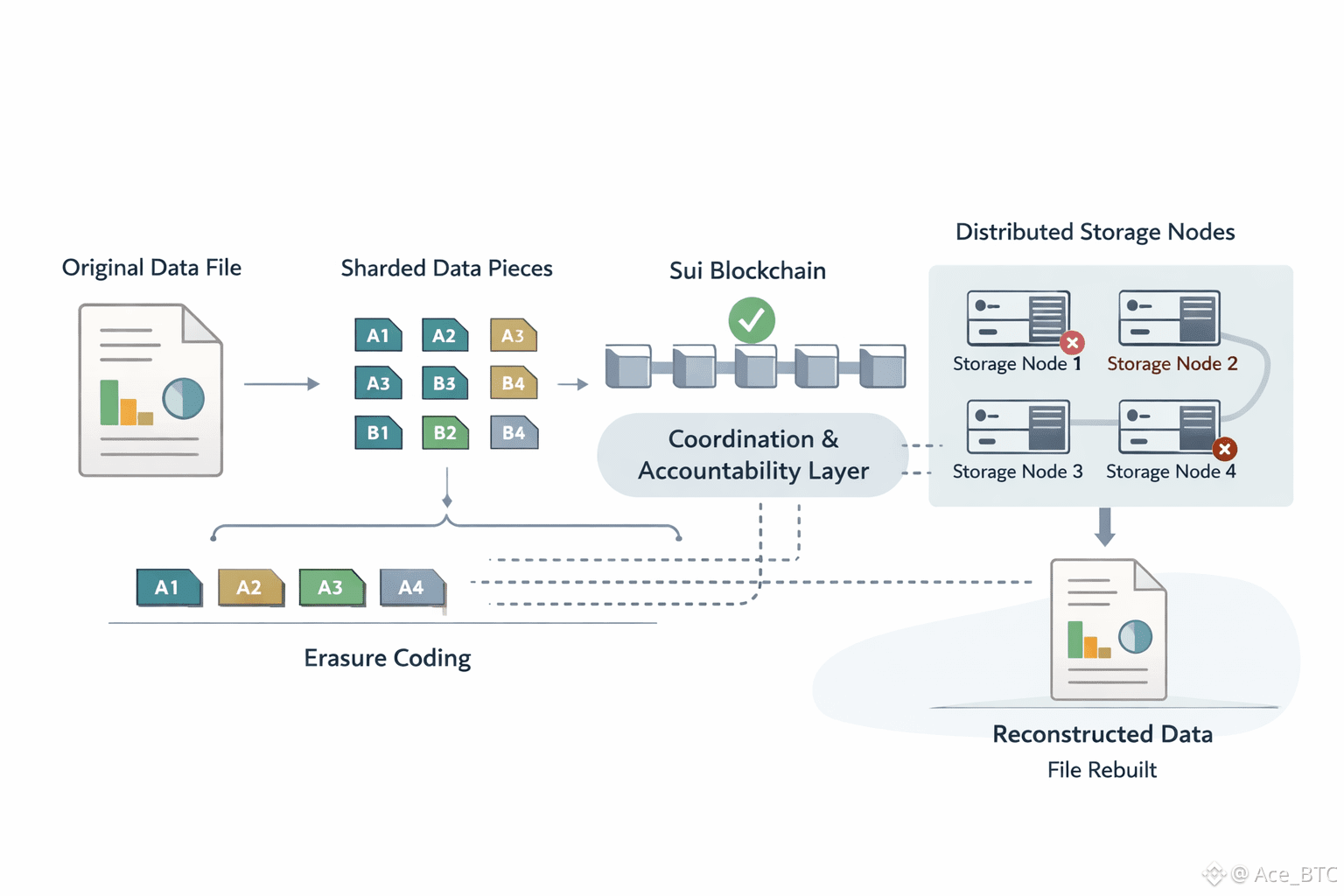
These data pieces are stored as blobs across a decentralized network of independent storage nodes. The blockchain records who is responsible for storing which pieces and under what conditions. It enforces rules around availability and verification. This separation of concerns is one of Walrus’s most important design decisions. Heavy data storage happens off chain where it is efficient. Trust coordination happens on chain where it is transparent and verifiable. The system becomes scalable without becoming fragile.
The WAL token exists to make this coordination work economically. Storage providers stake WAL to participate in the network. By staking, they signal commitment. If they store data correctly and keep it available, they earn rewards. If they fail to meet their obligations, their stake can be reduced. WAL is also used for governance, allowing participants to vote on protocol parameters, upgrades, and long term rules. It is not designed as a speculative centerpiece. It is designed as a control and incentive mechanism that keeps the network aligned over time.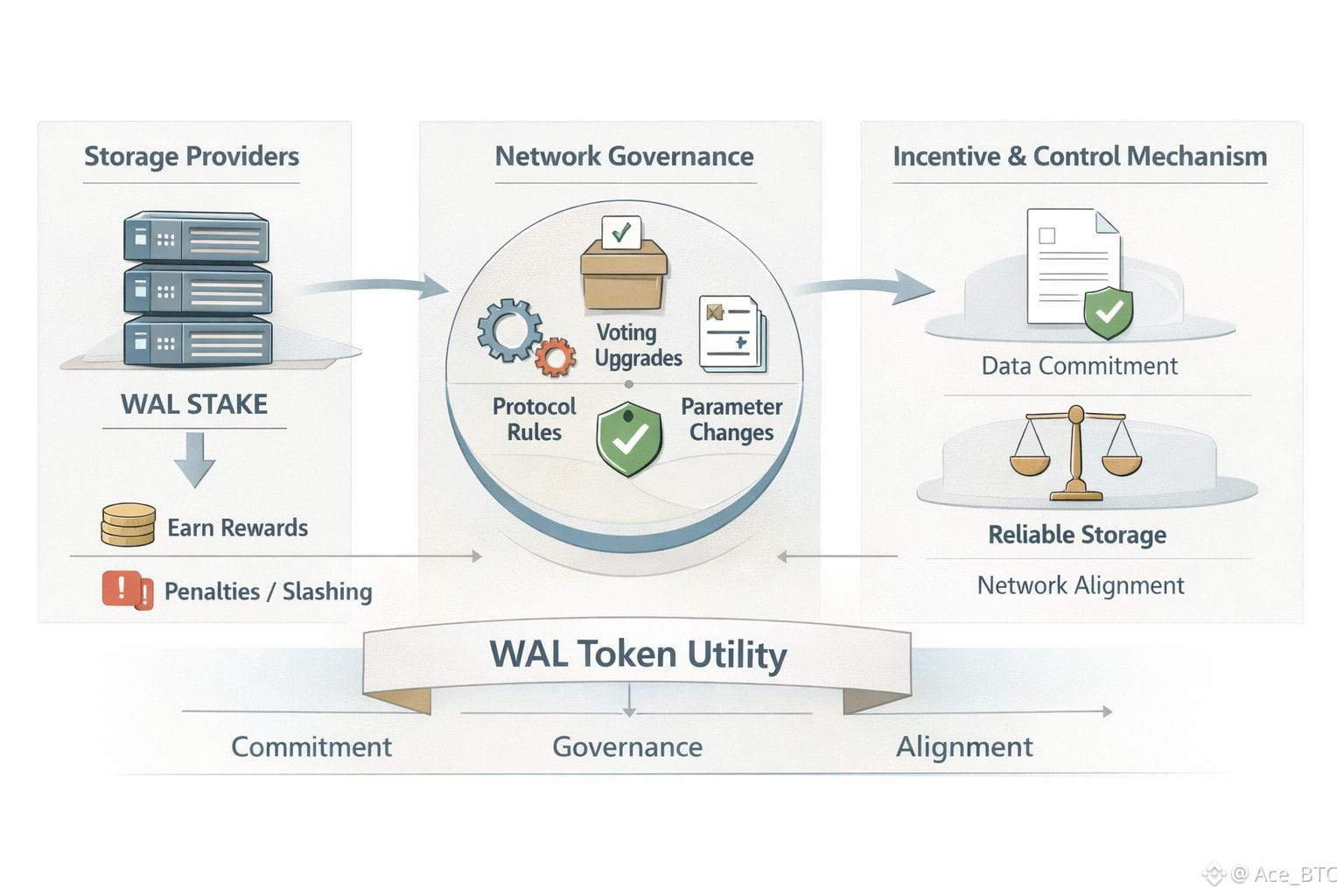
In real world use, Walrus is aimed at developers, enterprises, and infrastructure builders rather than casual users. A decentralized application can use Walrus to store large assets without relying on centralized cloud services. Media files, application state, historical records, and long lived data sets can all live within a system that does not depend on a single provider. Enterprises looking for censorship resistance and predictable long term storage costs can integrate Walrus as an alternative to traditional cloud infrastructure. Individuals who care about ownership and persistence gain another option that does not disappear when a platform changes direction.
One of the reasons Walrus stands out is that it does not try to solve every problem at once. It does not claim to replace all cloud storage overnight. It focuses on data availability and durability first. Erasure coding reduces unnecessary redundancy while still protecting against failure. Blob storage allows the system to handle large files efficiently. Sui’s high throughput allows coordination to scale without bottlenecks. Each architectural choice reduces risk rather than introducing complexity.
Growth for Walrus is measured differently than for financial applications. Storage infrastructure earns trust slowly. Early signals show up in developer experimentation, test deployments, tooling, and governance participation rather than explosive user numbers. WAL staking activity indicates engagement, but the more important metric is whether data remains available over time without incident. This kind of growth is quiet by nature, and that is appropriate for infrastructure meant to last.
There are also clear risks. Decentralized storage networks are difficult to operate at scale. Incentives must remain balanced so that providers stay motivated without making storage costs uncompetitive. Walrus is tightly connected to the Sui ecosystem, so changes in Sui’s adoption or tooling will have an impact. Regulatory uncertainty around tokens, staking, and decentralized infrastructure remains an external factor that cannot be ignored. These risks are not hidden, and early awareness matters because systems like this require long term planning rather than reactive fixes.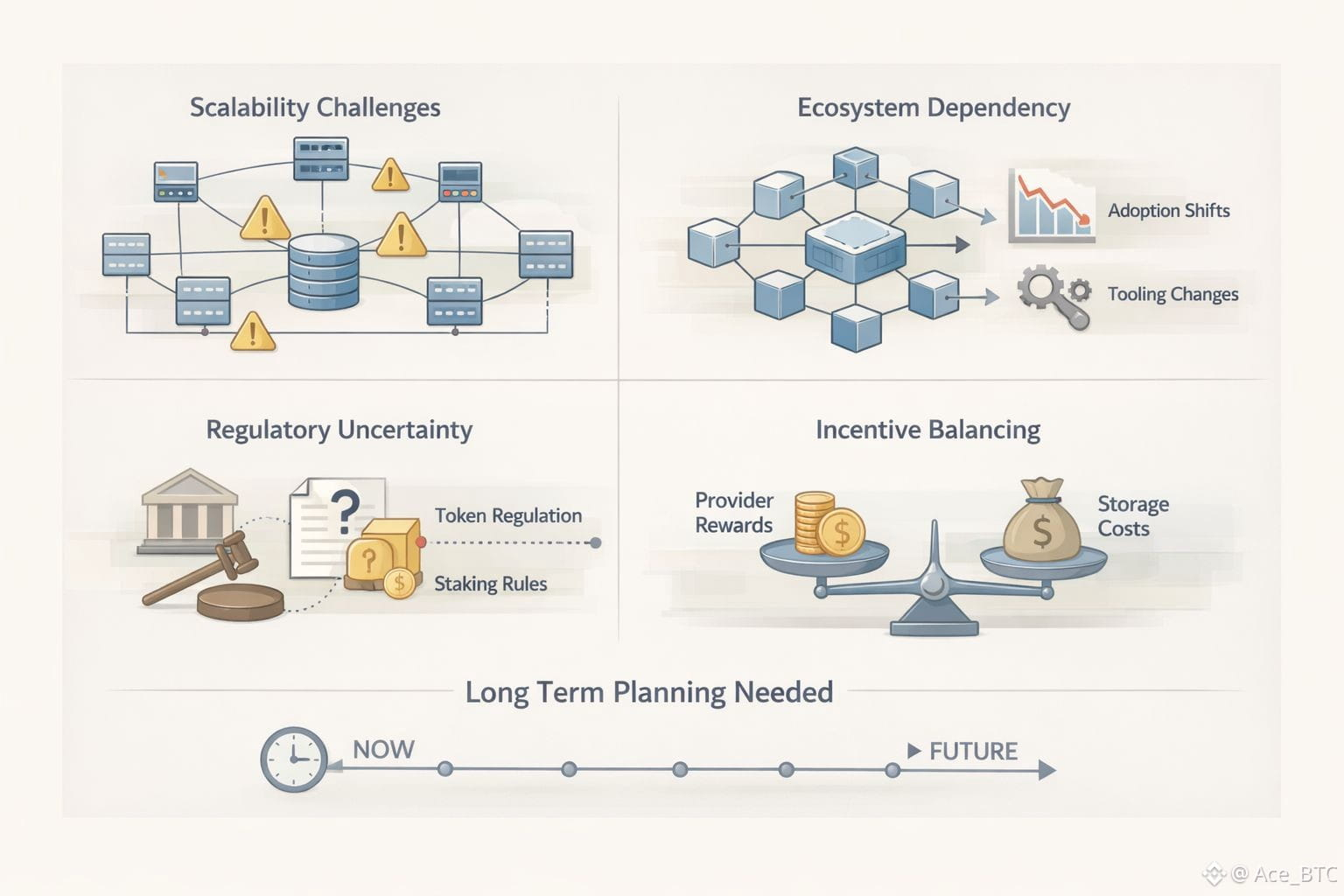
Looking forward, Walrus is not building toward visibility. It is building toward reliability. If it succeeds, most users will never think about it. Data will simply be there when needed. Applications will keep running. Files will remain accessible years later without intervention. The protocol fades into the background and becomes part of the underlying digital fabric.
That outcome may not sound exciting, but it is meaningful. In a world where data increasingly defines value, memory, and continuity, the systems that protect that data must be designed for endurance rather than attention. Walrus is making a deliberate attempt to become one of those systems, and its success will be measured not by how loudly it is discussed, but by how quietly it continues to work.

