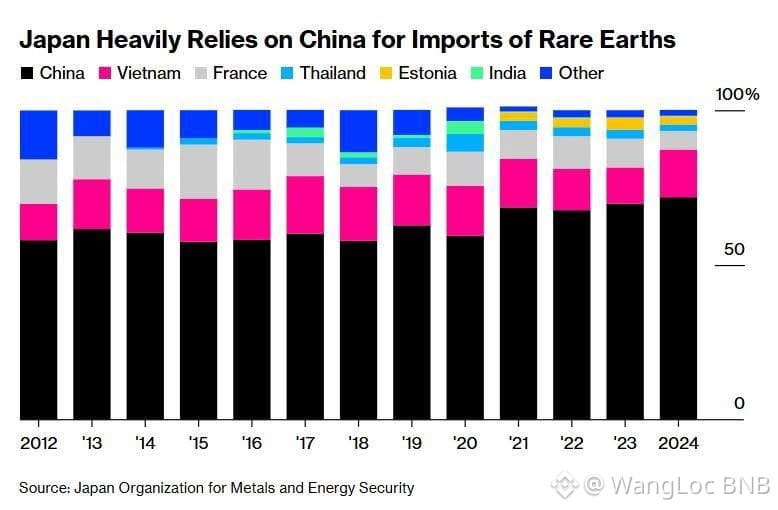
The phrase “don’t put all your eggs in one basket” has long been a guiding principle of risk management, and Japan has taken this lesson seriously when it comes to rare earths for more than a decade.
Yet the latest data from the Japan Organization for Metals and Energy Security paints a far more uncomfortable reality than many would expect.
Since 2012, Japan has actively pursued supply chain diversification to reduce its reliance on China.
New partners have gradually entered the picture, with Vietnam emerging as a key alternative supplier, alongside growing contributions from France, Thailand, and more recently Estonia and India. On paper, this expanding network suggests meaningful progress toward a more balanced and resilient supply chain.
In practice, however, market forces have proven far stronger than policy ambitions. After a brief period of declining dependence, Japan’s imports of rare earths from China began rising sharply again from 2021 onward. By 2024, China’s share had climbed back above 60%, approaching the highest level seen in the past 12 years.
Vietnam now stands as Japan’s second-largest partner and has helped ease some of the pressure, but its scale remains modest when compared with its massive neighbor.
The challenge goes far beyond mining. China’s true dominance lies in refining and processing, where it holds critical know-how and operates at exceptionally low costs that few countries can match.
As demand surges from strategic industries such as electric vehicles and semiconductors, Japan has little choice but to lean on the most reliable, abundant, and immediately available source even if that means renewed dependence on China.
This reality underscores a hard truth: supply chain diversification is a long, expensive, and structurally complex journey. After 12 years of sustained effort, Japan is still navigating the trade-offs between strategic independence and economic efficiency.
Rare earths are no longer just a commodity issue; they sit at the intersection of industrial power, technological capability, and geopolitics, where advantages built over decades cannot be replaced overnight.
#Japan #RWA #USCryptoMarketStructureBill