
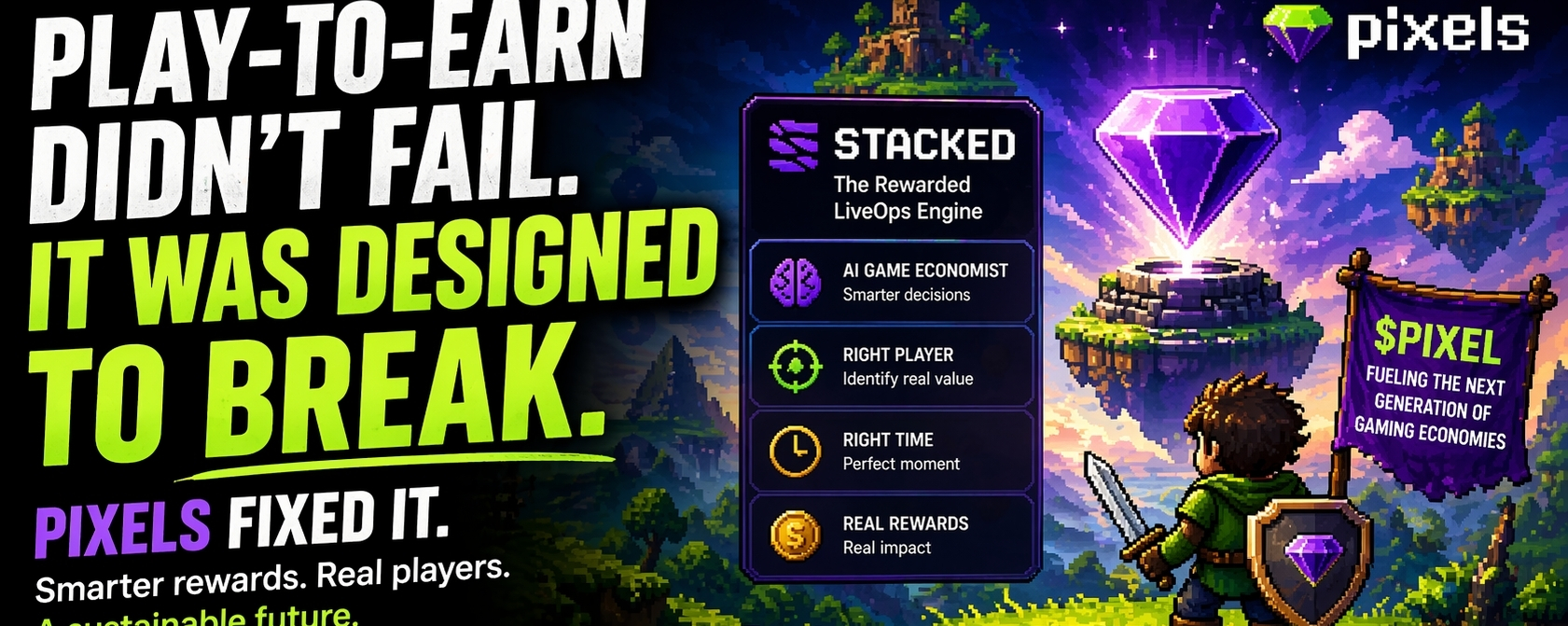
Most Web3 games didn’t collapse because of bad luck.
They collapsed because their economies were fragile from the start.
Rewards were too easy to farm.
Bots quickly outperformed real players.
Tokens inflated faster than demand could keep up.
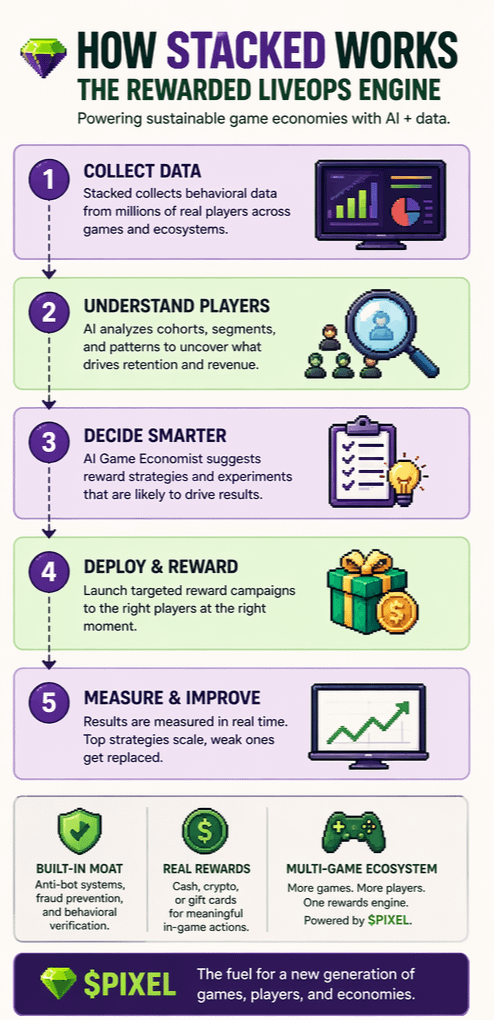
And eventually, the system turned into a race to extract value, not create it.
That’s the part most people still misunderstand.
The problem was never “rewards.”
The problem was how rewards were distributed.
That’s where @Pixels took a different path.
Instead of launching another play-to-earn loop, they focused on fixing the layer underneath it, the reward system itself.
What came out of that is something called Stacked.
Not a game.
Not a quest board.
But a reward engine designed to survive real usage.
Stacked works on a simple idea that most systems ignored:
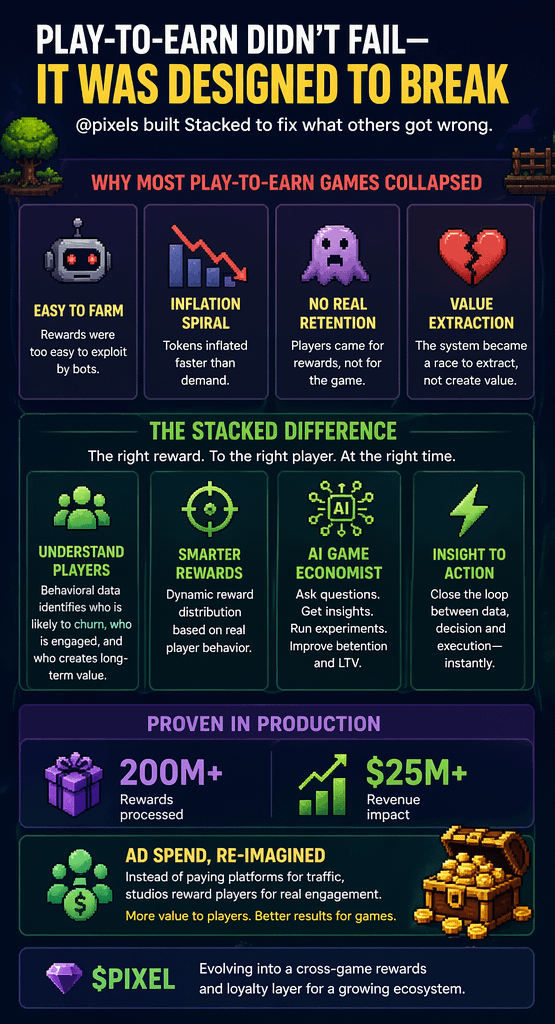
The right reward only matters if it reaches the right player at the right time.
Sounds obvious. Almost too obvious.
But most games never implemented it.
Instead, they handed out rewards blindly, and paid the price.
Stacked flips that.
It uses behavioral data to understand players:
Who is likely to churn
Who is actually engaged
Who contributes long-term value
Then it adjusts rewards dynamically.
Not more rewards, smarter rewards. And here’s where it gets interesting.
There’s an AI layer sitting on top of this system.
Not in a buzzword way, in a functional way.
Studios can actually ask:
Why do users drop off after a few days?
What actions correlate with long-term retention?n?
Where is reward spend being wasted?
And instead of waiting weeks for analysis, they can act on it immediately.
That closes the loop between data → decision → execution.
This isn’t theory either.
The system has already:
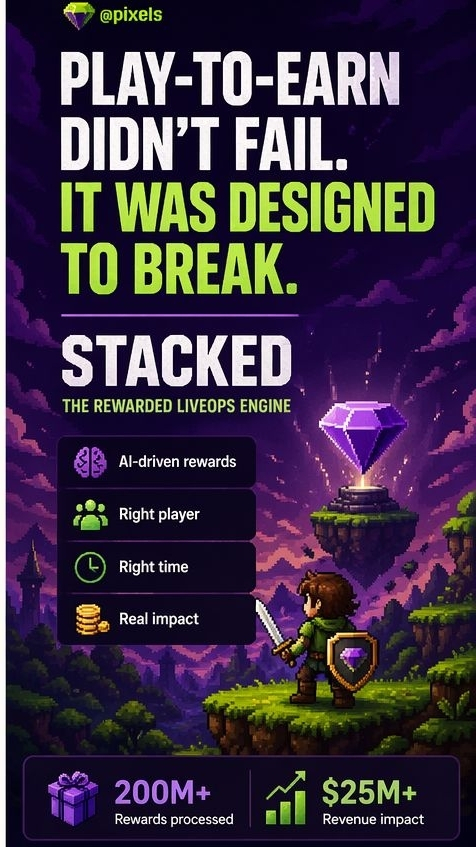
Processed over 200M+ rewards
Contributed to $25M+ in revenue within the ecosystem
That matters more than any whitepaper ever could.
Because it proves one thing:
This model doesn’t just sound good, it works under pressure.
Zoom out, and the bigger shift becomes clear.
Gaming studios already spend billions on user acquisition.
Most of that money goes to ad platforms.
Stacked changes that flow.
Instead of paying platforms for traffic, studios can: → reward players directly for meaningful engagement
It’s not just more efficient.
It’s measurable.
And more importantly, it aligns incentives.
That’s a completely different economic model.
Inside this system, PIXEL isn’t just a token tied to one game anymore.
It’s evolving into something broader: → a reward and loyalty layer across multiple experiences
As more games plug into the system, the role of $PIXEL expands with it.
Not because of speculation, but because of utility.
Of course, this doesn’t magically solve everything.
Sustainability still depends on:
keeping bots out
maintaining reward balance
ensuring real demand
But unlike most projects, this system was built while facing those exact challenges.Not after.
That’s the difference.
Most projects are designed in theory.
This one was shaped by failure, iteration, and real usage.
And maybe that’s the real takeaway.
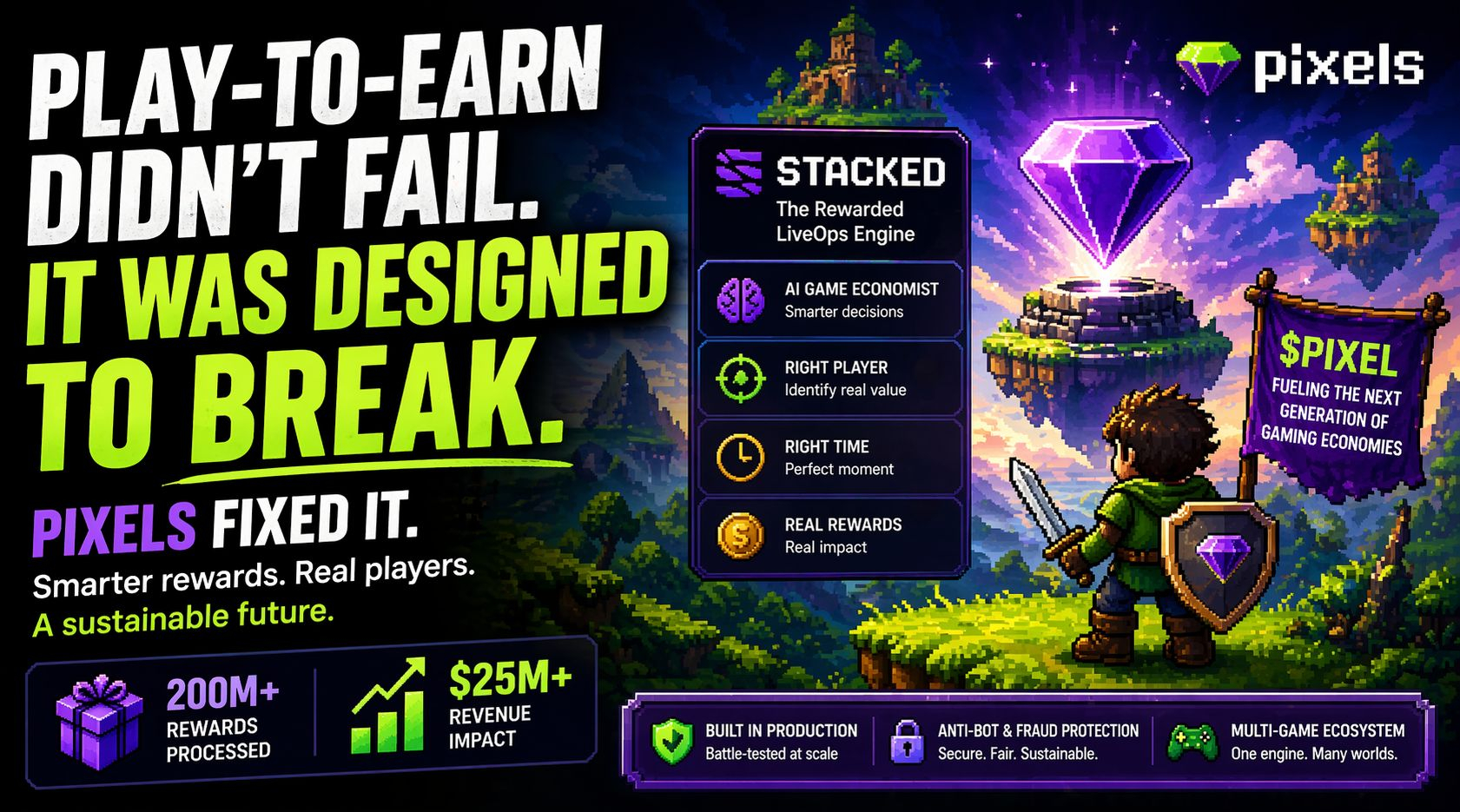
Play-to-earn didn’t fail because the idea was wrong.
It failed because execution was naive.
What @undefined is building with Stacked feels less like a fix……and more like a second attempt, done properly this time.
