
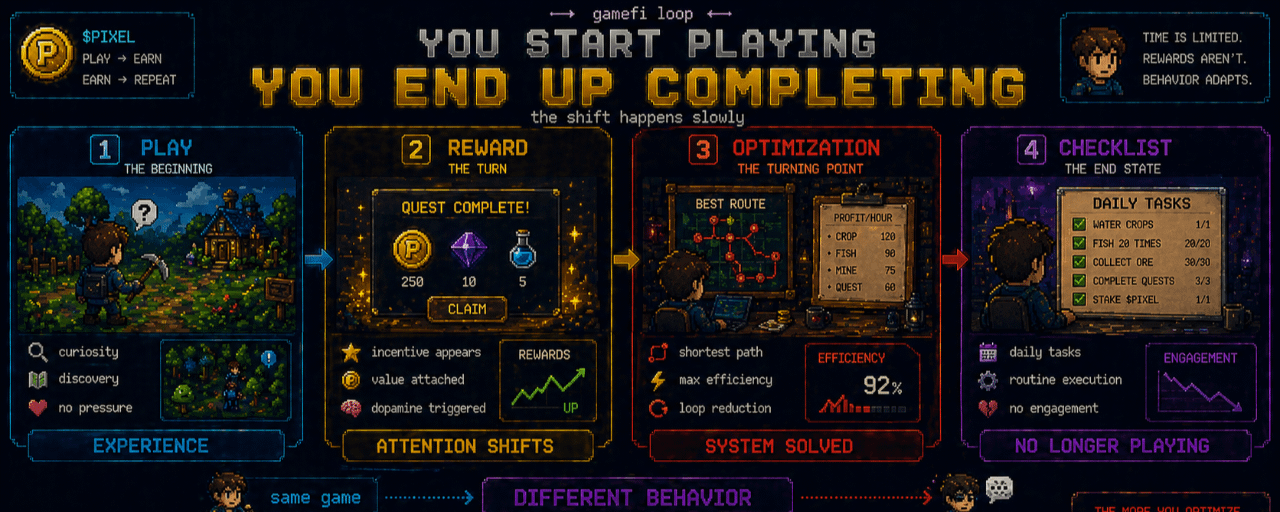
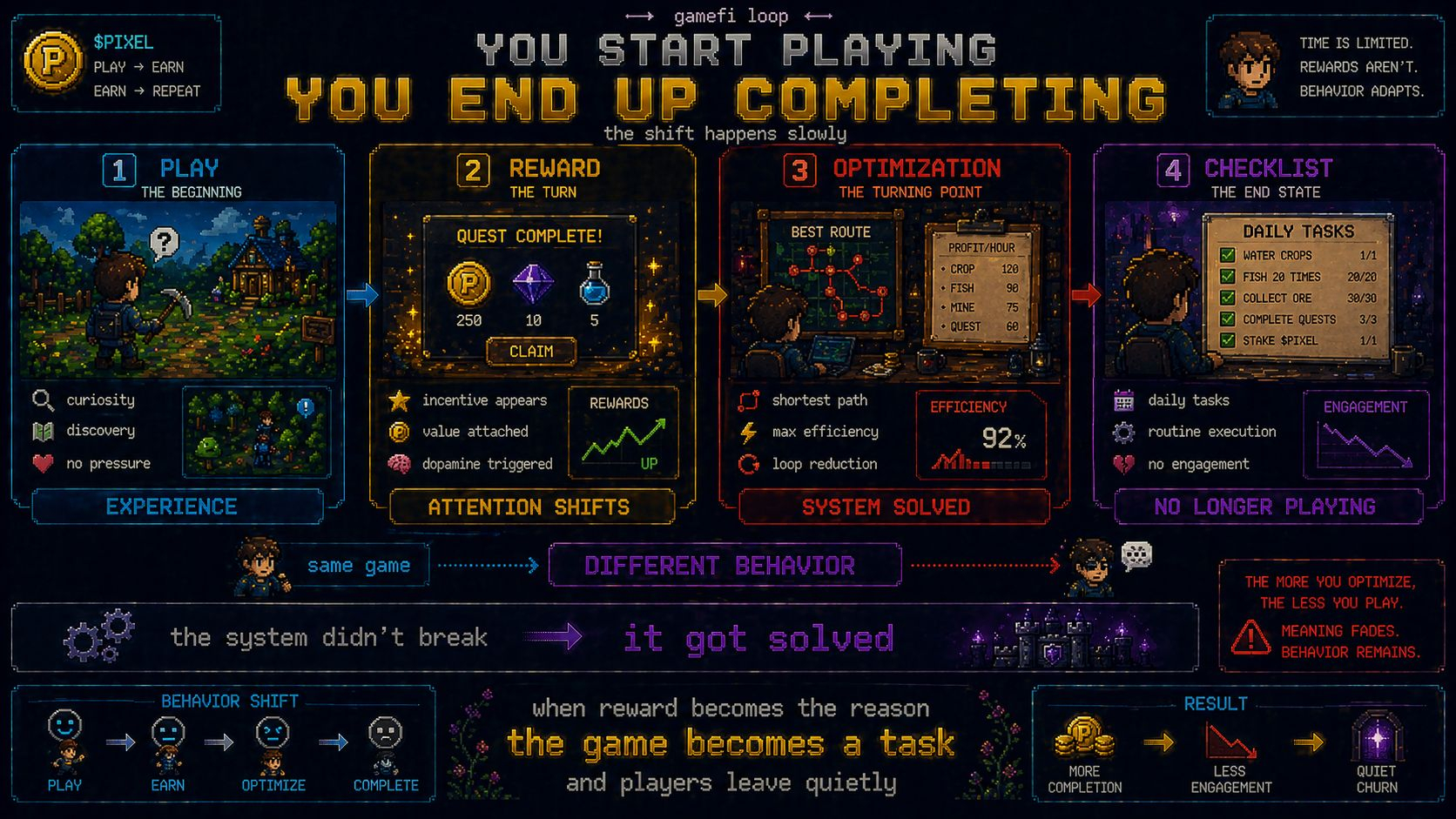
I’ve watched this loop in GameFi enough times that it barely feels like a failure anymore. More like a default state. A new model shows up, promises a better economy, rewards go out, numbers look good for a bit… then slowly people stop showing up.
No collapse, no big moment. Just absence.
That’s why when I look at Pixels and the whole Stacked direction, I don’t really focus on what’s “new.” I keep thinking about what hasn’t changed across the space. That strange feeling when you log into a game, do a few tasks, collect rewards, and then pause for a second wondering if you’re actually playing or just completing something.
That feeling matters more than most token designs.
Because from where I stand, Play-to-Earn didn’t struggle because of missing sinks or bad emissions. It struggled because of behavior. Players didn’t stay for the game, they stayed for the reward. And once reward becomes the only reason, everything else bends around extracting it.
People optimize. They find the shortest loop. They reduce the game into a checklist.
And systems kept responding the same way. Add more layers, more mechanics, more quests, more constraints. As if complexity could force engagement. But it usually does the opposite. The more structured it gets, the faster players learn how to break it down.
So you end up with something that looks like a game, but behaves like a distribution system.
That’s the part that feels unfinished in GameFi.
And this is where Pixels starts to feel slightly different to me. Not because it solved anything, but because it seems to be poking at the loop itself instead of just adding to it.
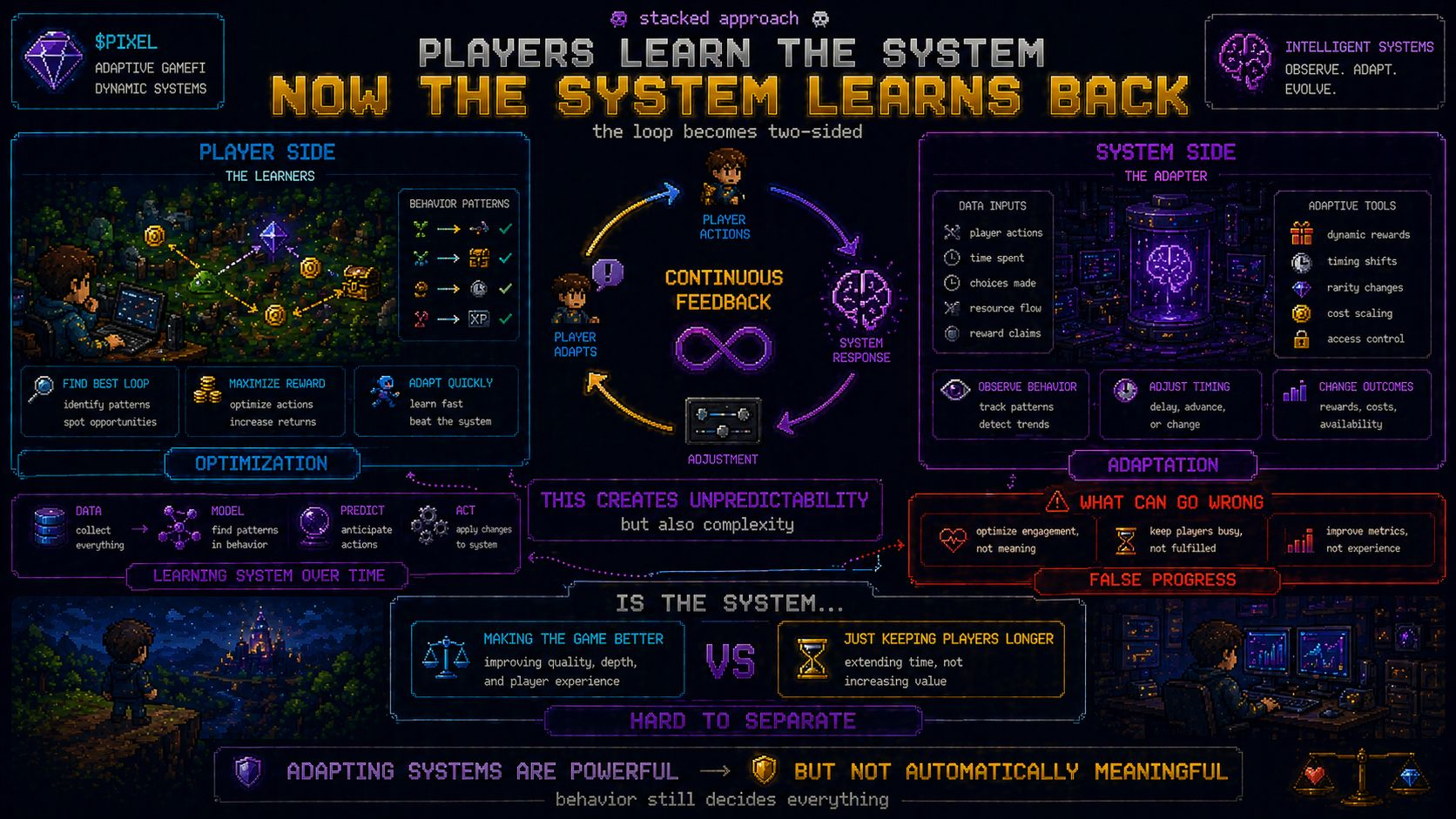
Stacked, at least how I understand it, isn’t about increasing rewards. It’s about changing how and when rewards show up. Less fixed, more reactive. Instead of assuming how players will behave, it tries to observe and adjust in real time.
That sounds simple, but it shifts the relationship.
In older systems, players learn the rules and optimize them. Here, it feels like the system is also learning back. That alone introduces a bit of unpredictability again. And maybe that’s important. Because one of the biggest issues before was how quickly everything became solved.
But I’m still careful with how I read this.
Because making a system adaptive doesn’t automatically make it meaningful. It can just become a more efficient way to maintain engagement without actually improving the experience. That line is thin.
And in the end, it still comes back to the same questions.
Do players stay when rewards aren’t obvious?
Do they come back when the system stops pushing?
Do they play when there’s nothing immediate to extract?
Those aren’t things you can answer with a whitepaper or a dashboard.
They take time.
Pixels has already pushed a lot of rewards through the system. Real volume, real usage. But I’ve seen before that distribution alone doesn’t equal retention. You can fund activity for a long time without building a reason to return.
That’s why I’m watching Stacked less as a “solution” and more as an experiment.
It feels like an attempt to deal with something GameFi usually avoids… real player behavior. Not ideal behavior, not designed behavior, but what people actually do when incentives are present.
And that’s a harder problem.
Because once you start reacting instead of dictating, you also take on new risks. The system can optimize in the wrong direction. It can learn to keep people busy without making the game better. It can improve metrics while slowly draining meaning.
I don’t think Pixels has solved that.
But I do think it’s one of the few trying to approach the loop from a different angle. Less about token mechanics, more about how the system responds to players over time.
And right now, that’s enough to keep me paying attention.
Not because I expect a breakthrough.
But because I want to see what happens when a system stops assuming… and starts adapting instead.