
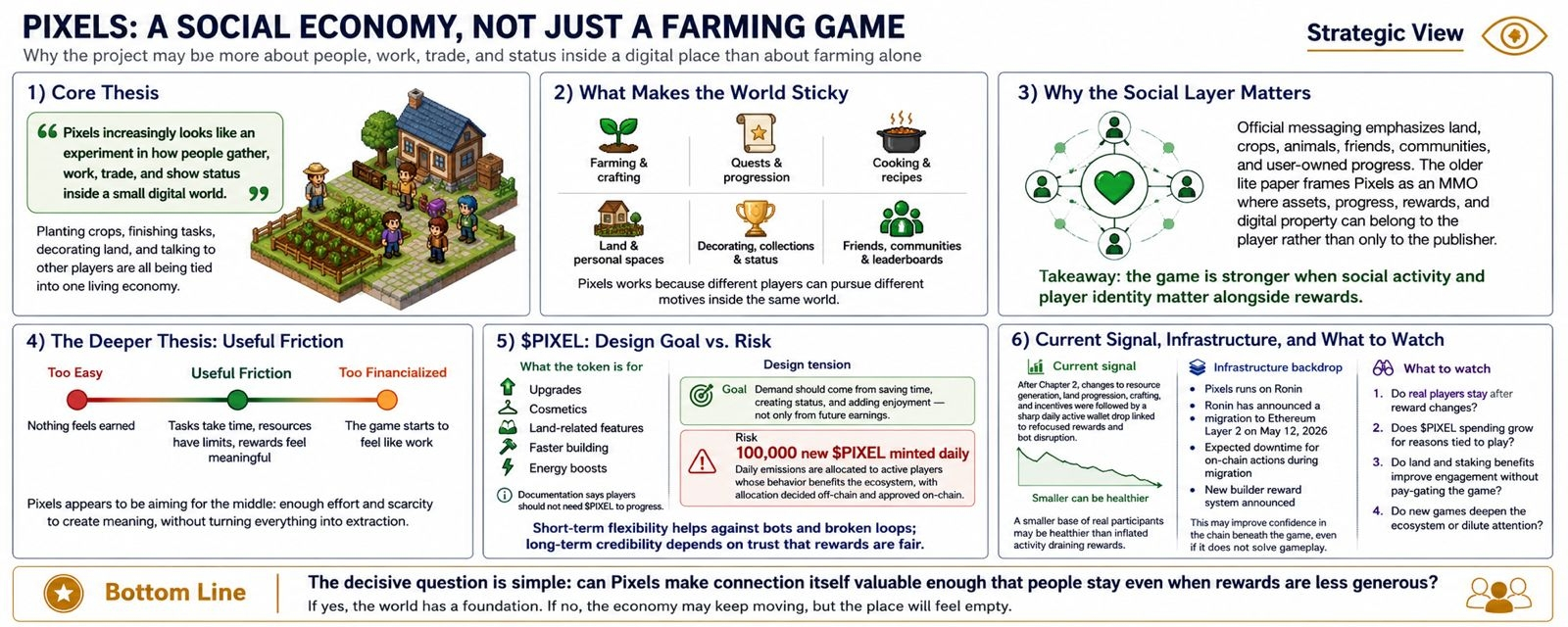

I used to think Pixels was easiest to understand as a farming game with crypto features attached. My view has changed because the more I look at it the more it seems like an experiment in how people gather and work and trade and show status inside a small digital place. Pixels is trying to make planting crops and finishing tasks and decorating land and talking to other players feel like parts of one living economy.
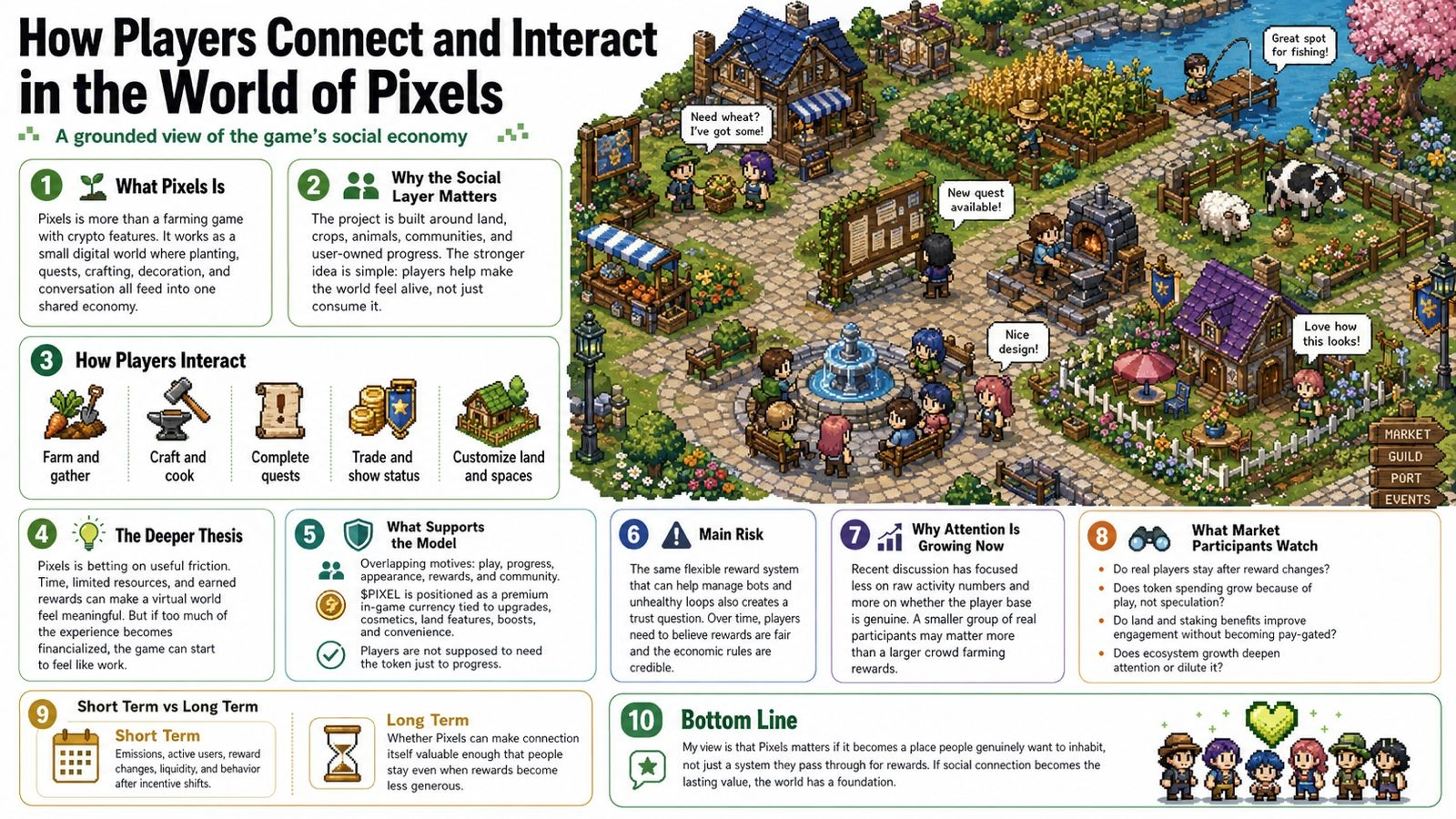
That is why the social layer matters. The official site frames Pixels around land and crops and animals and friends and communities and user owned progress while the older lite paper describes it as an MMO where digital assets and progress and rewards can belong to the player rather than only to the publisher. The core idea is plain: a game becomes stickier when players are not just consuming content but helping make the place feel active.
What interests me is that Pixels does not depend on one kind of interaction. Some players spend their time farming and crafting and completing quests while others care more about land and appearance and leaderboards and collections and rewards. The documentation points to farming and quests and cooking and recipes and personal spaces as core mechanics with social features and leaderboards built around them. That makes the world feel less like a single earning machine and more like a set of overlapping motives.
The deeper thesis as I see it is that Pixels is betting on useful friction. A world needs tasks that take time and resources that have limits and rewards that cannot be handed out carelessly. When everything is too easy nothing feels earned and when everything is financialized the game starts to feel like work. Pixels’ token design shows awareness of that tension because its documentation says PIXEL is a premium in game currency for upgrades and cosmetics and land related features and faster building and energy boosts and other premium uses while also saying players should not need the token to progress. It frames demand around whether the token saves time or creates status or adds enjoyment rather than whether it increases future earnings.
Still the risk sits inside the same design. Pixels says 100000 new PIXEL are minted daily for active players whose behavior benefits the ecosystem with allocation decided off chain and approved on chain. That gives the team room to adjust but it also asks players and market participants to trust its judgment about what behavior deserves rewards. In the short term that flexibility can help when bots or broken loops appear while in the long term it becomes a credibility question. A player owned economy cannot rely forever on players believing the referee is fair.
This is one reason the current moment is more interesting than it would have been five years ago. Web3 games have learned that big activity numbers can hide extraction and bots and users who arrive only for rewards. Pixels became a useful case study after Chapter 2 when reported changes to resource generation and land progression and crafting and incentives were followed by a sharp daily active wallet drop linked to refocused rewards and bot disruption. That drop can look ugly at first but I do not think it is automatically bad because a smaller group of real participants may be worth more than a larger crowd draining rewards.
The infrastructure backdrop is changing too. Ronin is the network Pixels runs on and it has announced a migration to Ethereum as a layer 2 on May 12 2026 with expected downtime for on chain actions and a new builder reward system. For Pixels that does not solve gameplay but it may matter for confidence around security and incentives and the chain beneath the game.
From an investment or trading perspective I would not look at Pixels only through price. The better questions are whether real players keep showing up after rewards change and whether PIXEL spending grows for reasons tied to play and whether land and staking benefits improve engagement without making the game feel pay gated. I would also watch whether new games share attention across the ecosystem or simply dilute it. In the short term participants may care about emissions and active users and reward changes and liquidity while in the long term I think the decisive question is simpler: can Pixels make connection itself valuable enough that people stay even when rewards are less generous? If it can then the world has a foundation. If it cannot then the economy may keep moving but the place will feel empty.


